On the Planning Abilities of OpenAI’s o1 Models
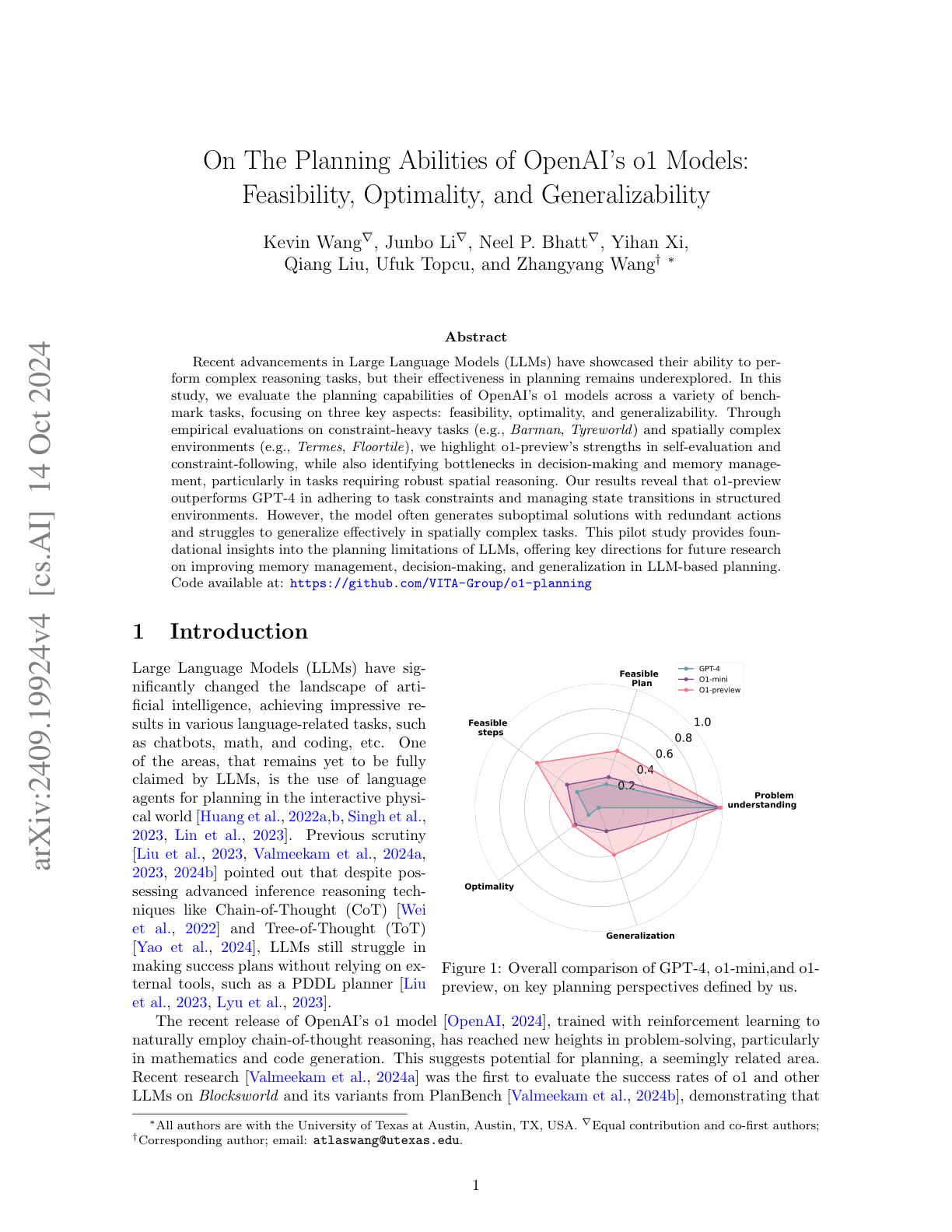
reports that o1-preview is particularly strong in self-evaluation and constraint-following; also mentions that these o1 models demonstrate bottlenecks in decision-making and memory management, which are more pronounced in spatial reasoning; in particular, the models produce redundant action and struggle to generalize in spatially complex tasks.
Ask this paper
Abstract
Recent advancements in Large Language Models (LLMs) have showcased their ability to perform complex reasoning tasks, but their effectiveness in planning remains underexplored. In this study, we evaluate the planning capabilities of OpenAI's o1 models across a variety of benchmark tasks, focusing on three key aspects: feasibility, optimality, and generalizability. Through empirical evaluations on constraint-heavy tasks (e.g., $\textit{Barman}$, $\textit{Tyreworld}$) and spatially complex environments (e.g., $\textit{Termes}$, $\textit{Floortile}$), we highlight o1-preview's strengths in self-evaluation and constraint-following, while also identifying bottlenecks in decision-making and memory management, particularly in tasks requiring robust spatial reasoning. Our results reveal that o1-preview outperforms GPT-4 in adhering to task constraints and managing state transitions in structured environments. However, the model often generates suboptimal solutions with redundant actions and struggles to generalize effectively in spatially complex tasks. This pilot study provides foundational insights into the planning limitations of LLMs, offering key directions for future research on improving memory management, decision-making, and generalization in LLM-based planning. Code available at https://github.com/VITA-Group/o1-planning.