Open-Source LLMs vs. ChatGPT
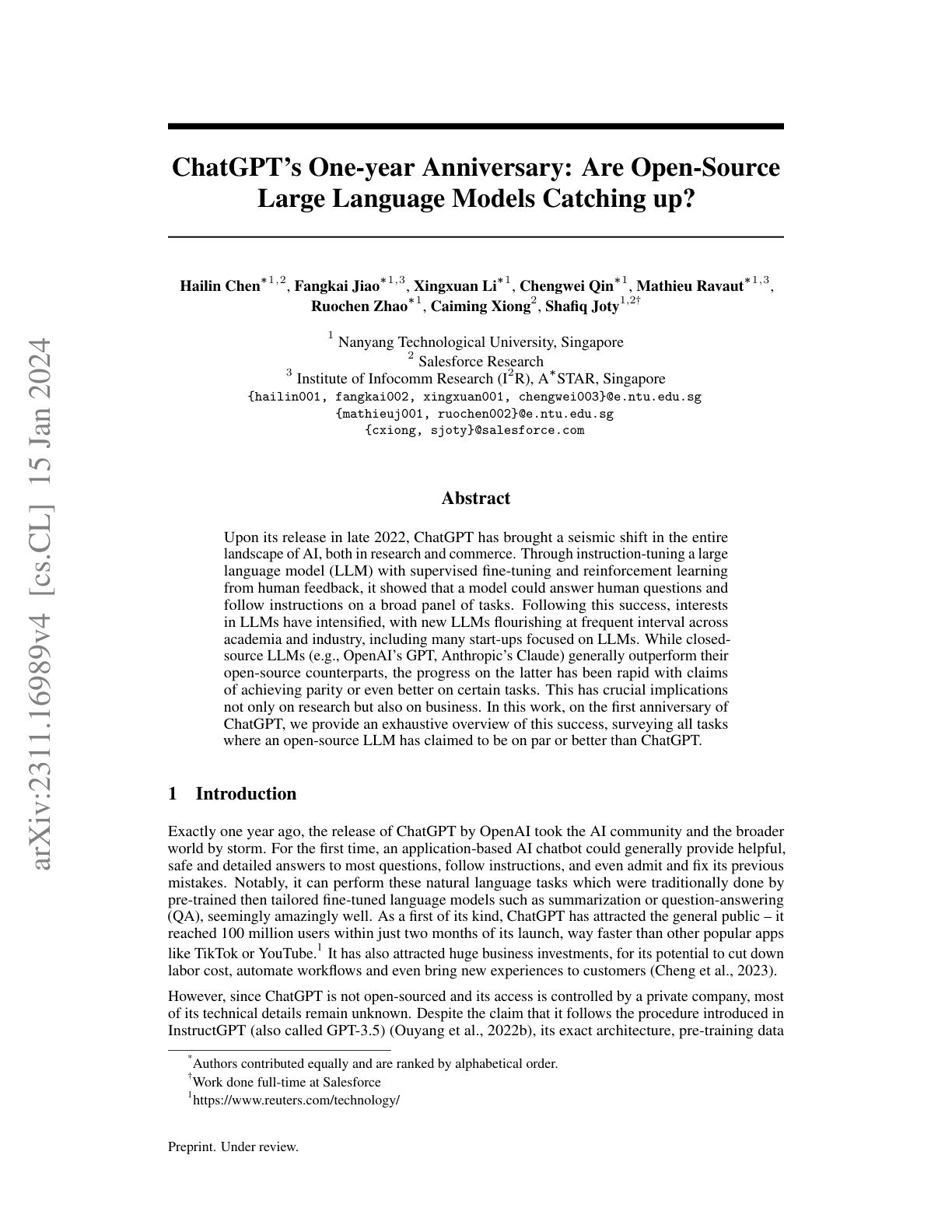
A survey cataloguing tasks where open-source LLMs claim to be on par with or better than ChatGPT.
Ask this paper
Task-by-task audit: Organizes claims by task category (code, math, reasoning, summarization, etc.) with the specific open models and benchmarks backing each claim.
Gap measurement: Clarifies where open-source genuinely closes the gap vs. where "comparable" actually hides meaningful performance differences.
Critical lens: Calls out evaluation-methodology issues in specific open-source claims, including benchmark contamination, cherry-picked subsets, and inconsistent judge setups.
2023 snapshot: Captures where open-source LLMs stood at the end of 2023 - a useful reference point for tracking how the gap evolved through 2024.
Abstract
Upon its release in late 2022, ChatGPT has brought a seismic shift in the entire landscape of AI, both in research and commerce. Through instruction-tuning a large language model (LLM) with supervised fine-tuning and reinforcement learning from human feedback, it showed that a model could answer human questions and follow instructions on a broad panel of tasks. Following this success, interests in LLMs have intensified, with new LLMs flourishing at frequent interval across academia and industry, including many start-ups focused on LLMs. While closed-source LLMs (e.g., OpenAI's GPT, Anthropic's Claude) generally outperform their open-source counterparts, the progress on the latter has been rapid with claims of achieving parity or even better on certain tasks. This has crucial implications not only on research but also on business. In this work, on the first anniversary of ChatGPT, we provide an exhaustive overview of this success, surveying all tasks where an open-source LLM has claimed to be on par or better than ChatGPT.