OPRO (LLMs as Optimizers)
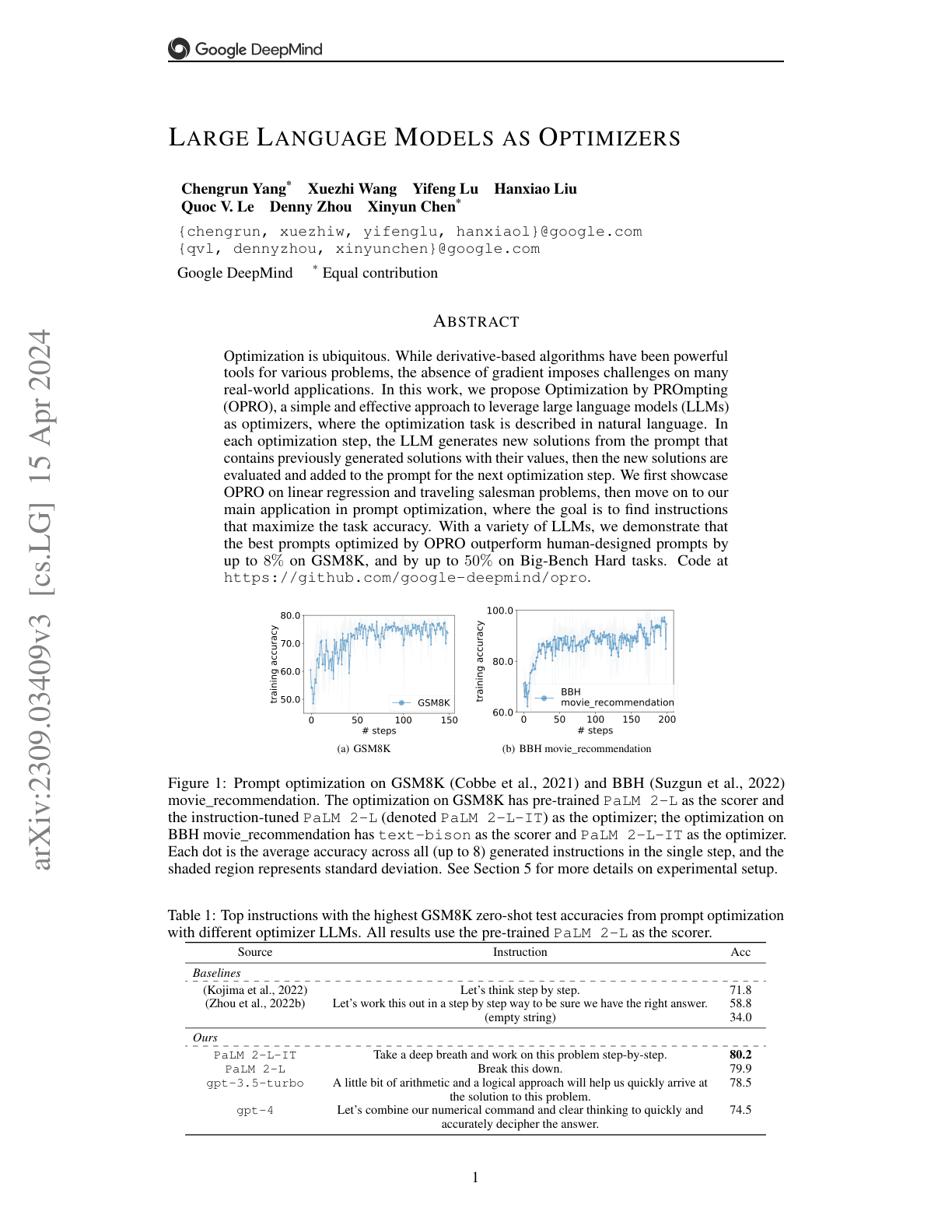
DeepMind's OPRO uses LLMs as general-purpose optimizers over natural-language-described problems.
Ask this paper
Natural-language optimization: The optimization problem is described in natural language; the LLM iteratively proposes new solutions conditioned on previously found solutions.
Prompt optimization: As a key application, optimizes prompts to maximize test accuracy, using previously evaluated prompts as trajectory context.
Big gains over human prompts: LLM-optimized prompts outperform human-designed prompts on GSM8K and BIG-Bench Hard, sometimes by over 50 percentage points.
General-purpose pattern: Positions LLMs as general-purpose optimizers for problems that are hard to specify mathematically, including linear regression, traveling salesman variants, and prompt design.
Abstract
Optimization is ubiquitous. While derivative-based algorithms have been powerful tools for various problems, the absence of gradient imposes challenges on many real-world applications. In this work, we propose Optimization by PROmpting (OPRO), a simple and effective approach to leverage large language models (LLMs) as optimizers, where the optimization task is described in natural language. In each optimization step, the LLM generates new solutions from the prompt that contains previously generated solutions with their values, then the new solutions are evaluated and added to the prompt for the next optimization step. We first showcase OPRO on linear regression and traveling salesman problems, then move on to our main application in prompt optimization, where the goal is to find instructions that maximize the task accuracy. With a variety of LLMs, we demonstrate that the best prompts optimized by OPRO outperform human-designed prompts by up to 8% on GSM8K, and by up to 50% on Big-Bench Hard tasks. Code at https://github.com/google-deepmind/opro.