RLAIF (Scaling RLHF with AI Feedback)
Google compares RLHF with RLAIF (Reinforcement Learning from AI Feedback) to test whether AI preferences can replace human preferences.
Ask this paper
Head-to-head comparison: Directly compares the efficacy of human vs. AI feedback for preference-based alignment, using the same policy optimization pipeline.
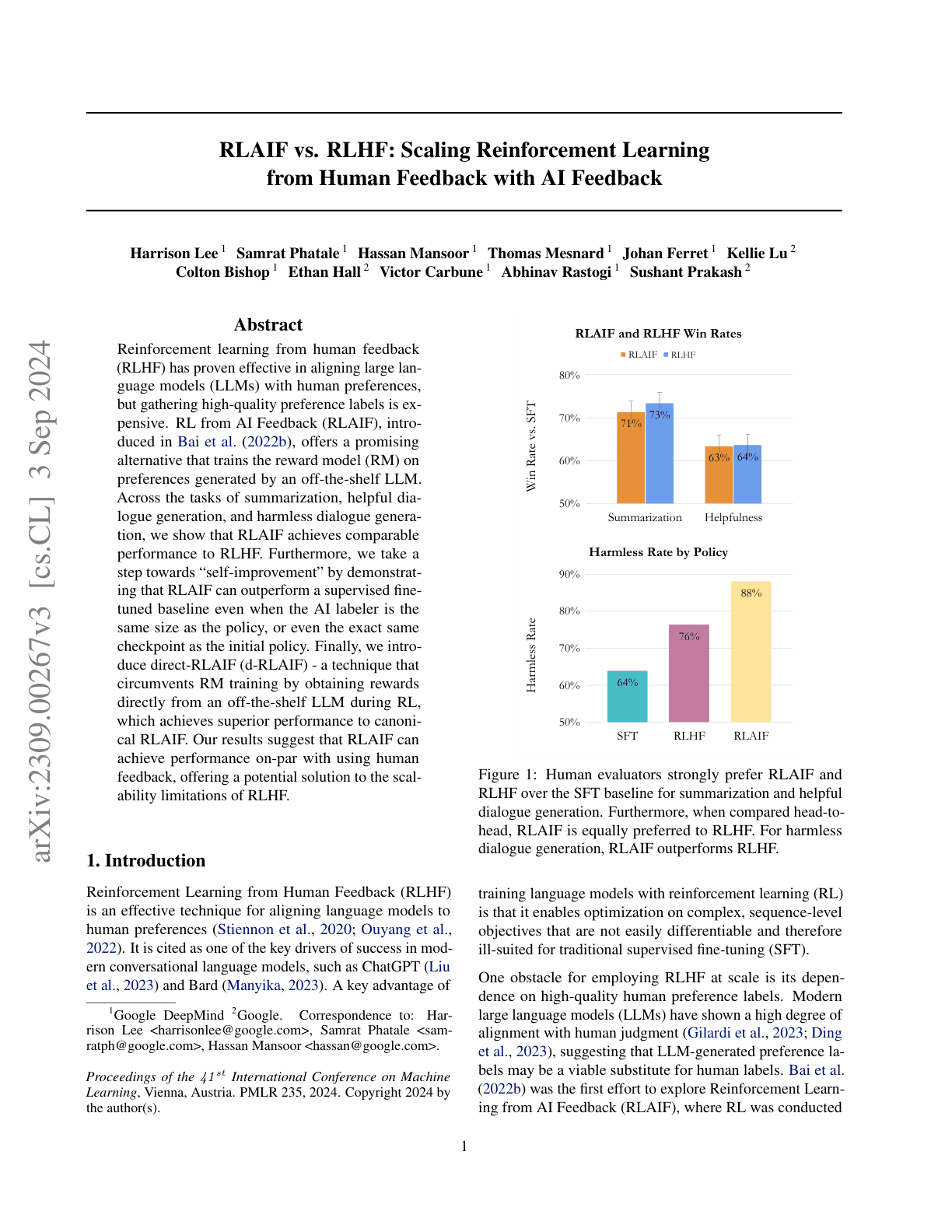
~70% preference: On summarization, human evaluators prefer both RLAIF and RLHF outputs over the baseline SFT model in roughly 70% of cases - statistical parity.
Scaling studies: Reports optimal settings for AI-feedback generation, including prompt design, chain-of-thought, and label-combining strategies.
Cost-reduction implication: Suggests RLAIF can substitute for RLHF for many alignment use cases, dramatically reducing the human-labeling cost of alignment.
Abstract
Reinforcement learning from human feedback (RLHF) has proven effective in aligning large language models (LLMs) with human preferences, but gathering high-quality preference labels is expensive. RL from AI Feedback (RLAIF), introduced in Bai et al., offers a promising alternative that trains the reward model (RM) on preferences generated by an off-the-shelf LLM. Across the tasks of summarization, helpful dialogue generation, and harmless dialogue generation, we show that RLAIF achieves comparable performance to RLHF. Furthermore, we take a step towards "self-improvement" by demonstrating that RLAIF can outperform a supervised fine-tuned baseline even when the AI labeler is the same size as the policy, or even the exact same checkpoint as the initial policy. Finally, we introduce direct-RLAIF (d-RLAIF) - a technique that circumvents RM training by obtaining rewards directly from an off-the-shelf LLM during RL, which achieves superior performance to canonical RLAIF. Our results suggest that RLAIF can achieve performance on-par with using human feedback, offering a potential solution to the scalability limitations of RLHF.