Optimizing Model Selection for Compound AI
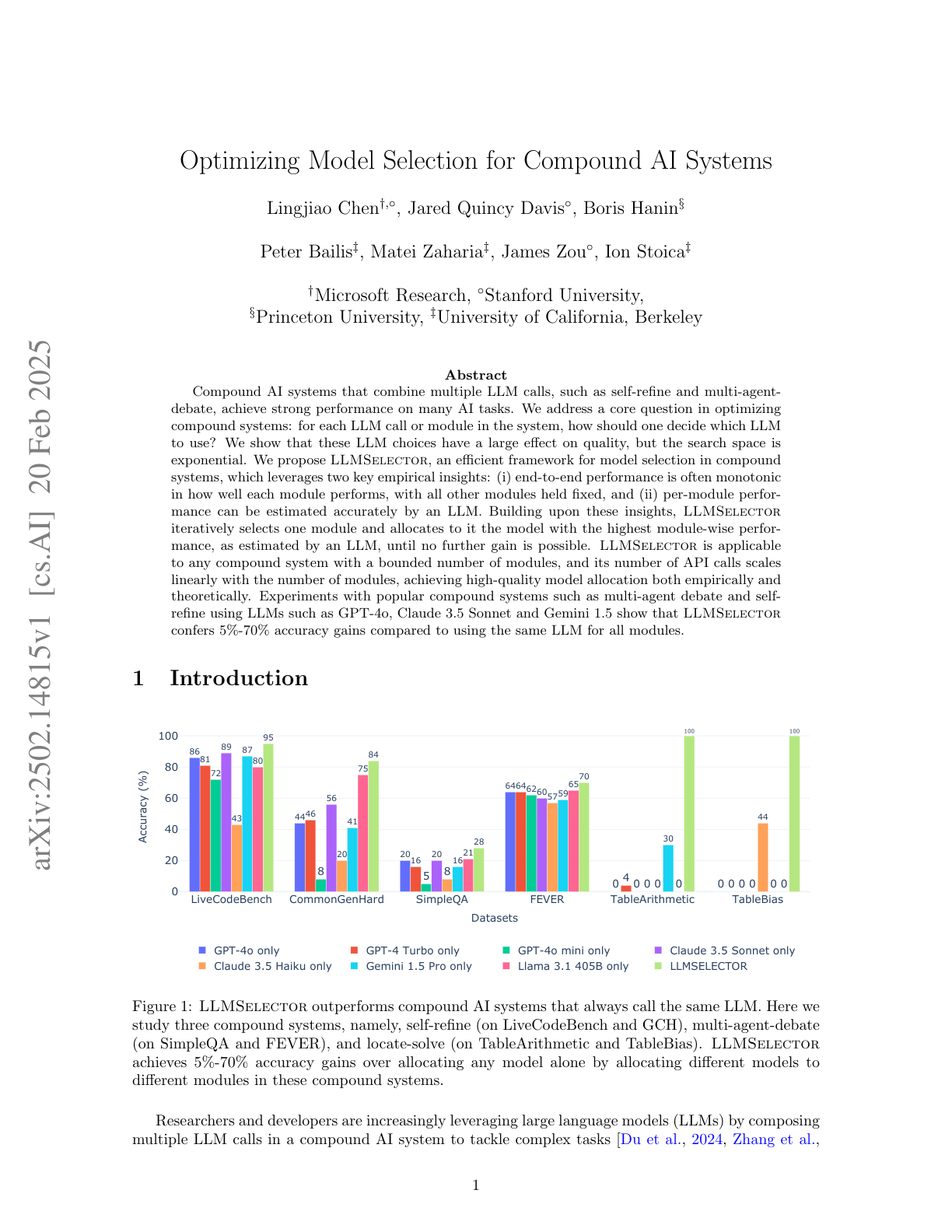
Researchers from Microsoft Research and collaborators introduce LLMSelector, a framework to improve multi-call LLM pipelines by selecting the best model per module instead of using one LLM everywhere. Key insights include:
Ask this paper
Large performance boost with per-module model choices – Rather than relying on a single LLM for each sub-task in compound systems, the authors show that mixing different LLMs can yield 5%–70% higher accuracy. Each model has unique strengths (e.g., better at critique vs. generation), so assigning modules selectively substantially improves end-to-end results.
LLMSelector algorithm – They propose an iterative routine that assigns an optimal model to each module, guided by a novel “LLM diagnoser” to estimate per-module performance. The procedure scales linearly with the number of modules—far more efficient than exhaustive search.
Monotonicity insights – Empirically, boosting any single module’s performance (while holding others fixed) often improves the overall system. This motivates an approximate factorization approach, where local gains translate into global improvements. LLMSelector works for any static compound system with fixed modules (e.g., generator–critic–refiner).