Overview of LLMs for Evaluation
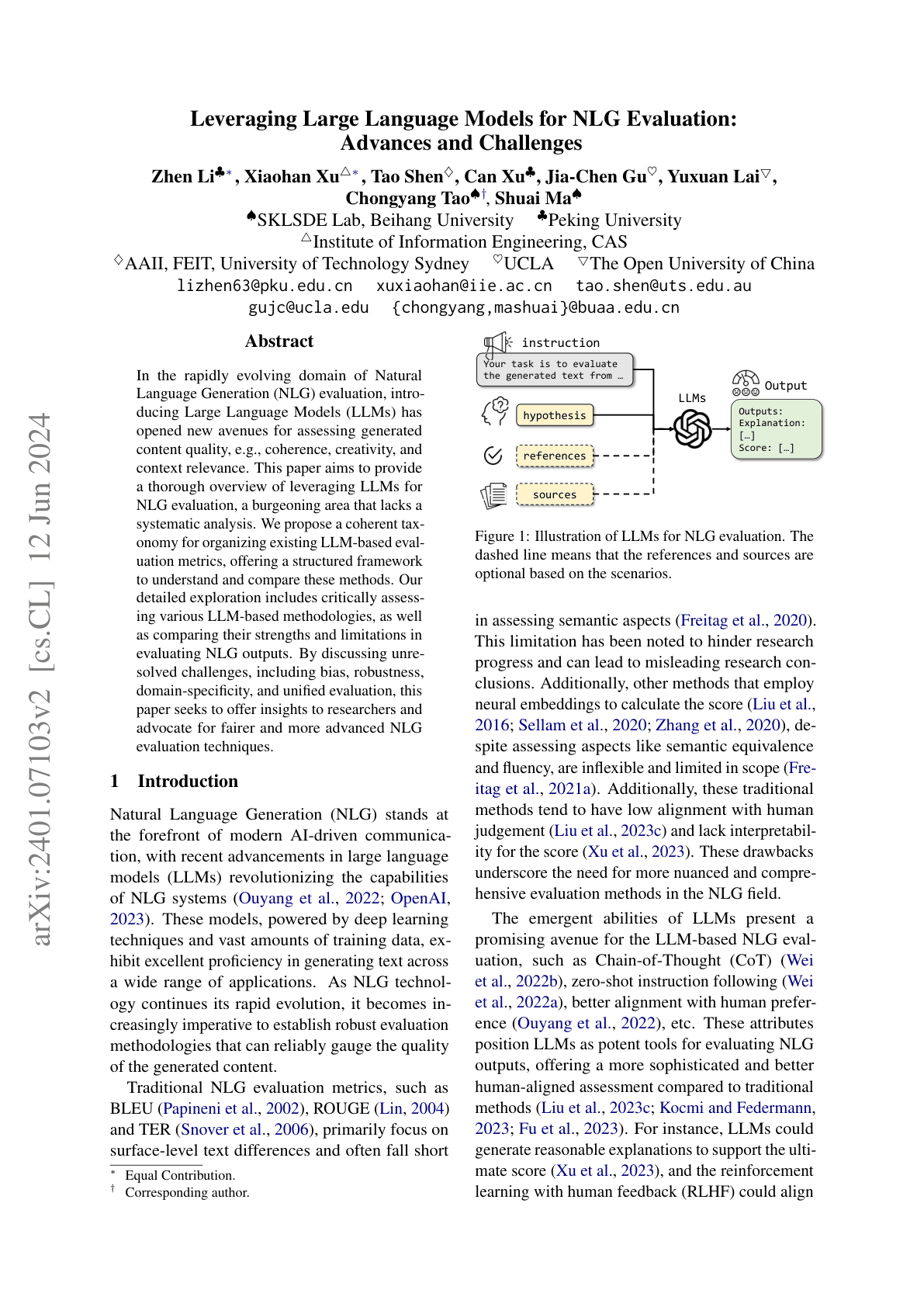
A thorough survey of LLM-as-a-Judge and LLM-based evaluation methodologies, mapping strengths, limitations, and open problems.
Ask this paper
Taxonomy: Groups evaluators by whether they use prompt engineering alone, calibrated prompts, or fine-tuned open-source LLMs - a clean mental model for practitioners choosing a judge.
Task coverage: Analyzes LLM evaluators across summarization, dialogue, translation, code, and reasoning tasks, showing where they are and aren't reliable.
Failure modes: Reviews known biases including length bias, position bias, self-preference, and sycophancy - and the mitigation strategies published for each.
Future directions: Argues for standardized benchmarks for evaluators themselves (meta-evaluation) and more transparent calibration procedures.
Abstract
In the rapidly evolving domain of Natural Language Generation (NLG) evaluation, introducing Large Language Models (LLMs) has opened new avenues for assessing generated content quality, e.g., coherence, creativity, and context relevance. This paper aims to provide a thorough overview of leveraging LLMs for NLG evaluation, a burgeoning area that lacks a systematic analysis. We propose a coherent taxonomy for organizing existing LLM-based evaluation metrics, offering a structured framework to understand and compare these methods. Our detailed exploration includes critically assessing various LLM-based methodologies, as well as comparing their strengths and limitations in evaluating NLG outputs. By discussing unresolved challenges, including bias, robustness, domain-specificity, and unified evaluation, this paper seeks to offer insights to researchers and advocate for fairer and more advanced NLG evaluation techniques.