Probing Stability-Plasticity Tradeoffs in Agent Memory through Cognitive Experimental Paradigms
Jiaqi Ding and Guorong Wu at UNC-Chapel Hill (EMNLP 2026 Main) introduce MemProbe, a diagnostic suite that borrows four experimental paradigms from human memory research to test how agent memory systems update, preserve and attribute information over time.
Ask this paper
Four paradigms. Interference, misinformation, consolidation strength and reconsolidation window, each controlling when a memory should be updated, kept, or marked uncertain.
Behavioral profiles. Correctness is broken into how a system updates, preserves, attributes sources and orders information in time, instead of a single accuracy number.
Scale. 56 diagnostic episodes; six incremental memory systems (Mem0, Graphiti, LangMem, Cognee, A-MEM, MemoryOS) plus RAG and full-context references under one sequential-ingestion protocol.
Overall scores. Full context scores 88.8 and A-MEM 88.4, while Mem0 scores 41.5, below naive RAG at 68.3.
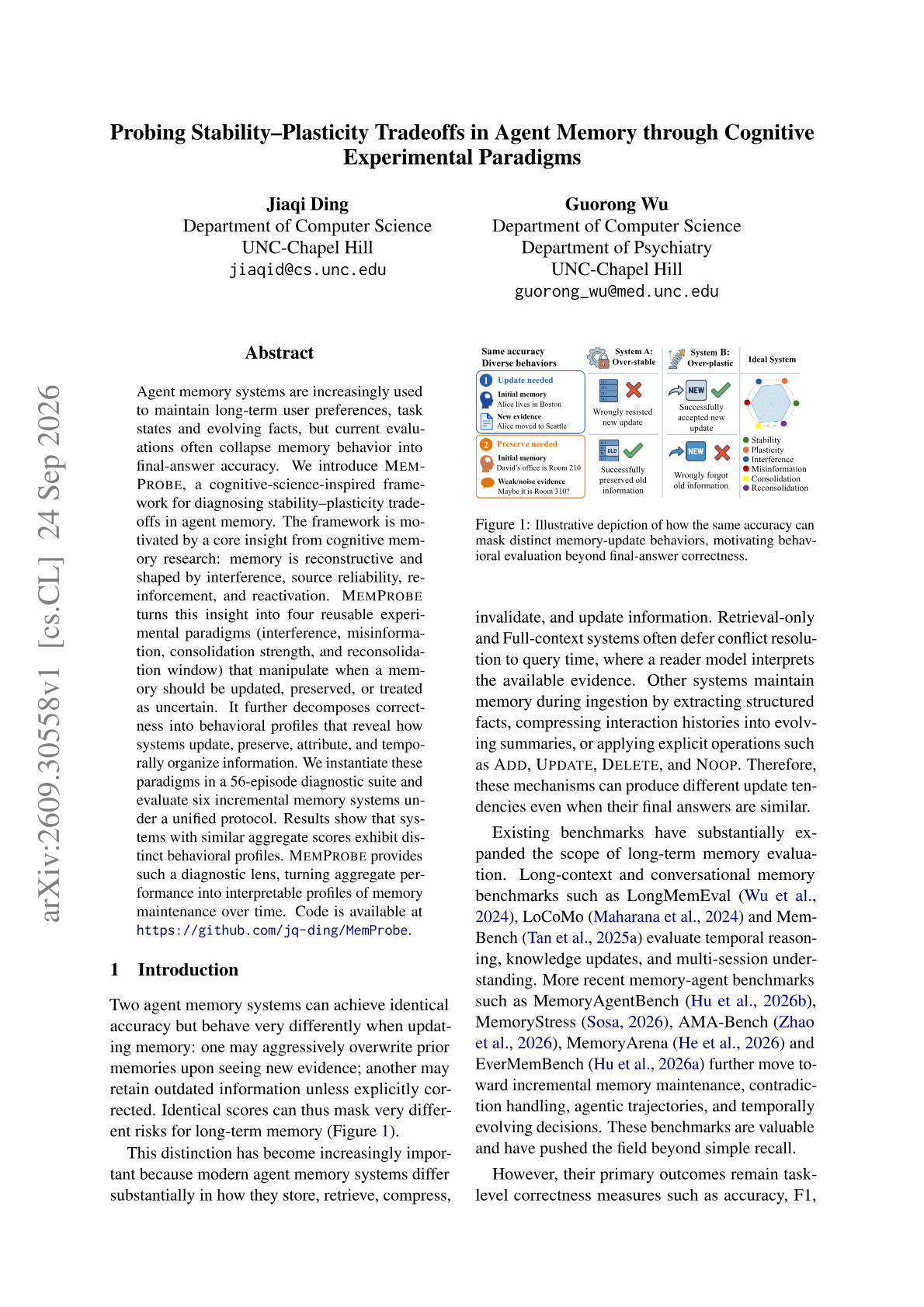
Main finding. Systems with similar aggregate scores behave differently on the individual paradigms, so a single accuracy number hides how a memory system handles changing facts.
Abstract
Agent memory systems are increasingly used to maintain long-term user preferences, task states and evolving facts, but current evaluations often collapse memory behavior into final-answer accuracy. We introduce MemProbe, a cognitive-science-inspired framework for diagnosing stability-plasticity tradeoffs in agent memory. The framework is motivated by a core insight from cognitive memory research: memory is reconstructive and shaped by interference, source reliability, reinforcement, and reactivation. MemProbe turns this insight into four reusable experimental paradigms (interference, misinformation, consolidation strength, and reconsolidation window) that manipulate when a memory should be updated, preserved, or treated as uncertain. It further decomposes correctness into behavioral profiles that reveal how systems update, preserve, attribute, and temporally organize information. We instantiate these paradigms in a 56-episode diagnostic suite and evaluate six incremental memory systems under a unified protocol. Results show that systems with similar aggregate scores exhibit distinct behavioral profiles. MemProbe provides such a diagnostic lens, turning aggregate performance into interpretable profiles of memory maintenance over time. Code is available at https://github.com/jq-ding/MemProbe.