Program-Aided Patchable Skill Evolution
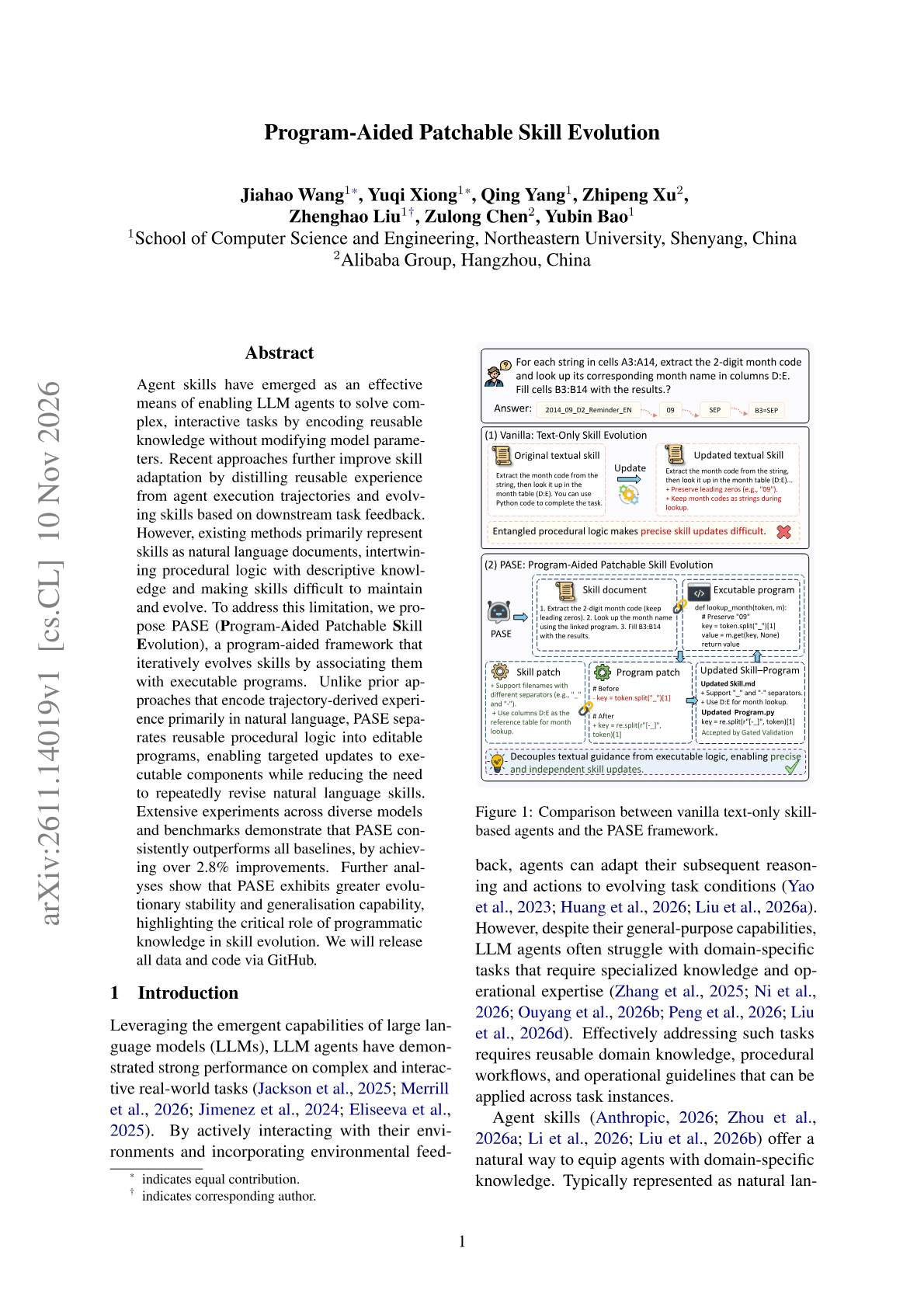
Jiahao Wang, Yuqi Xiong and colleagues at Northeastern University (China) and Alibaba Group propose PASE, which evolves agent skills as natural-language descriptions paired with executable programs, so updates can patch the program logic directly.
Ask this paper
Problem. Skills learned from trajectories are usually plain text that mixes procedure with description, so revising one behavior risks changing others.
Method. PASE moves reusable procedural logic into editable programs attached to the skill and proposes patches to skills and programs separately, accepting a patch only if it raises the validation score.
Results. PASE beats prior skill-evolution methods by over 2.8% across models and benchmarks, including a gain of over 14% on in-domain SpreadsheetBench-Verified, and gives the best results on out-of-domain table QA such as WikiTQ and HiTab.
Limits. Skills are injected directly into the prompt, so retrieval is not tested, and a ReAct agent with a shell can skip the provided program and reimplement the logic itself.
Abstract
Agent skills have emerged as an effective means of enabling LLM agents to solve complex, interactive tasks by encoding reusable knowledge without modifying model parameters. Recent approaches further improve skill adaptation by distilling reusable experience from agent execution trajectories and evolving skills based on downstream task feedback. However, existing methods primarily represent skills as natural language documents, intertwining procedural logic with descriptive knowledge and making skills difficult to maintain and evolve. To address this limitation, we propose PASE (Program-Aided Patchable Skill Evolution), a program-aided framework that iteratively evolves skills by associating them with executable programs. Unlike prior approaches that encode trajectory-derived experience primarily in natural language, PASE separates reusable procedural logic into editable programs, enabling targeted updates to executable components while reducing the need to repeatedly revise natural language skills. Extensive experiments across diverse models and benchmarks demonstrate that PASE consistently outperforms all baselines, by achieving over 2.8% improvements. Further analyses show that PASE exhibits greater evolutionary stability and generalisation capability, highlighting the critical role of programmatic knowledge in skill evolution. We will release all data and code via GitHub.