RAG in the Era of Long-Context LLMs
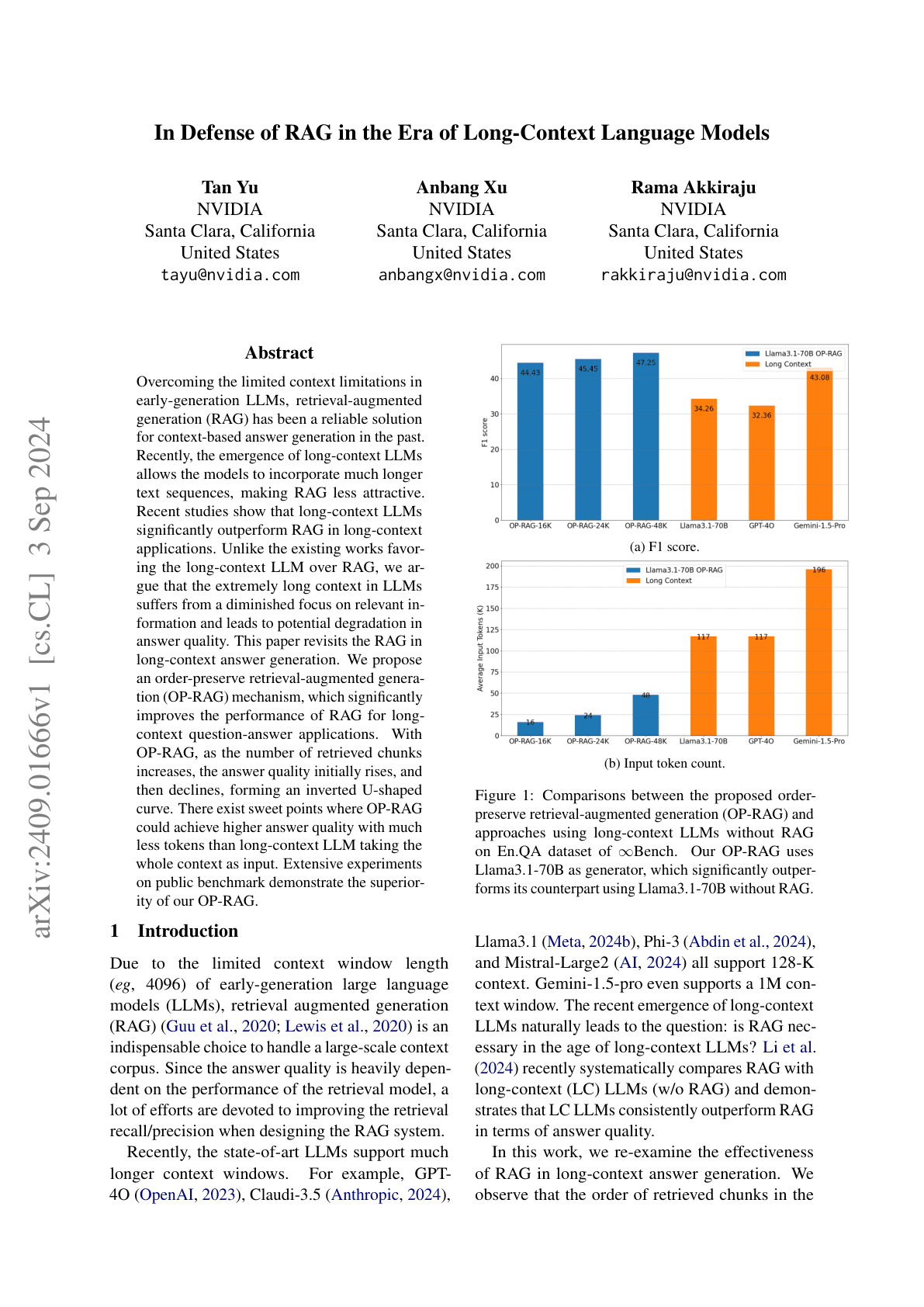
reports that longer-context LLMs suffer from a diminished focus on relevant information, which is one of the primary issues that a RAG system addresses (i.e., uses more relevant information); they propose an order-preserving RAG mechanism that improves performance on long-context question answering; it's not perfect and in fact, as retrieved chunks increase the quality of responses go up and then declines; they mention a sweet spot where it can achieve better quality with a lot fewer tokens than long-context LLMs.
Ask this paper
Abstract
Overcoming the limited context limitations in early-generation LLMs, retrieval-augmented generation (RAG) has been a reliable solution for context-based answer generation in the past. Recently, the emergence of long-context LLMs allows the models to incorporate much longer text sequences, making RAG less attractive. Recent studies show that long-context LLMs significantly outperform RAG in long-context applications. Unlike the existing works favoring the long-context LLM over RAG, we argue that the extremely long context in LLMs suffers from a diminished focus on relevant information and leads to potential degradation in answer quality. This paper revisits the RAG in long-context answer generation. We propose an order-preserve retrieval-augmented generation (OP-RAG) mechanism, which significantly improves the performance of RAG for long-context question-answer applications. With OP-RAG, as the number of retrieved chunks increases, the answer quality initially rises, and then declines, forming an inverted U-shaped curve. There exist sweet points where OP-RAG could achieve higher answer quality with much less tokens than long-context LLM taking the whole context as input. Extensive experiments on public benchmark demonstrate the superiority of our OP-RAG.