Retentive Network (RetNet)
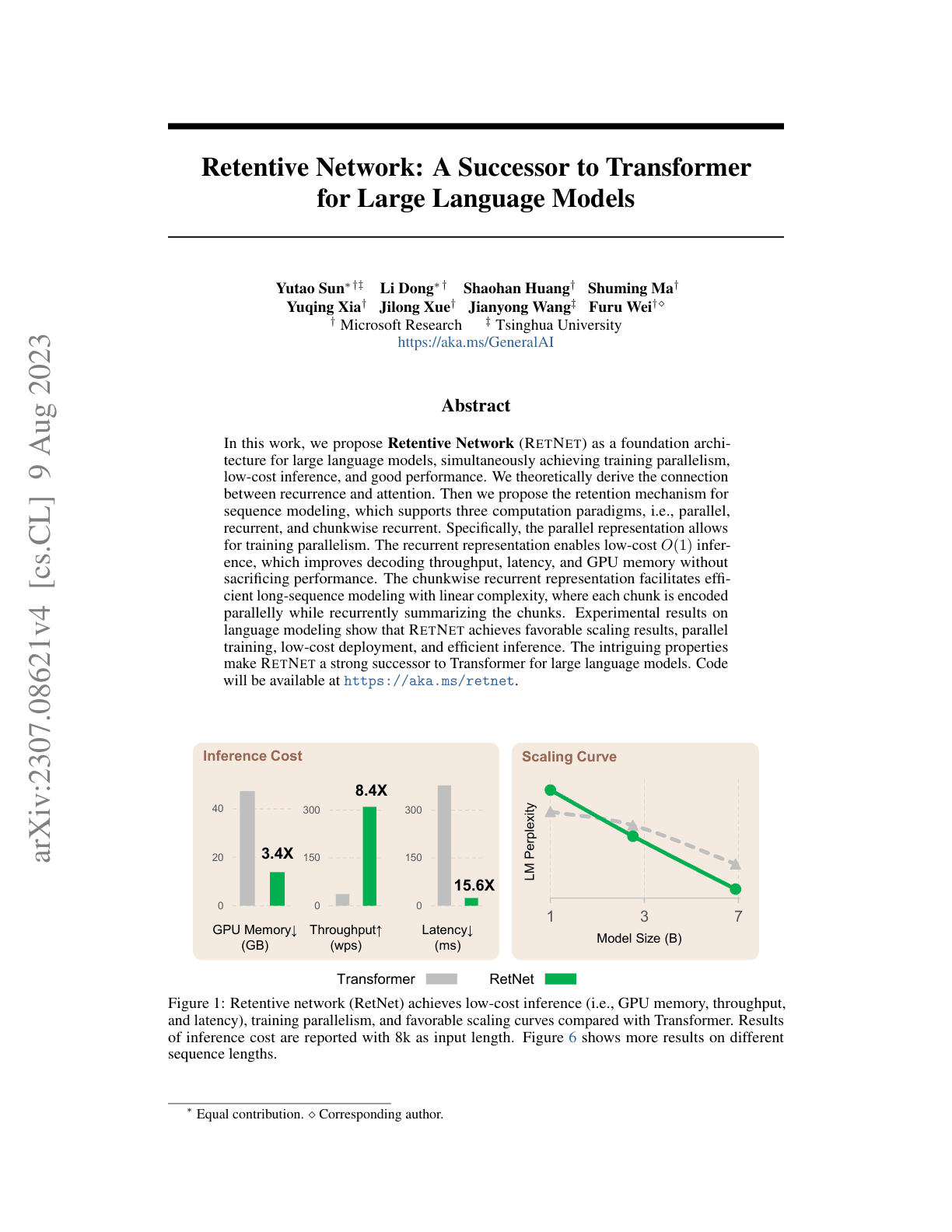
Microsoft's proposed foundation architecture aiming to replace Transformer attention for LLMs.
Ask this paper
Three-mode formulation: Supports parallel training, recurrent inference, and chunkwise recurrent representation - combining Transformer-style training with RNN-style inference.
O(1) inference cost: Achieves constant-memory inference per step via the recurrent form, dramatically cheaper than attention's O(n) per-token cost.
Retention mechanism: Replaces softmax attention with an exponentially-decaying retention kernel that supports both parallel and recurrent computation.
Post-Transformer contender: Positioned alongside Mamba, RWKV, and Hyena as one of the credible attempts to dethrone attention - though attention remained dominant through 2024.
Abstract
In this work, we propose Retentive Network (RetNet) as a foundation architecture for large language models, simultaneously achieving training parallelism, low-cost inference, and good performance. We theoretically derive the connection between recurrence and attention. Then we propose the retention mechanism for sequence modeling, which supports three computation paradigms, i.e., parallel, recurrent, and chunkwise recurrent. Specifically, the parallel representation allows for training parallelism. The recurrent representation enables low-cost $O(1)$ inference, which improves decoding throughput, latency, and GPU memory without sacrificing performance. The chunkwise recurrent representation facilitates efficient long-sequence modeling with linear complexity, where each chunk is encoded parallelly while recurrently summarizing the chunks. Experimental results on language modeling show that RetNet achieves favorable scaling results, parallel training, low-cost deployment, and efficient inference. The intriguing properties make RetNet a strong successor to Transformer for large language models. Code will be available at https://aka.ms/retnet.