RLAC: Adversarial Critic for RL Post-Training
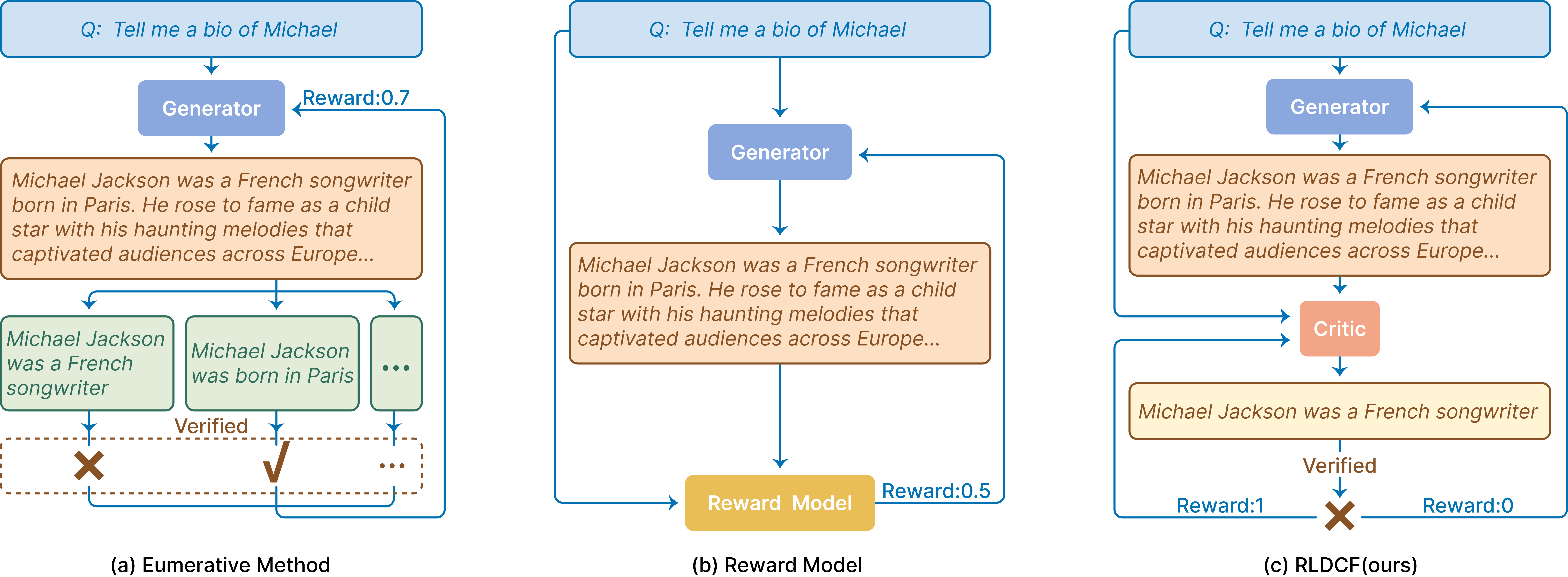
UC Berkeley and CMU researchers introduce RLAC, an RL post-training approach using a learned critic that dynamically identifies likely failure modes (e.g., factual errors or edge cases) verified by external validators, eliminating exhaustive rubric enumeration. On biography generation, RLAC achieves 0.889 FactScore (vs 0.867 for FactTune-FS) while reducing verification calls by 5.7×, and on code generation reaches 56.6 average score using only 9% of training data. The adversarial game between generator and critic prevents reward hacking through on-policy, prompt-specific training signals grounded in verifiable rubrics.
Ask this paper
Abstract
Open-ended generation tasks require outputs to satisfy diverse and often implicit task-specific evaluation rubrics. The sheer number of relevant rubrics leads to prohibitively high verification costs and incomplete assessments of a response, making reinforcement learning (RL) post-training with rubric-based rewards difficult to scale. This problem is exacerbated by the fact that often the best way to combine these rubrics into one single reward is also highly prompt-specific. We propose Reinforcement Learning with Adversarial Critic (RLAC), a post-training approach that addresses these challenges via dynamic rubric verification. Our approach employs a large language model (LLM) as a critic that dynamically identifies only the most likely failure modes (e.g., a factual error or unhandled edge case), which are then verified by an external validator to optimize both generator and critic jointly. By training both the generator and the critic, this game enhances the critic's error detection and the generator's output quality while reducing required verifications. Our experiments demonstrate that RLAC improves factual accuracy in text generation and correctness in code generation, while also outperforming exhaustive verification and reward model methods. We show that dynamic critics are more effective than fixed critics, showcasing the potential of RLAC for scaling RL post-training to free-form generation tasks.