ROAM: Robust Organization of Atomic Memories for Agents through Semantic Relations
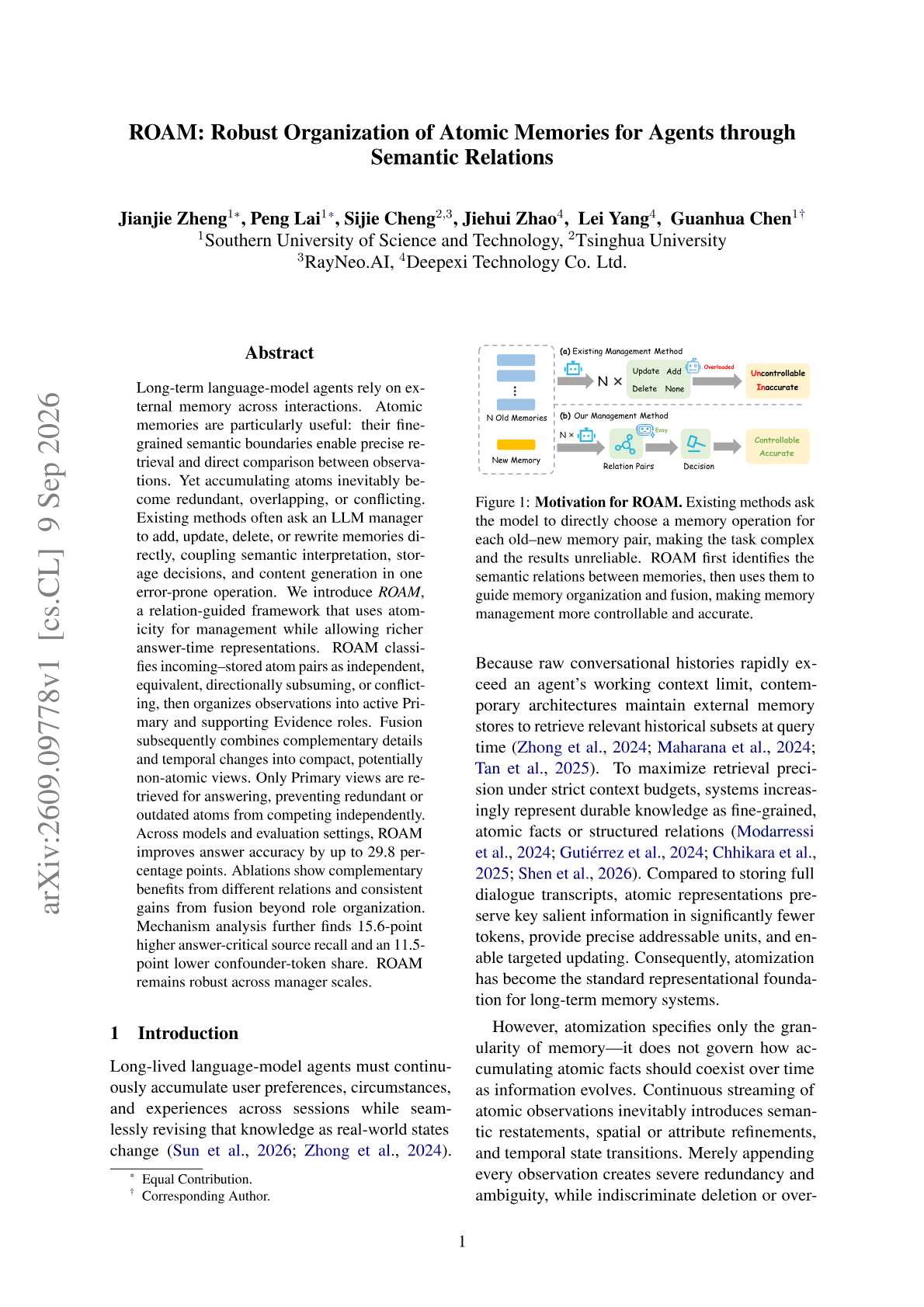
Jianjie Zheng, Peng Lai, Sijie Cheng and Guanhua Chen (SUSTech, Tsinghua, RayNeo, Deepexi) propose ROAM, which classifies each incoming-versus-stored memory pair by semantic relation before deciding what to store, instead of asking an LLM to add, update, delete or rewrite in one step.
Ask this paper
The operation being split apart: Existing methods couple semantic interpretation, storage decision and content generation into one LLM call. ROAM separates the relation judgment from the storage action.
Four relations: Incoming and stored atoms are classified as independent, equivalent, directionally subsuming, or conflicting, and observations are then organized into active Primary and supporting Evidence roles.
Fusion at answer time: Complementary details and temporal changes are fused into compact, potentially non-atomic views. Only Primary views are retrieved for answering, so redundant or outdated atoms cannot compete independently at retrieval.
Result: Answer accuracy improves by up to 29.8 percentage points across models and evaluation settings.
Mechanism evidence: Answer-critical source recall is 15.6 points higher and the confounder-token share is 11.5 points lower, and ablations show relations and fusion contribute separately. Performance holds across manager model scales.
Abstract
Long-term language-model agents rely on external memory across interactions. Atomic memories are particularly useful: their fine-grained semantic boundaries enable precise retrieval and direct comparison between observations. Yet accumulating atoms inevitably become redundant, overlapping, or conflicting. Existing methods often ask an LLM manager to add, update, delete, or rewrite memories directly, coupling semantic interpretation, storage decisions, and content generation in one error-prone operation. We introduce ROAM, a relation-guided framework that uses atomicity for management while allowing richer answer-time representations. ROAM classifies incoming--stored atom pairs as independent, equivalent, directionally subsuming, or conflicting, then organizes observations into active Primary and supporting Evidence roles. Fusion subsequently combines complementary details and temporal changes into compact, potentially non-atomic views. Only Primary views are retrieved for answering, preventing redundant or outdated atoms from competing independently. Across models and evaluation settings, ROAM improves answer accuracy by up to 29.8 percentage points. Ablations show complementary benefits from different relations and consistent gains from fusion beyond role organization. Mechanism analysis further finds 15.6-point higher answer-critical source recall and an 11.5-point lower confounder-token share. ROAM remains robust across manager scales.