rStar
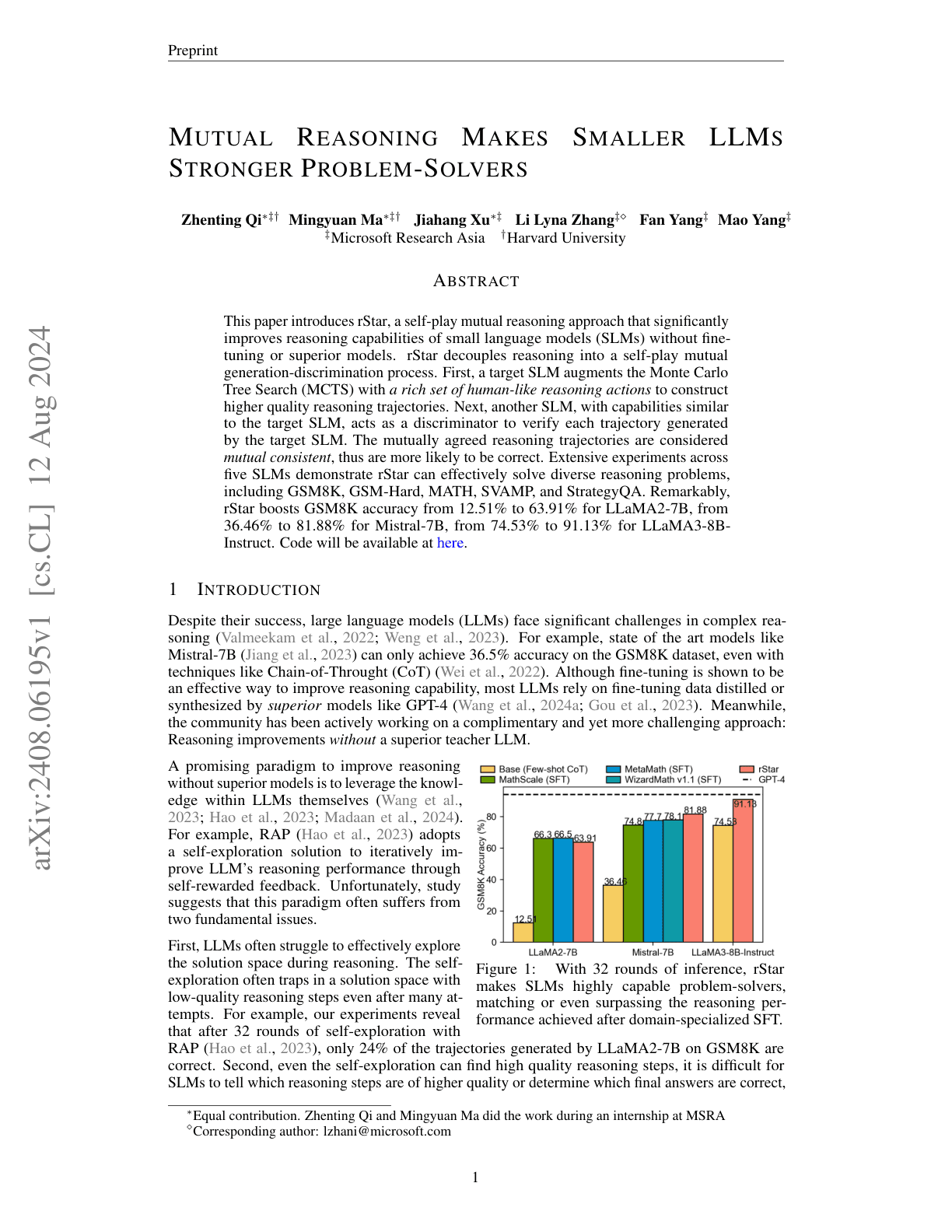
introduces self-play mutual reasoning to improve the reasoning capabilities of small language models without fine-tuning or superior models; MCTS is augmented with human-like reasoning actions, obtained from SLMs, to build richer reasoning trajectories; a separate SLM provides unsupervised feedback on the trajectories and the target SLM selects the final reasoning trajectory as the answer; rStar boosts GSM8K accuracy from 12.51% to 63.91% for LLaMA2-7B and consistently improves the accuracy of other SLMs.
Ask this paper
Abstract
This paper introduces rStar, a self-play mutual reasoning approach that significantly improves reasoning capabilities of small language models (SLMs) without fine-tuning or superior models. rStar decouples reasoning into a self-play mutual generation-discrimination process. First, a target SLM augments the Monte Carlo Tree Search (MCTS) with a rich set of human-like reasoning actions to construct higher quality reasoning trajectories. Next, another SLM, with capabilities similar to the target SLM, acts as a discriminator to verify each trajectory generated by the target SLM. The mutually agreed reasoning trajectories are considered mutual consistent, thus are more likely to be correct. Extensive experiments across five SLMs demonstrate rStar can effectively solve diverse reasoning problems, including GSM8K, GSM-Hard, MATH, SVAMP, and StrategyQA. Remarkably, rStar boosts GSM8K accuracy from 12.51% to 63.91% for LLaMA2-7B, from 36.46% to 81.88% for Mistral-7B, from 74.53% to 91.13% for LLaMA3-8B-Instruct. Code will be available at https://github.com/zhentingqi/rStar.