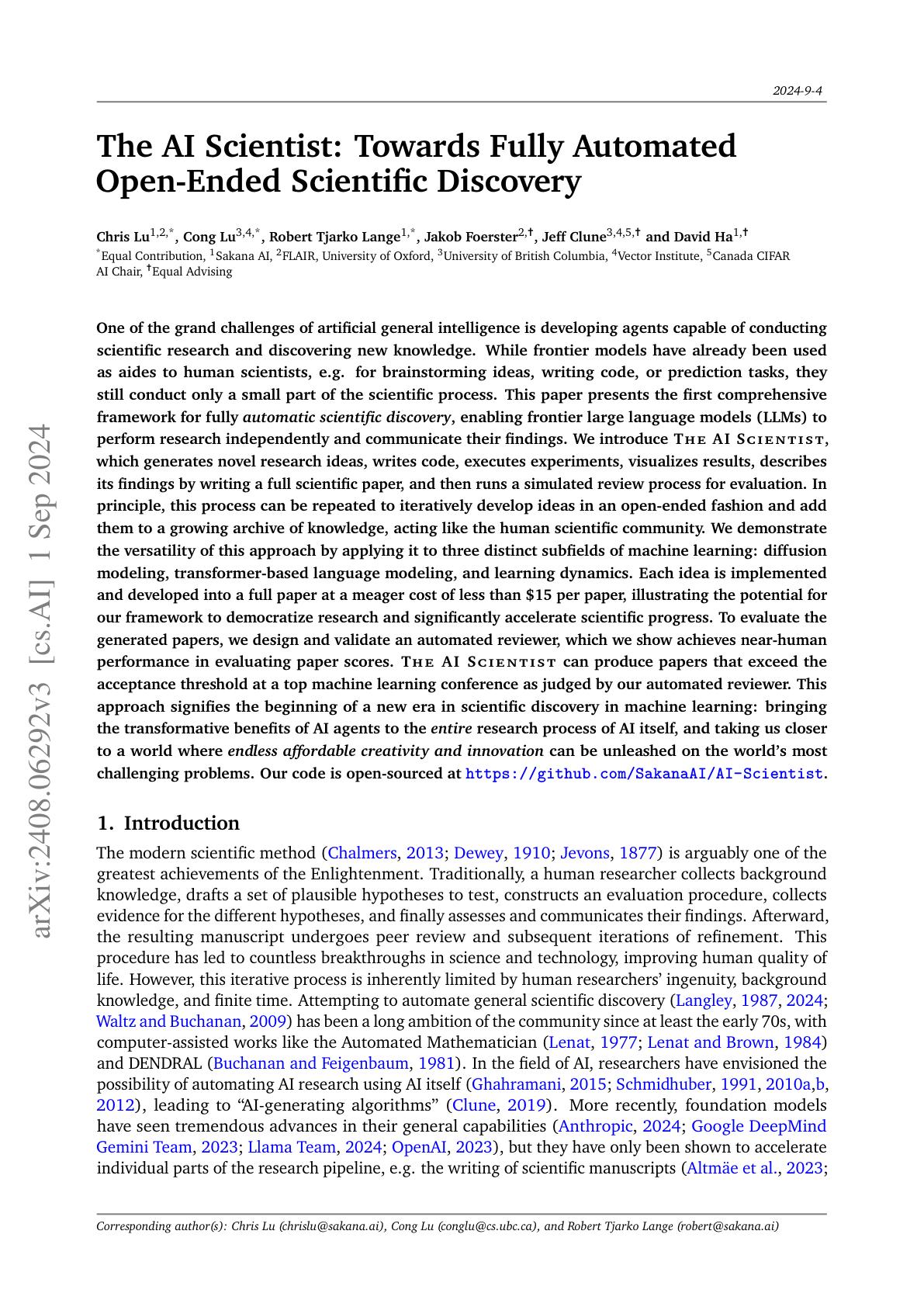
The AI Scientist
a novel AI agent that can develop and write a full conference-level scientific paper costing less than $15; it automates scientific discovery by enabling frontier LLMs to perform independent research and summarize findings; it also uses an automated reviewer to evaluate the generated papers; claims to achieve near-human performance in evaluating paper scores; claims to produce papers that exceed the acceptance threshold at a top machine learning conference as judged by their automated reviewer.
Grok-2
a new frontier model with strong code, math, and reasoning capabilities which includes a large and small model; outperforms both Claude 3.5 Sonnet and GPT-4-Turbo on the LMSYS Chatbot Arena; claims to improve capabilities including instruction following, retrieval, tool use, and enhancing factuality; competes with Claude 3.5 Sonnet (June release) and GPT-4o (May release) on MMLU and HumanEval.
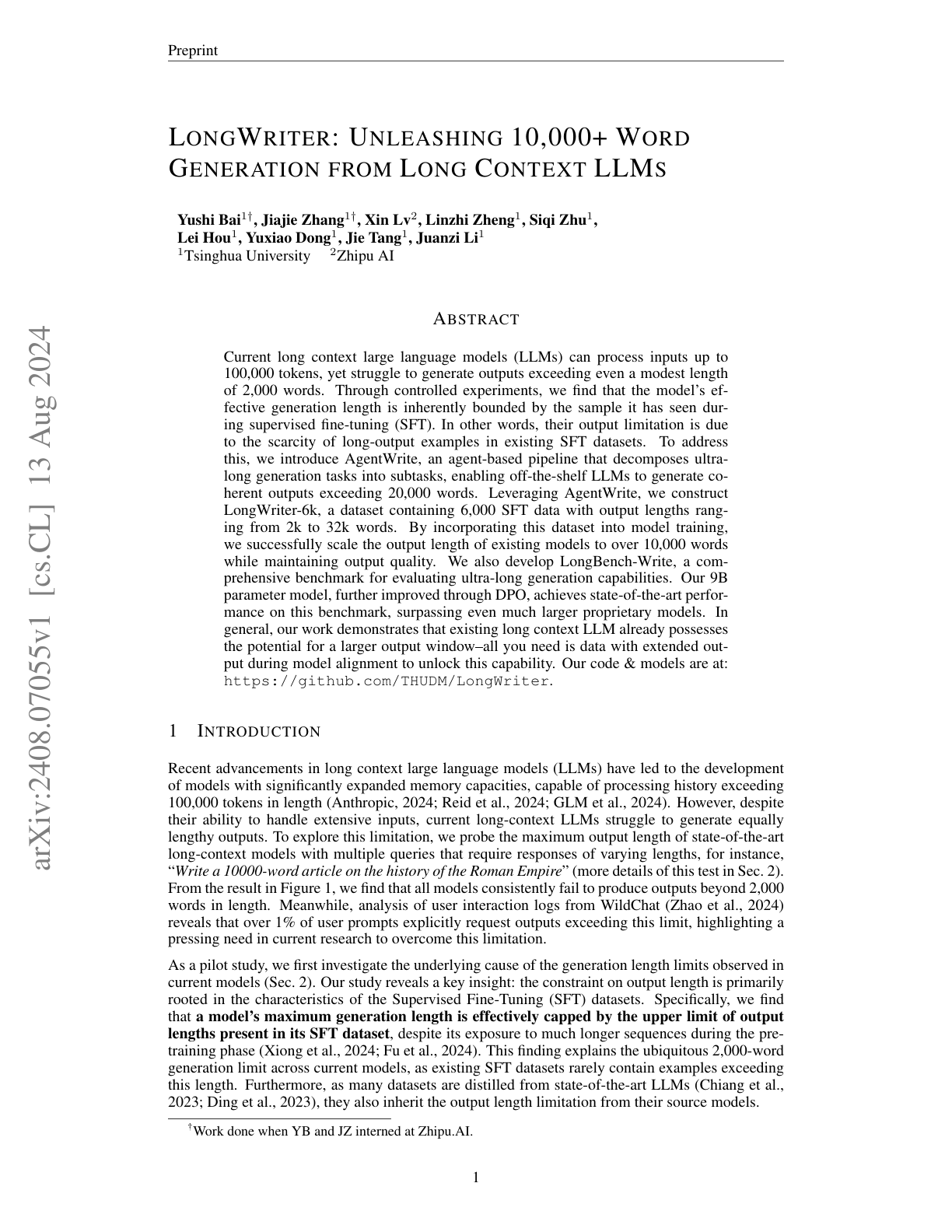
LongWriter
proposes AgentWrite to enable off-the-shelf LLMs to generate coherent outputs beyond 20K words; AgentWrite breaks down the long generation task into subtasks and in a divide-and-conquer approach generates; the agent breaks the task into multiple writing subtasks and concatenates the outputs to get a final output (i.e., plan + write); the approach is then used to build SFT datasets that are used to tune LLMs to generate coherent longer outputs automatically; a 9B parameter model, further improved through DPO, achieves state-of-the-art performance on their benchmark, and surpasses proprietary models.
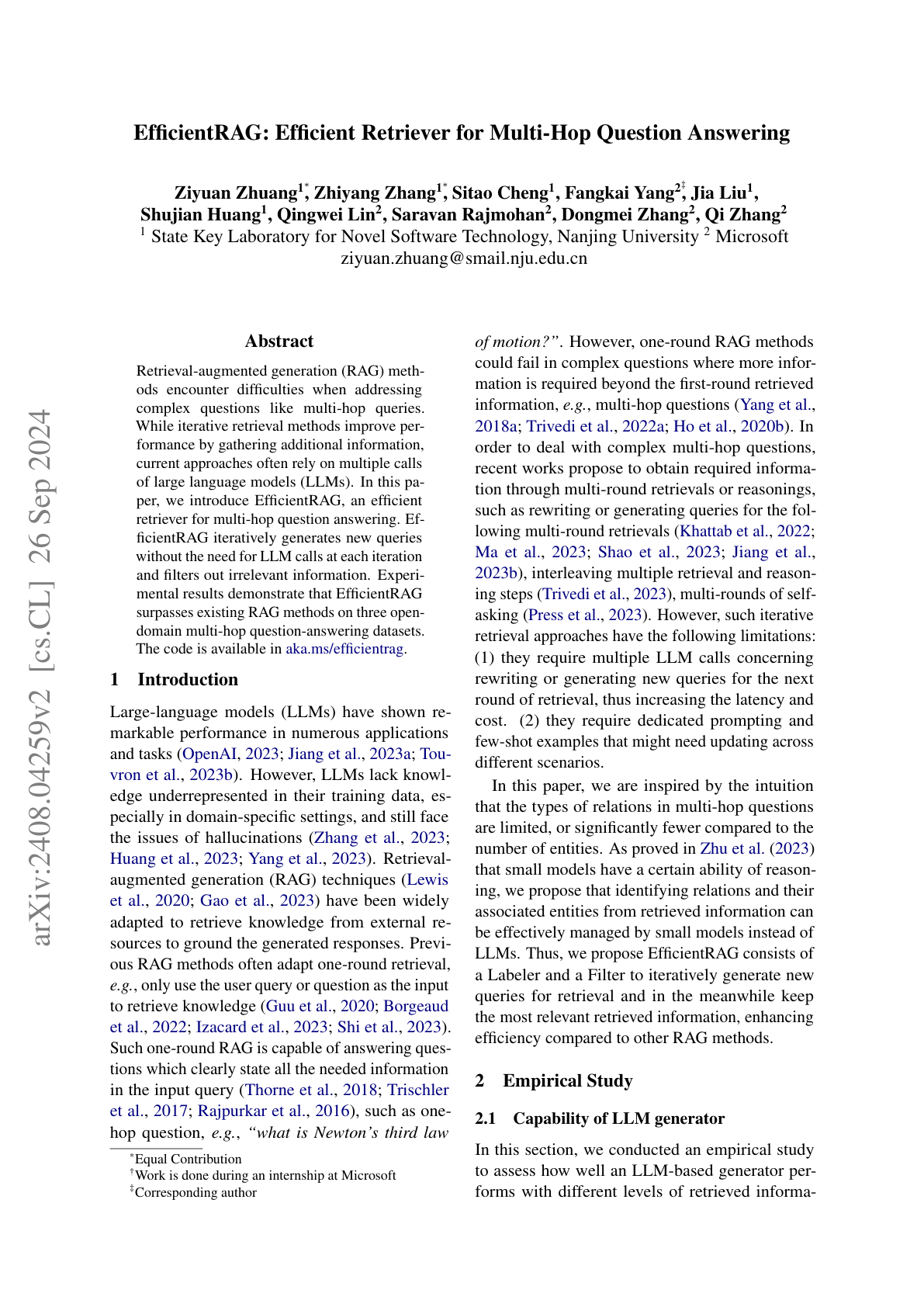
EfficientRAG
trains an auto-encoder LM to label and tag chunks; it retrieves relevant chunks, tags them as either <Terminate> or <Continue>, and annotates <Continue> chunks for continuous processing; then a filter model is trained to formulate the next-hop query based on the original question and previous annotations; this is done iteratively until all chunks are tagged as <Terminate> or the maximum # of iterations is reached; after the process above has gathered enough information to answer the initial question, the final generator (an LLM) generates the final answer.
RAGChecker
a fine-grained evaluation framework for diagnosing retrieval and generation modules in RAG; shows that RAGChecker has better correlations with human judgment; reports several revealing insightful patterns and trade-offs in design choices of RAG architectures.
HybridRAG
combines GraphRAG and VectorRAG leading to a HybridRAG system that outperforms both individually; it was tested on a set of financial earning call transcripts. Combining the advantages of both approaches provides more accurate answers to queries.
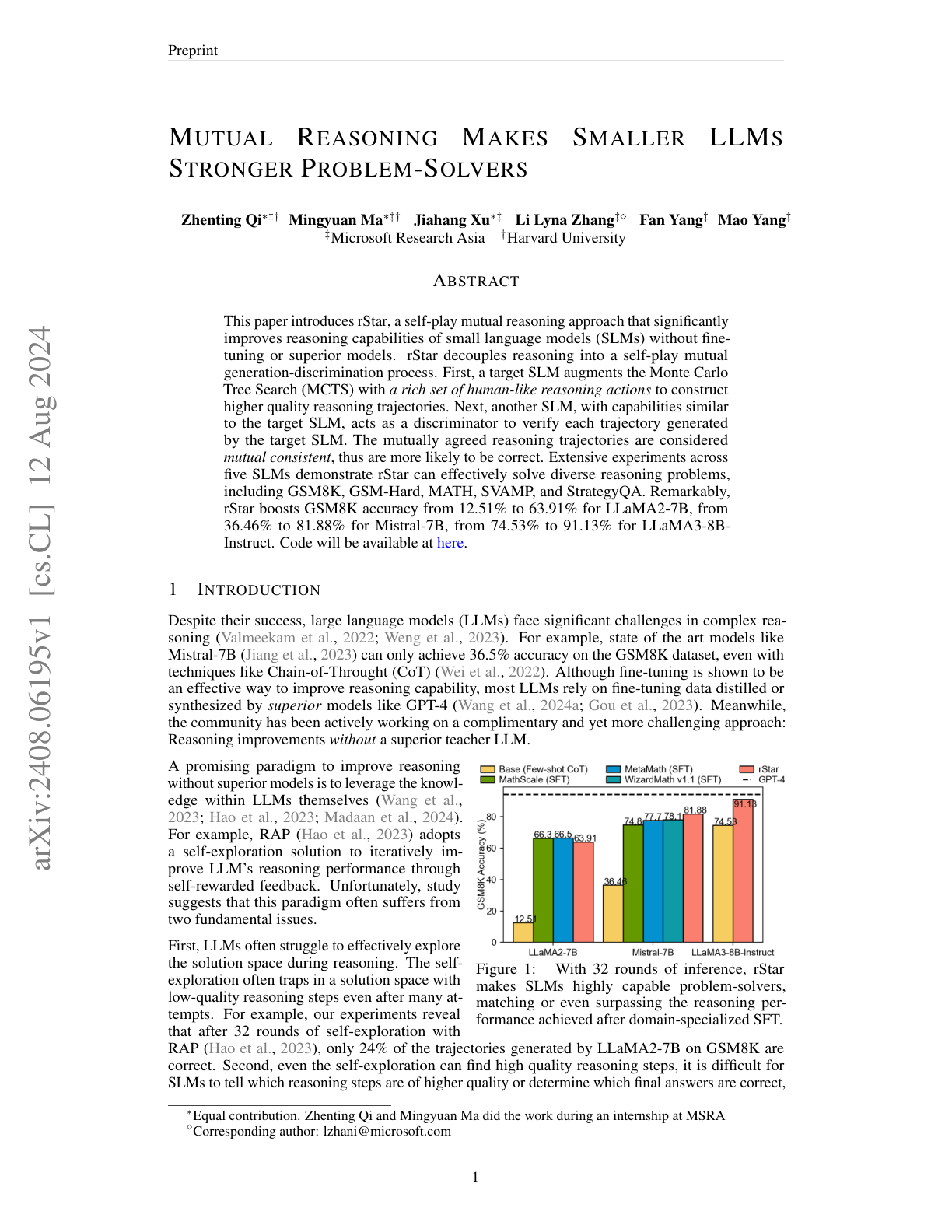
rStar
introduces self-play mutual reasoning to improve the reasoning capabilities of small language models without fine-tuning or superior models; MCTS is augmented with human-like reasoning actions, obtained from SLMs, to build richer reasoning trajectories; a separate SLM provides unsupervised feedback on the trajectories and the target SLM selects the final reasoning trajectory as the answer; rStar boosts GSM8K accuracy from 12.51% to 63.91% for LLaMA2-7B and consistently improves the accuracy of other SLMs.
Scaling LLM Test-Time Compute Optimally
investigates the scaling behaviors of inference-time computation in LLMs; in particular, it analyses how much an LLM can be improved provided a fixed amount of inference-time compute; finds that the effectiveness of different scaling approaches varies by difficulty of prompt; it then proposes an adaptive compute-optimal strategy that can improve efficiency by more than 4x compared to a best-of-N baseline; reports that in a FLOPs-matched evaluation, optimally scaling test-time compute can outperform a 14x larger model.
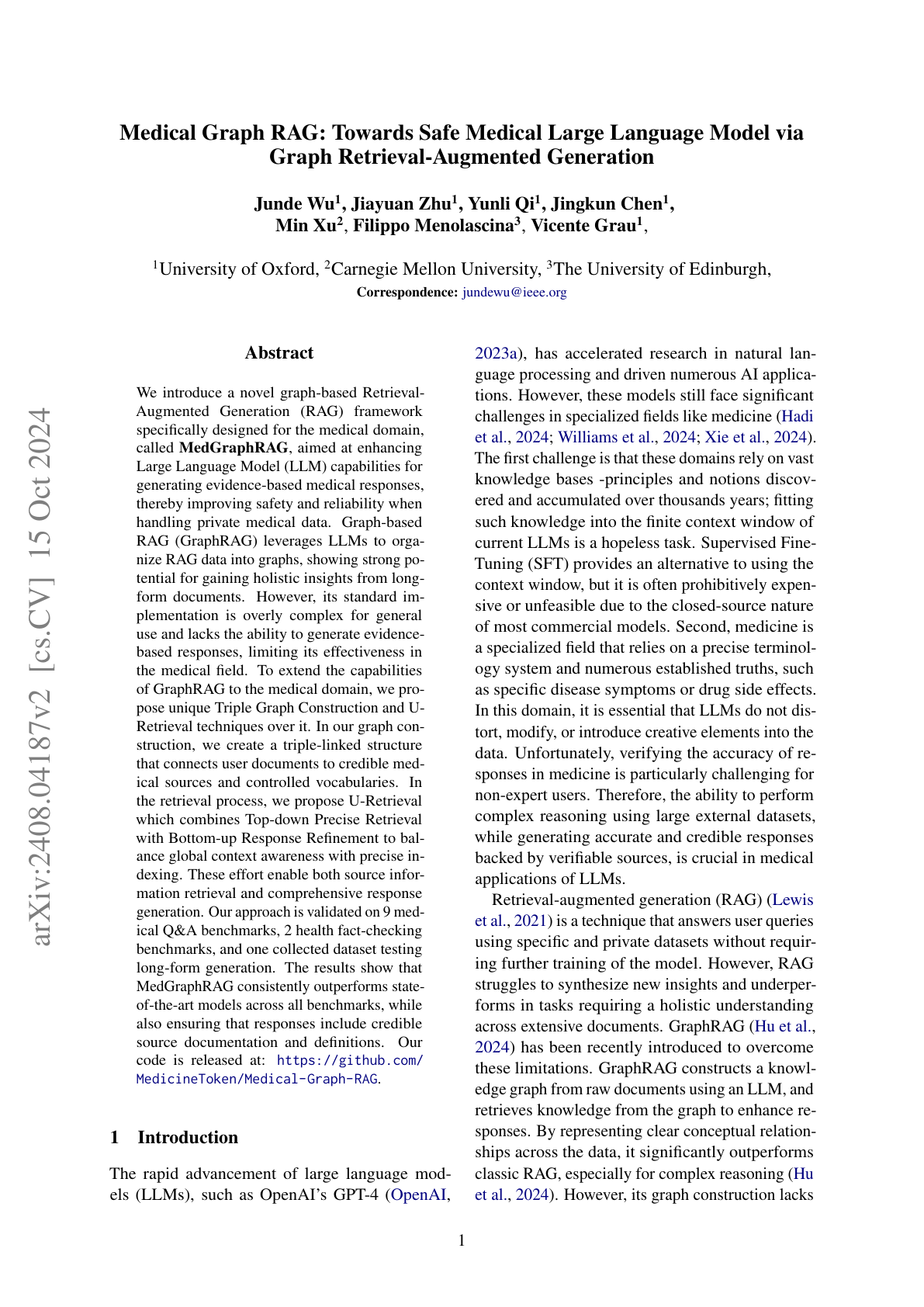
MedGraphRAG
a graph-based framework for the medical domain with a focus on enhancing LLMs and generating evidence-based results; leverages a hybrid static-semantic approach to chunk documents to improve context capture; entities and medical knowledge are represented through graphs which leads to an interconnected global graph; this approach improves precision and outperforms state-of-the-art models on multiple medical Q&A benchmarks.
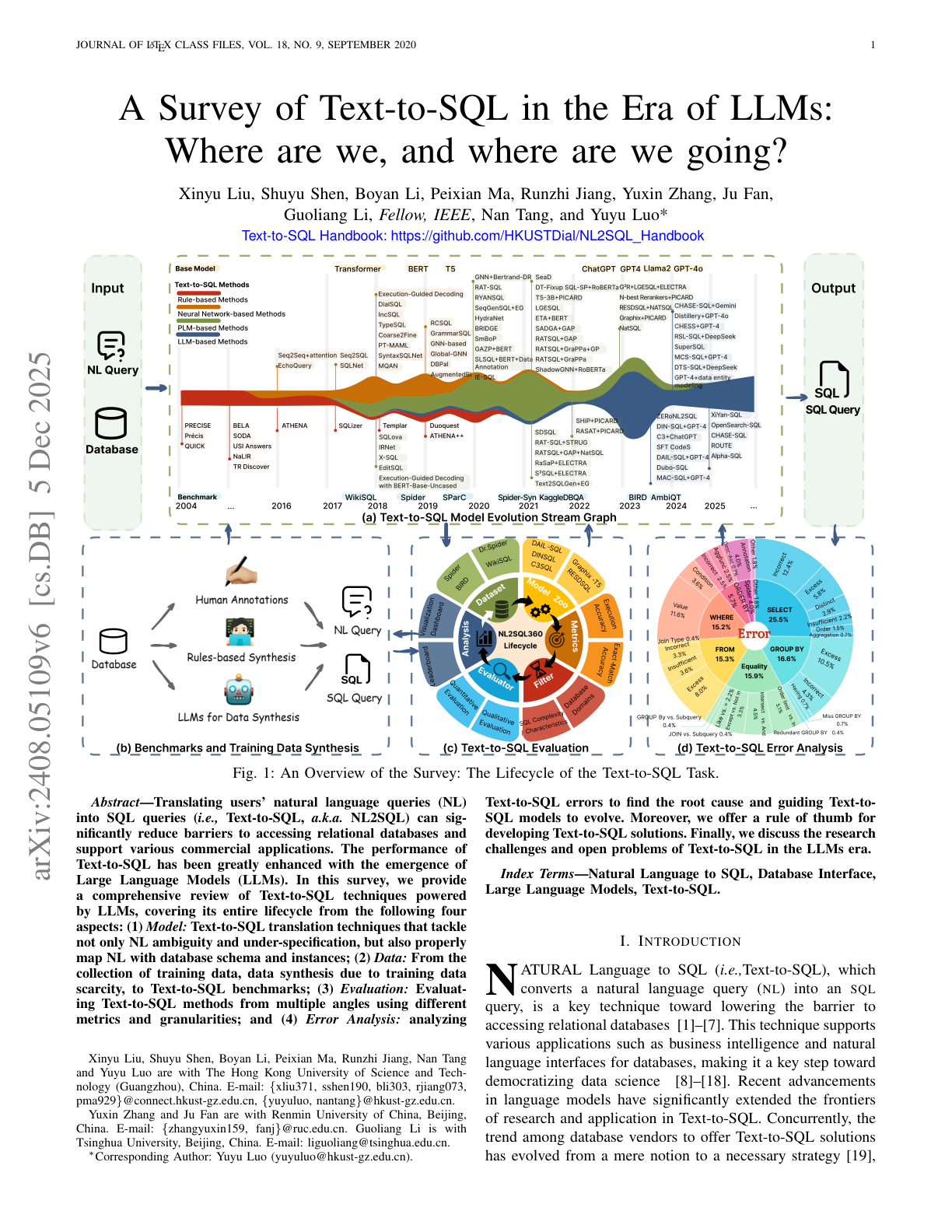
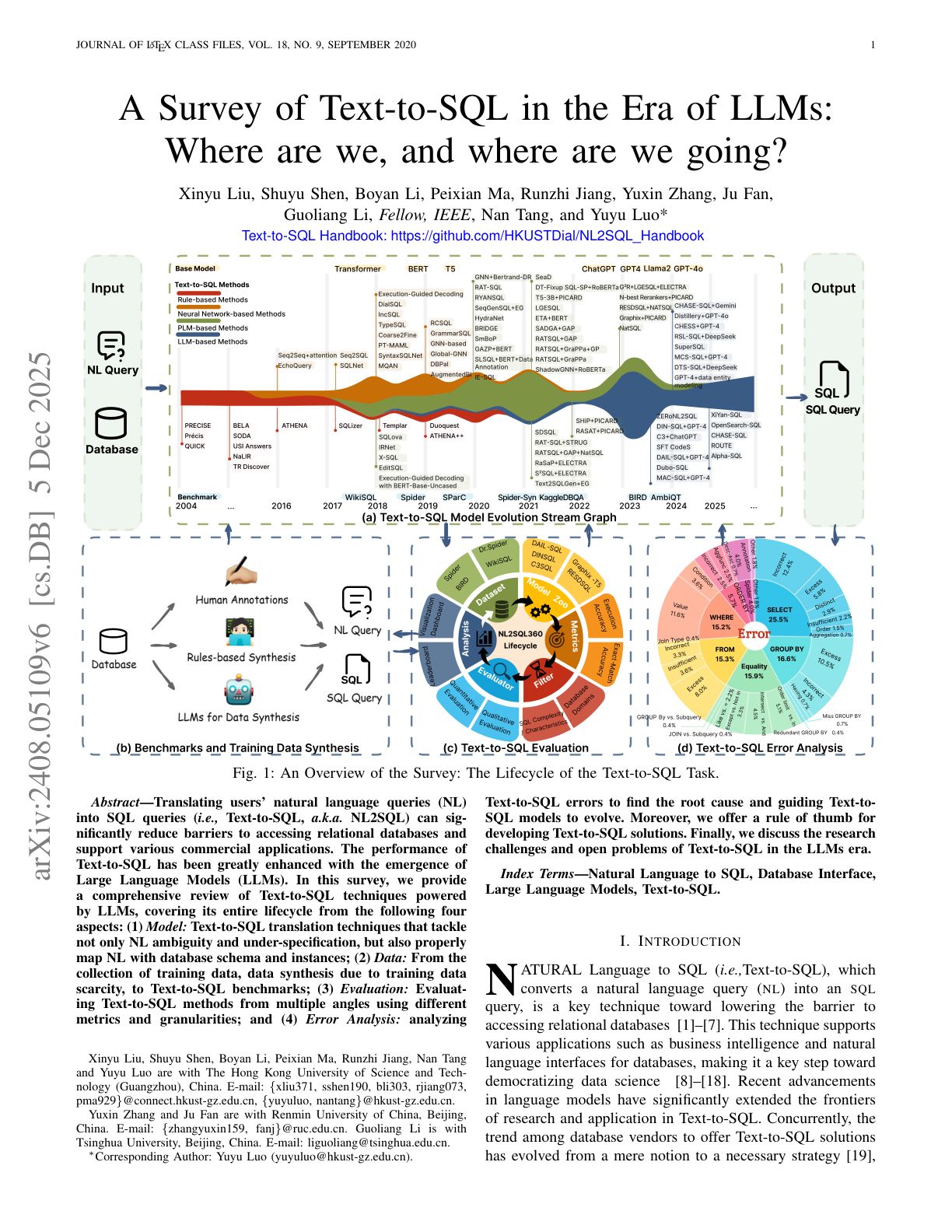
Survey of NL2QL
a comprehensive overview of NL2SQL techniques powered by LLMs; covers models, data collection, evaluation methods, and error analysis.