rStar2-Agent
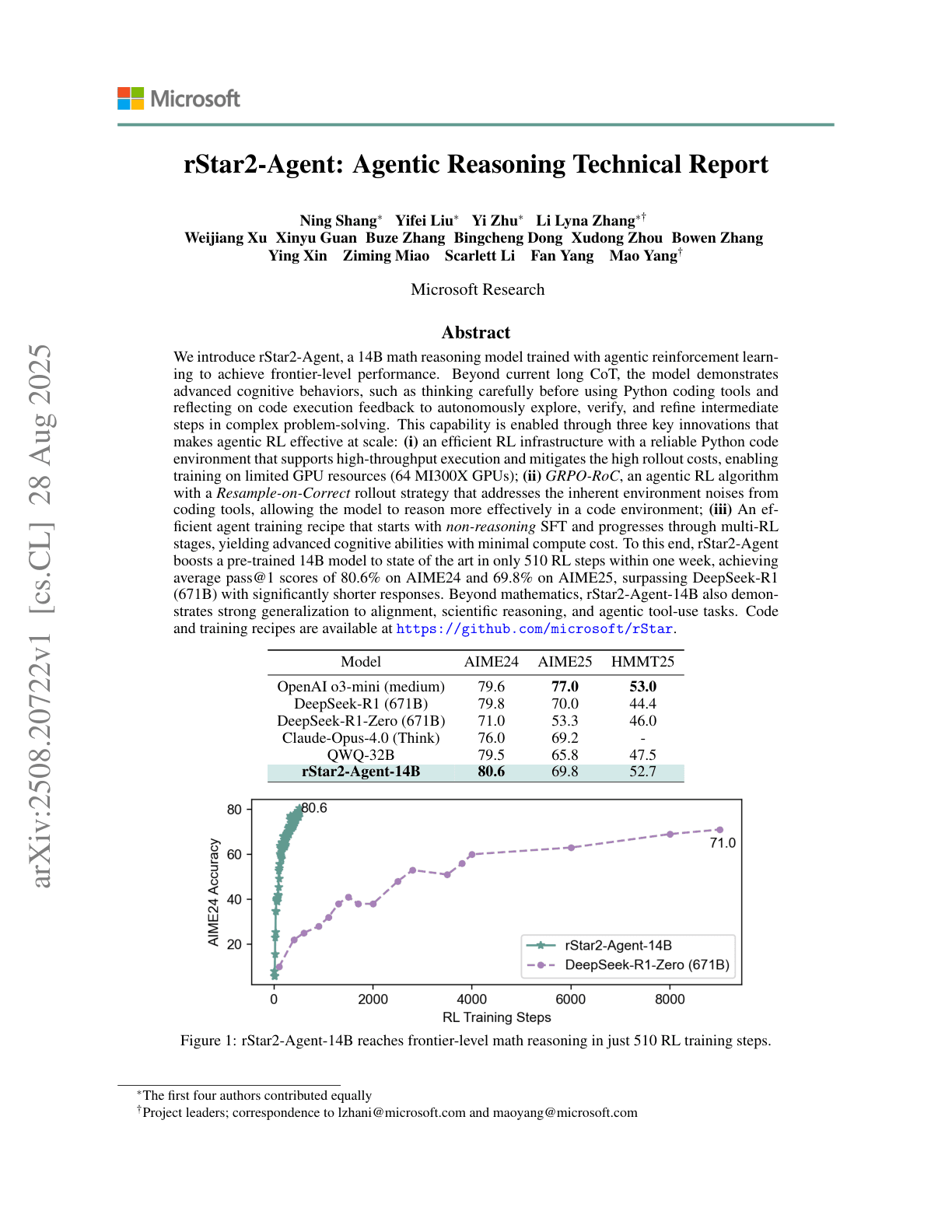
rStar2-Agent is a 14B math-reasoning model trained with agentic RL that learns to think smarter by using a Python tool environment, not just longer CoT. It introduces GRPO-RoC, a rollout strategy that filters noisy successful traces, plus infrastructure for massive, low-latency tool execution. In one week and 510 RL steps on 64 MI300X GPUs, the model reaches frontier-level AIME while producing shorter solutions and showing transfer beyond math.
Ask this paper
Method in one line: GRPO-RoC oversamples rollouts then keeps only the cleanest correct ones while preserving diverse failures, reducing tool-call errors and formatting issues during training.
Infrastructure: A dedicated, isolated code service reliably handles up to ~45K concurrent tool calls per training step with ~0.3 s end-to-end latency, and a load-balanced scheduler allocates rollouts by available KV cache to cut GPU idle time.
Training recipe: Start with non-reasoning SFT to teach tool use and formatting, then three RL stages that scale max output length 8K → 12K → 12K, and finally focus on harder problems; RL data curated to 42K math items with integer answers.
Results: Pass@1 AIME24 80.6, AIME25 69.8, HMMT25 52.7, exceeding or matching o3-mini (medium) and DeepSeek-R1 despite far smaller size; responses are shorter on AIME24/25 than Qwen3-14B and QWQ-32B.
Generalization and behaviors: Improves GPQA-Diamond to 60.9 and performs well on tool-use and alignment benchmarks; entropy analysis shows preserved forking tokens and new reflection tokens triggered by tool feedback, enabling verification and correction.
Abstract
We introduce rStar2-Agent, a 14B math reasoning model trained with agentic reinforcement learning to achieve frontier-level performance. Beyond current long CoT, the model demonstrates advanced cognitive behaviors, such as thinking carefully before using Python coding tools and reflecting on code execution feedback to autonomously explore, verify, and refine intermediate steps in complex problem-solving. This capability is enabled through three key innovations that makes agentic RL effective at scale: (i) an efficient RL infrastructure with a reliable Python code environment that supports high-throughput execution and mitigates the high rollout costs, enabling training on limited GPU resources (64 MI300X GPUs); (ii) GRPO-RoC, an agentic RL algorithm with a Resample-on-Correct rollout strategy that addresses the inherent environment noises from coding tools, allowing the model to reason more effectively in a code environment; (iii) An efficient agent training recipe that starts with non-reasoning SFT and progresses through multi-RL stages, yielding advanced cognitive abilities with minimal compute cost. To this end, rStar2-Agent boosts a pre-trained 14B model to state of the art in only 510 RL steps within one week, achieving average pass@1 scores of 80.6% on AIME24 and 69.8% on AIME25, surpassing DeepSeek-R1 (671B) with significantly shorter responses. Beyond mathematics, rStar2-Agent-14B also demonstrates strong generalization to alignment, scientific reasoning, and agentic tool-use tasks. Code and training recipes are available at https://github.com/microsoft/rStar.