Visual Story Telling
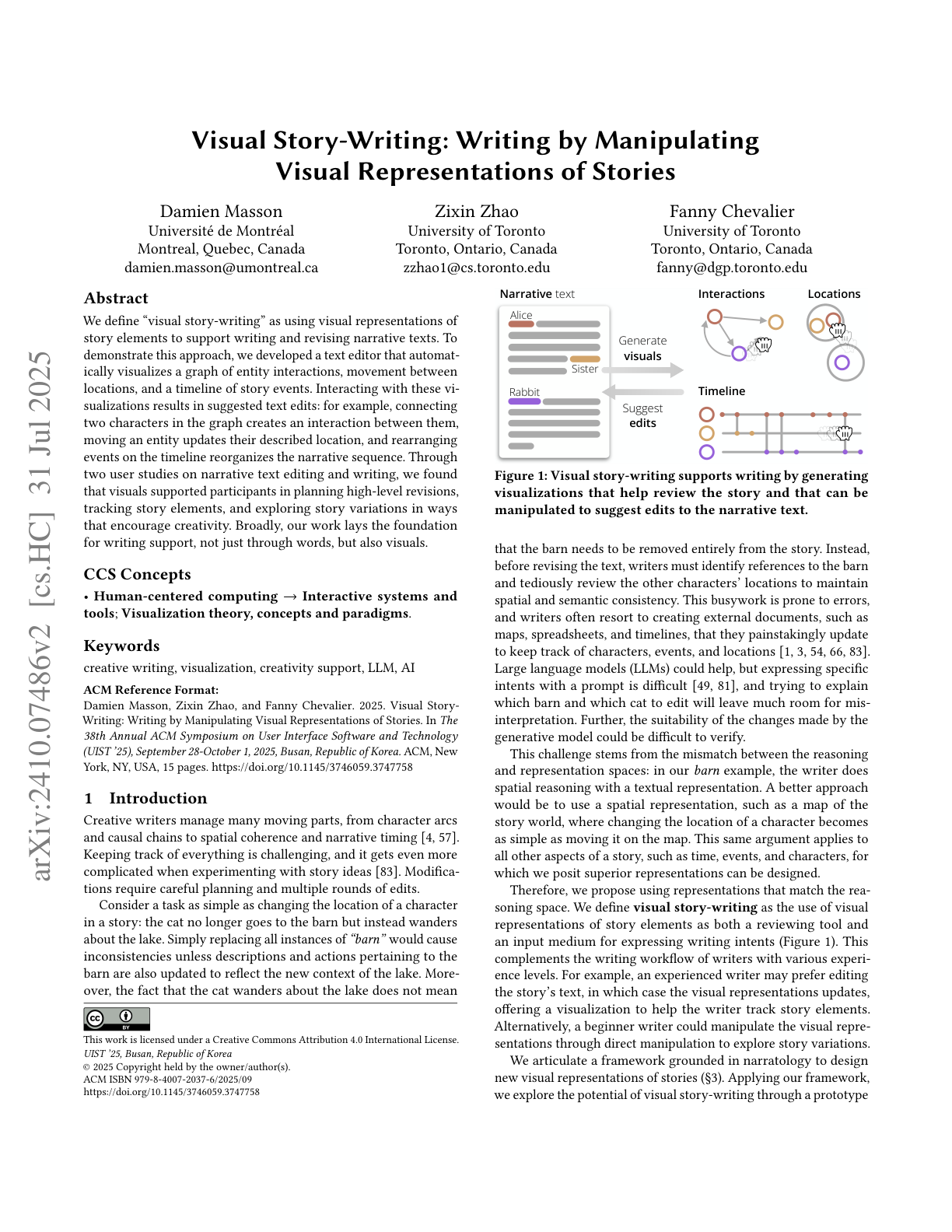
A system and design framework that lets writers edit stories by acting directly on visuals of characters, locations, and timelines. Instead of only prompting, authors drag, connect, and reorder visual elements; the tool proposes synchronized text edits and can regenerate passages from the visual skeleton.
Ask this paper
Framework: eight elements + four operators. Builds on narratology (fabula/syuzhet) with story elements (actors/characters, time/temporality, locations/space, events/focalization) and four compositional operators: position, associate, connect, unfold.
Prototype with three coordinated views. An entities–actions graph, a locations canvas, and an event timeline enable direct manipulation: add/remove characters or actions, drag entities between locations, reorder events; coordinated highlighting and selection constrain edits to chosen scenes.
Bi-directional editing and versioning. Manual text edits can refresh visuals; visual edits generate tracked diffs in text; a history tree supports branching exploration; a “refresh from visuals” mode rewrites the story from the current visual state.
Two studies: planning and editing. With 12 participants, visuals improved planning, search, and reflection compared to text-only, though cognitive-load results were mixed and mental-model mismatches appeared. With 8 creative writers, participants successfully expressed spatial, temporal, and entity edits, found it helpful for exploration and inconsistency fixing, and gave a high Creativity Support Index, while asking for more control over style and alternative visual layouts.
Implementation and limits. React + Slate.js front end; GPT-4o prompts for extraction and edits; parallel sentence-level extraction for speed. Occasional LLM latency or unintended edits remain; future work includes richer constructs (relationships, emotions), style controls, support for long/nonlinear narratives, and a view-builder for custom diagrams.