Scaling LLM Test-Time Compute Optimally
investigates the scaling behaviors of inference-time computation in LLMs; in particular, it analyses how much an LLM can be improved provided a fixed amount of inference-time compute; finds that the effectiveness of different scaling approaches varies by difficulty of prompt; it then proposes an adaptive compute-optimal strategy that can improve efficiency by more than 4x compared to a best-of-N baseline; reports that in a FLOPs-matched evaluation, optimally scaling test-time compute can outperform a 14x larger model.
Ask this paper
Abstract
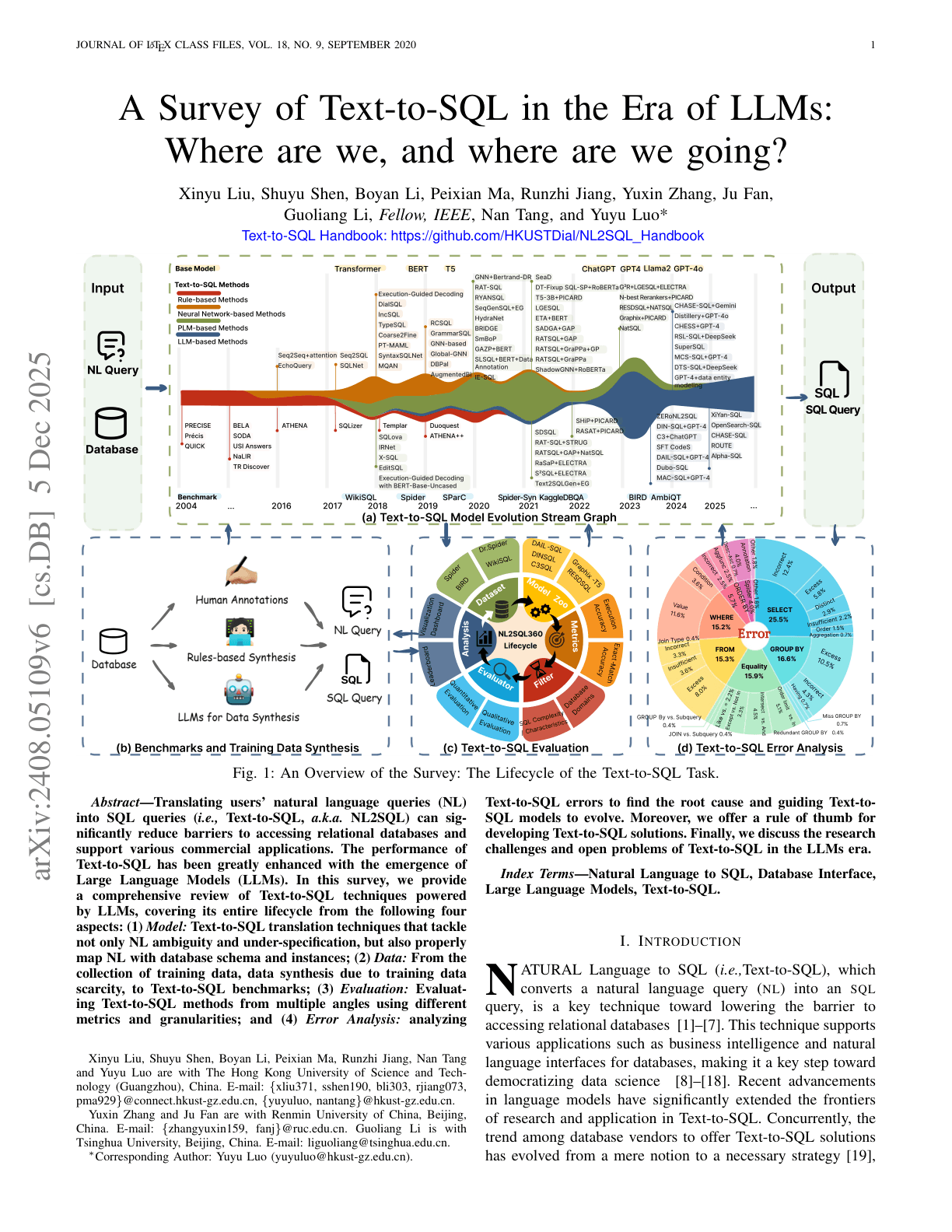
Translating users' natural language queries (NL) into SQL queries (i.e., Text-to-SQL, a.k.a. NL2SQL) can significantly reduce barriers to accessing relational databases and support various commercial applications. The performance of Text-to-SQL has been greatly enhanced with the emergence of Large Language Models (LLMs). In this survey, we provide a comprehensive review of Text-to-SQL techniques powered by LLMs, covering its entire lifecycle from the following four aspects: (1) Model: Text-to-SQL translation techniques that tackle not only NL ambiguity and under-specification, but also properly map NL with database schema and instances; (2) Data: From the collection of training data, data synthesis due to training data scarcity, to Text-to-SQL benchmarks; (3) Evaluation: Evaluating Text-to-SQL methods from multiple angles using different metrics and granularities; and (4) Error Analysis: analyzing Text-to-SQL errors to find the root cause and guiding Text-to-SQL models to evolve. Moreover, we offer a rule of thumb for developing Text-to-SQL solutions. Finally, we discuss the research challenges and open problems of Text-to-SQL in the LLMs era. Text-to-SQL Handbook: https://github.com/HKUSTDial/NL2SQL_Handbook