Scaling MLPs: A Tale of Inductive Bias
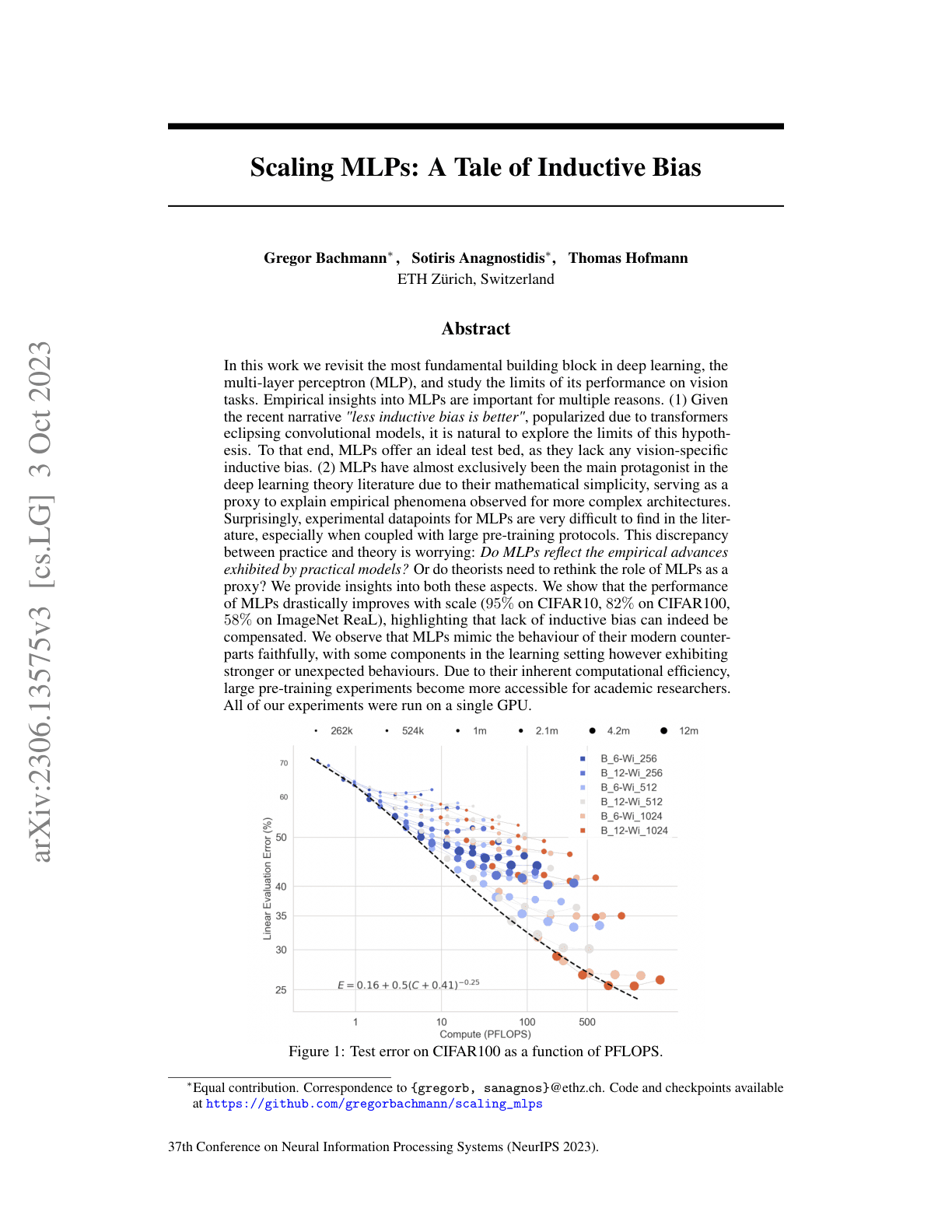
Shows MLPs scale with compute despite their lack of inductive bias.
Ask this paper
Pure-MLP scaling: Demonstrates that large pure-MLP models trained on enough data can reach surprisingly strong performance on image classification.
Inductive bias is compensable: Challenges the dogma that CNN/Transformer inductive biases are necessary - scale and data can substitute.
Bitter lesson evidence: Adds to the "bitter lesson" empirical evidence that general methods leveraging computation outperform those leveraging human-designed priors.
Architecture agnosticism: Part of the 2023 trend showing that many architectures (MLPs, State Space Models, RNNs, Transformers) converge at scale.
Abstract
In this work we revisit the most fundamental building block in deep learning, the multi-layer perceptron (MLP), and study the limits of its performance on vision tasks. Empirical insights into MLPs are important for multiple reasons. (1) Given the recent narrative "less inductive bias is better", popularized due to transformers eclipsing convolutional models, it is natural to explore the limits of this hypothesis. To that end, MLPs offer an ideal test bed, as they lack any vision-specific inductive bias. (2) MLPs have almost exclusively been the main protagonist in the deep learning theory literature due to their mathematical simplicity, serving as a proxy to explain empirical phenomena observed for more complex architectures. Surprisingly, experimental datapoints for MLPs are very difficult to find in the literature, especially when coupled with large pre-training protocols. This discrepancy between practice and theory is worrying: Do MLPs reflect the empirical advances exhibited by practical models? Or do theorists need to rethink the role of MLPs as a proxy? We provide insights into both these aspects. We show that the performance of MLPs drastically improves with scale (95% on CIFAR10, 82% on CIFAR100, 58% on ImageNet ReaL), highlighting that lack of inductive bias can indeed be compensated. We observe that MLPs mimic the behaviour of their modern counterparts faithfully, with some components in the learning setting however exhibiting stronger or unexpected behaviours. Due to their inherent computational efficiency, large pre-training experiments become more accessible for academic researchers. All of our experiments were run on a single GPU.