Self-Evolving Agents Can Repair Failures but Struggle to Generalize from Them
Weixiang Zhao, Yichen Zhang, Bing Qin, Ting Liu and colleagues (Harbin Institute of Technology) study self-evolving agents that start with no experience and learn only from their own failures, and find a consistent gap: failure-derived experience repairs the failed tasks but rarely transfers to new ones.
Ask this paper
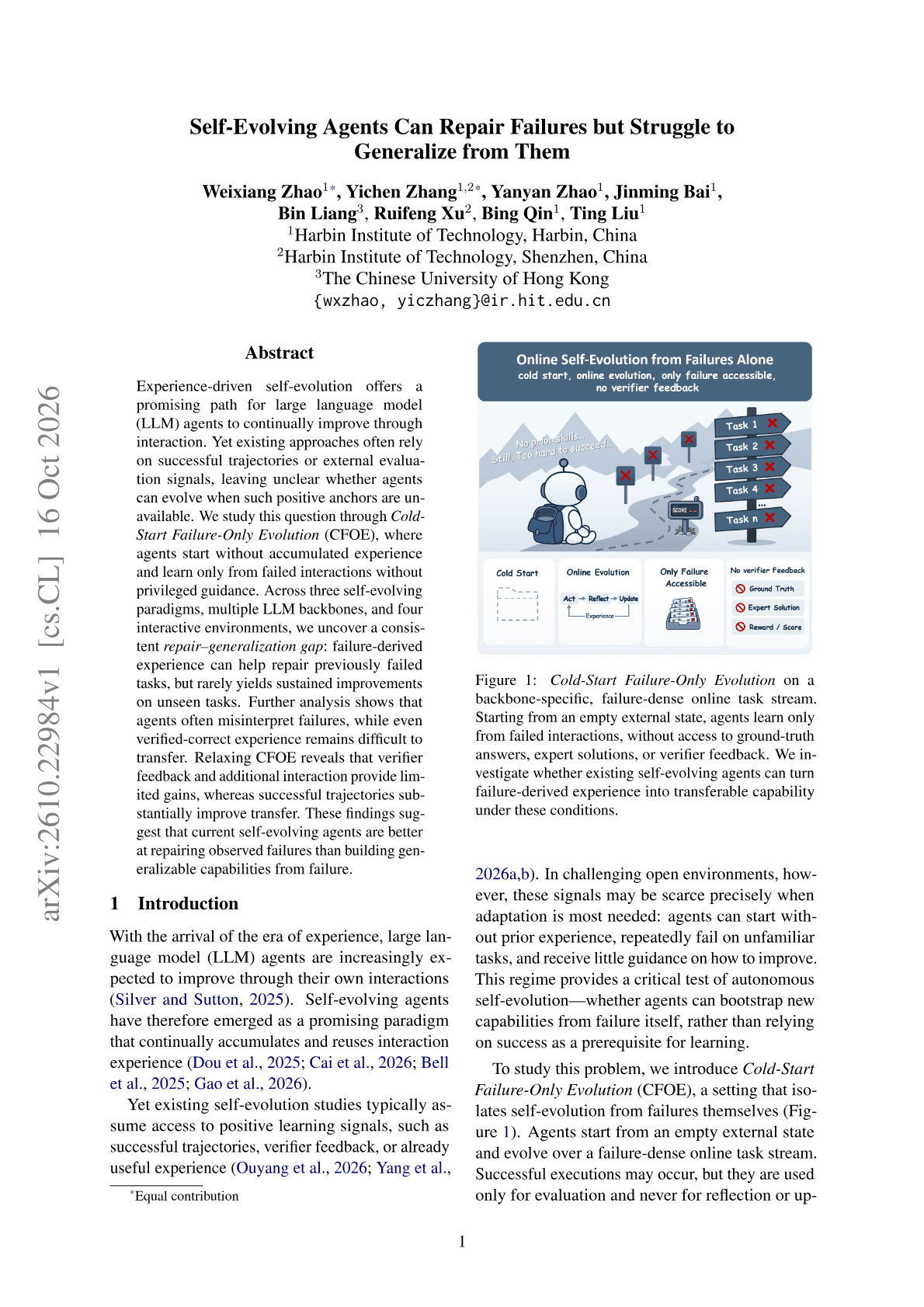
Setting. Cold-Start Failure-Only Evolution (CFOE) removes successful trajectories and privileged feedback, so the agent must improve from failed interactions alone.
Coverage. Three self-evolving paradigms, multiple LLM backbones and four interactive environments.
Repair-generalization gap. Experience distilled from failures helps the agent fix tasks it previously failed, but rarely yields sustained improvement on unseen tasks.
Cause. Agents often misattribute why they failed, and even verified-correct experience is hard to transfer. Adding verifier feedback or more interaction helps little, while adding successful trajectories substantially improves transfer.
Why it matters. Many self-improvement results report gains on the tasks used to generate the experience. This paper separates repair from generalization and shows they behave differently.
Abstract
Experience-driven self-evolution offers a promising path for large language model (LLM) agents to continually improve through interaction. Yet existing approaches often rely on successful trajectories or external evaluation signals, leaving unclear whether agents can evolve when such positive anchors are unavailable. We study this question through Cold-Start Failure-Only Evolution (CFOE), where agents start without accumulated experience and learn only from failed interactions without privileged guidance. Across three self-evolving paradigms, multiple LLM backbones, and four interactive environments, we uncover a consistent repair-generalization gap: failure-derived experience can help repair previously failed tasks, but rarely yields sustained improvements on unseen tasks. Further analysis shows that agents often misinterpret failures, while even verified-correct experience remains difficult to transfer. Relaxing CFOE reveals that verifier feedback and additional interaction provide limited gains, whereas successful trajectories substantially improve transfer. These findings suggest that current self-evolving agents are better at repairing observed failures than building generalizable capabilities from failure.