Self-Improvement Memory Enables Continual Recursive Self-Improvement
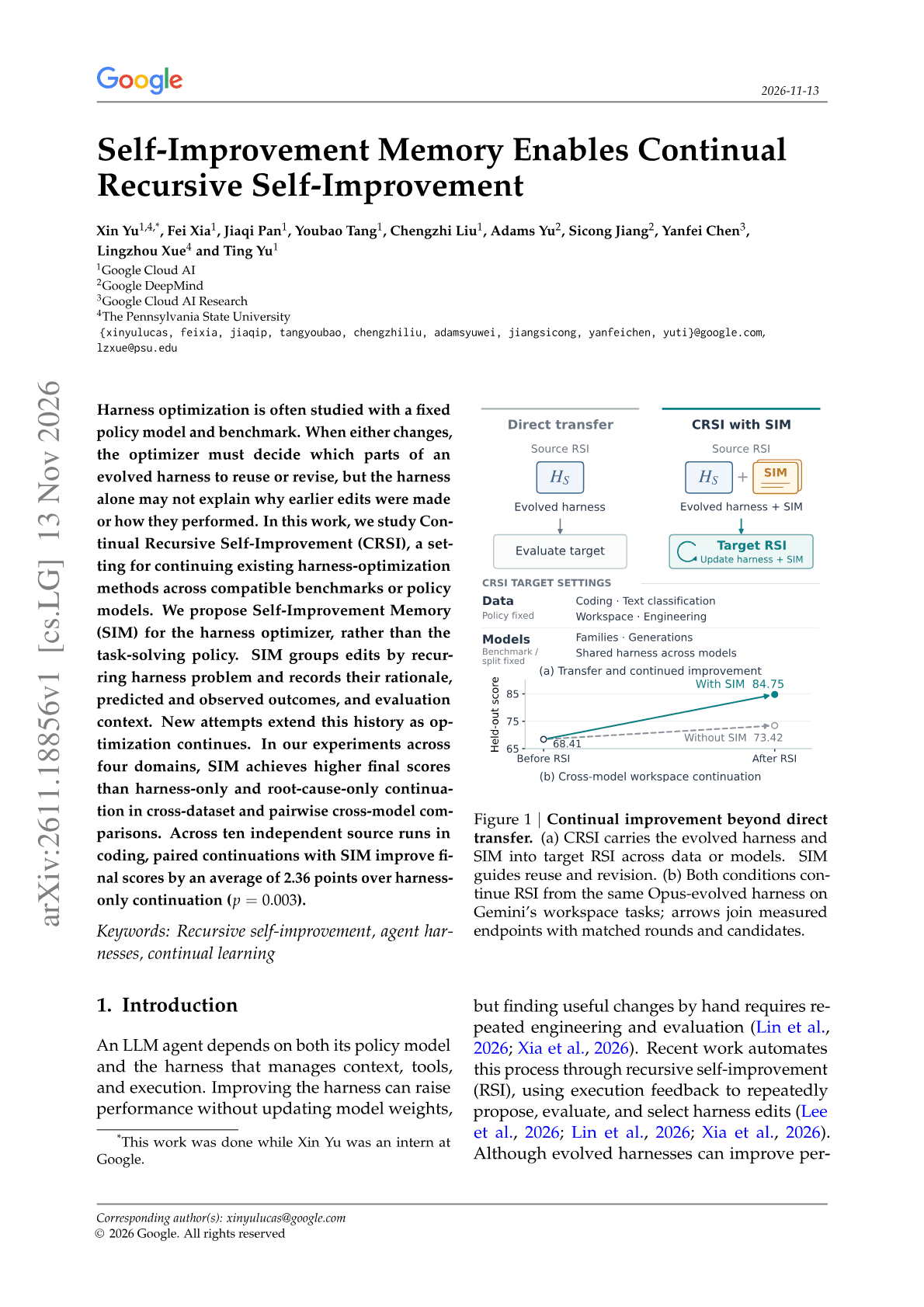
Researchers at Google Cloud AI and Google DeepMind, with Penn State, study what happens when a harness optimizer has to keep going after the benchmark or the policy model changes, and give the optimizer a memory of its own past edits, called Self-Improvement Memory (SIM).
Ask this paper
Setting. Continual Recursive Self-Improvement continues an existing harness-optimization run on a new benchmark (policy fixed) or a new policy model (benchmark fixed). An evolved harness does not always transfer: an Opus-evolved workspace harness starts at 68.41 on Gemini, below the 73.89 of the seed harness.
Method. SIM groups past edits by the recurring harness problem they addressed and stores the rationale, the predicted and observed outcome, and the evaluation context. Both the proposer and the selector read it, and new attempts are appended as optimization continues.
Results. With matched starting harnesses, rounds and candidate budgets, full SIM beats harness-only and root-cause-only continuation in six cross-dataset and four Opus-to-Gemini settings across four domains, including Terminal-Bench 2.1 to Terminal-Bench 4.
Paired test. Across ten independent source runs in coding, SIM improves 9 of 10 continuations, with a mean gain of 2.36 points over harness-only continuation (p=0.003).
Abstract
Harness optimization is often studied with a fixed policy model and benchmark. When either changes, the optimizer must decide which parts of an evolved harness to reuse or revise, but the harness alone may not explain why earlier edits were made or how they performed. In this work, we study Continual Recursive Self-Improvement (CRSI), a setting for continuing existing harness-optimization methods across compatible benchmarks or policy models. We propose Self-Improvement Memory (SIM) for the harness optimizer, rather than the task-solving policy. SIM groups edits by recurring harness problem and records their rationale, predicted and observed outcomes, and evaluation context. New attempts extend this history as optimization continues. In our experiments across four domains, SIM achieves higher final scores than harness-only and root-cause-only continuation in cross-dataset and pairwise cross-model comparisons. Across ten independent source runs in coding, paired continuations with SIM improve final scores by an average of 2.36 points over harness-only continuation ($p=0.003$).