Show-Harness: Just a VLM Agent Can Play Robots
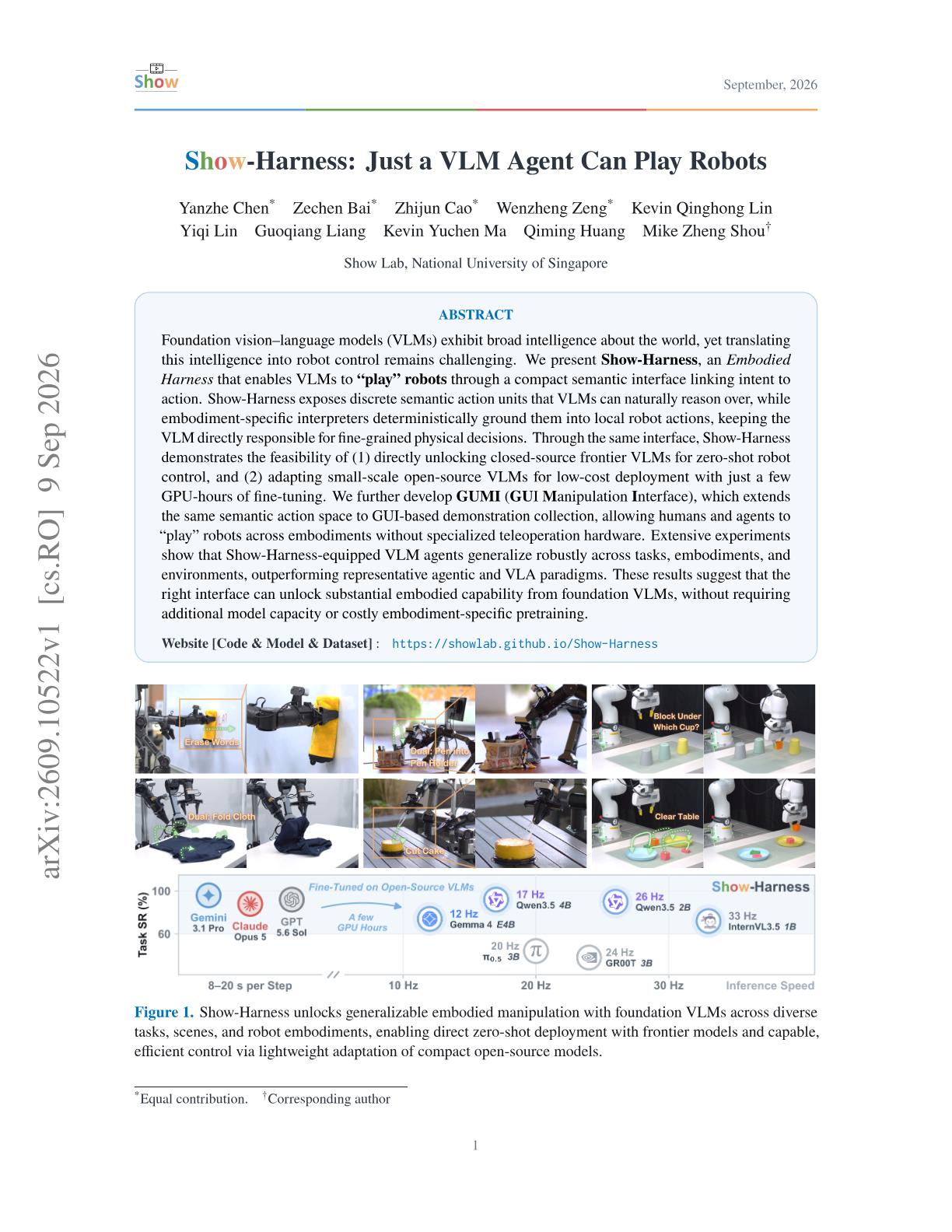
Yanzhe Chen, Zechen Bai, Kevin Qinghong Lin and Mike Zheng Shou (Show Lab, NUS) present Show-Harness, a semantic action interface that lets a VLM control a robot directly, with embodiment-specific interpreters grounding each discrete action unit deterministically.
Ask this paper
Where the harness draws the line: The VLM reasons over discrete semantic action units and stays responsible for fine-grained physical decisions. Embodiment-specific interpreters only ground those units into local robot actions deterministically, so the interface does not absorb the policy.
Two deployment paths through one interface: Closed-source frontier VLMs get zero-shot robot control with no training, and small open-source VLMs are adapted for low-cost deployment with a few GPU-hours of fine-tuning.
GUI-based demonstration collection: GUMI extends the same semantic action space to a GUI, so humans and agents can collect demonstrations across embodiments without specialized teleoperation hardware.
Result: Show-Harness-equipped VLM agents generalize across tasks, embodiments and environments, outperforming representative agentic and VLA baselines.
The claim: Substantial embodied capability is reachable through interface design, without added model capacity or embodiment-specific pretraining.
Abstract
Foundation vision-language models (VLMs) exhibit broad intelligence about the world, yet translating this intelligence into robot control remains challenging. We present Show-Harness, an Embodied Harness that enables VLMs to "play" robots through a compact semantic interface linking intent to action. Show-Harness exposes discrete semantic action units that VLMs can naturally reason over, while embodiment-specific interpreters deterministically ground them into local robot actions, keeping the VLM directly responsible for fine-grained physical decisions. Through the same interface, Show-Harness demonstrates the feasibility of (1) directly unlocking closed-source frontier VLMs for zero-shot robot control, and (2) adapting small-scale open-source VLMs for low-cost deployment with just a few GPU-hours of fine-tuning. We further develop GUMI (GUI Manipulation Interface), which extends the same semantic action space to GUI-based demonstration collection, allowing humans and agents to "play" robots across embodiments without specialized teleoperation hardware. Extensive experiments show that Show-Harness-equipped VLM agents generalize robustly across tasks, embodiments, and environments, outperforming representative agentic and VLA paradigms. These results suggest that the right interface can unlock substantial embodied capability from foundation VLMs, without requiring additional model capacity or costly embodiment-specific pretraining.