SkillGLoW: Procedural-Family Skill Consolidation for Self-Improving Agents on Long-Horizon Task Streams
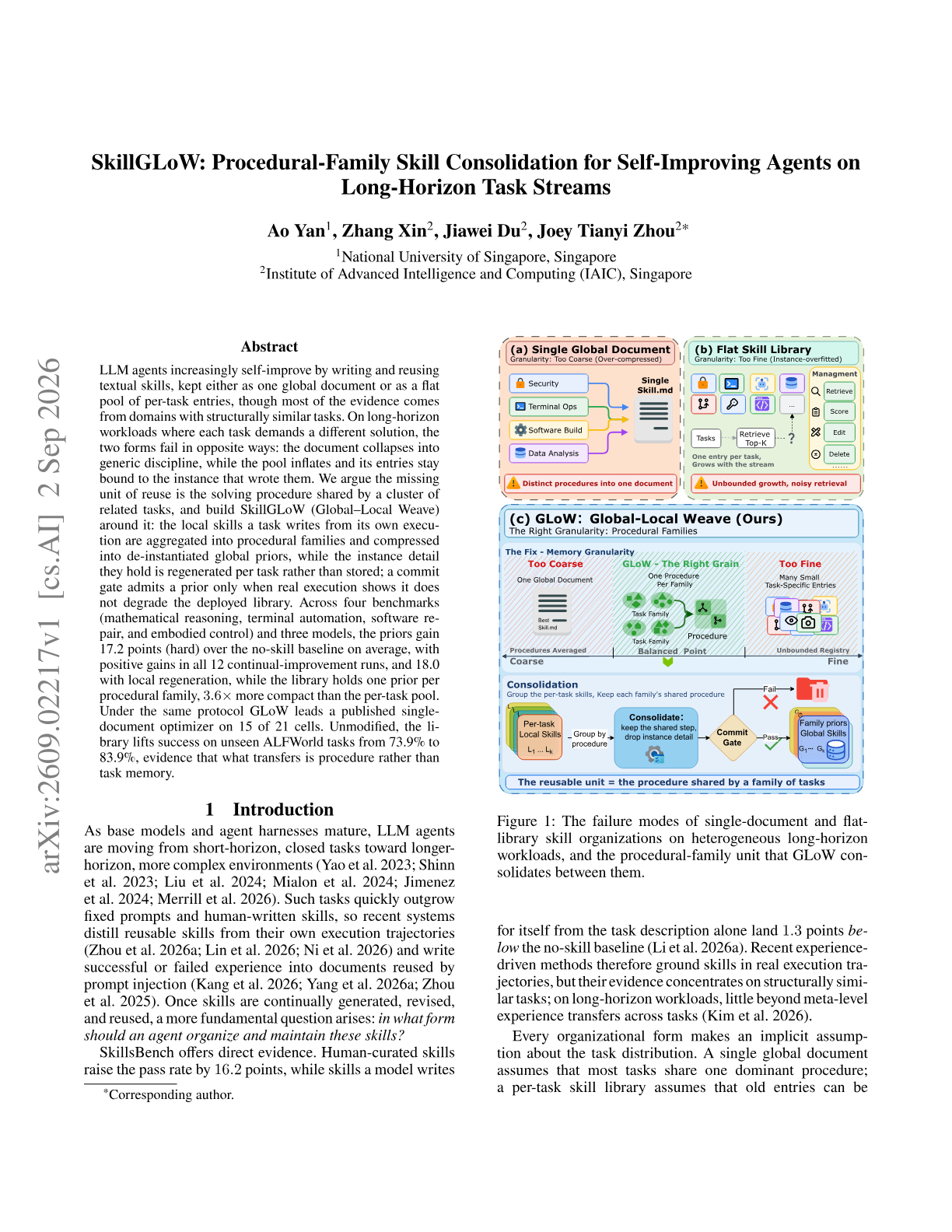
Ao Yan, Xin Zhang, Jiawei Du and Joey Tianyi Zhou (A*STAR) introduce SkillGLoW, arguing that the right unit of reuse for a self-improving agent is neither one global playbook nor a flat per-task pool but the solving procedure shared by a family of related tasks.
Ask this paper
Both existing skill formats fail, in opposite directions: On long-horizon streams where every task needs a different solution, the single document collapses into generic discipline while the per-task pool inflates and its entries stay welded to the instance that wrote them.
Procedural families as the unit: Local skills written from execution are clustered into families and compressed into de-instantiated global priors; the instance detail is regenerated per task instead of stored, which is what keeps the library from growing.
A commit gate on the library: A prior is admitted only when real execution shows it does not degrade the deployed library, so the library cannot silently rot.
Consistent gains across four domains: Math reasoning, terminal automation, software repair and embodied control across three models: 17.2 points on hard tasks over no-skill, positive in all 12 continual-improvement runs, 18.0 with local regeneration, 3.6x more compact than the per-task pool, and unseen ALFWorld success from 73.9 to 83.9 percent.
Why it matters: Positive gains in 12 of 12 continual runs is the number to note. Most skill-accumulation systems degrade somewhere; a commit gate is apparently what buys monotonicity.
Abstract
LLM agents increasingly self-improve by writing and reusing textual skills, kept either as one global document or as a flat pool of per-task entries, though most of the evidence comes from domains with structurally similar tasks. On long-horizon workloads where each task demands a different solution, the two forms fail in opposite ways: the document collapses into generic discipline, while the pool inflates and its entries stay bound to the instance that wrote them. We argue the missing unit of reuse is the solving procedure shared by a cluster of related tasks, and build SkillGLoW (Global-Local Weave) around it: the local skills a task writes from its own execution are aggregated into procedural families and compressed into de-instantiated global priors, while the instance detail they hold is regenerated per task rather than stored; a commit gate admits a prior only when real execution shows it does not degrade the deployed library. Across four benchmarks (mathematical reasoning, terminal automation, software repair, and embodied control) and three models, the priors gain 17.2 points (hard) over the no-skill baseline on average, with positive gains in all 12 continual-improvement runs, and 18.0 with local regeneration, while the library holds one prior per procedural family, 3.6x more compact than the per-task pool. Under the same protocol GLoW leads a published single-document optimizer on 15 of 21 cells. Unmodified, the library lifts success on unseen ALFWorld tasks from 73.9% to 83.9%, evidence that what transfers is procedure rather than task memory.