SplatLab: Autonomous Scientific Discovery for 3DGS Research
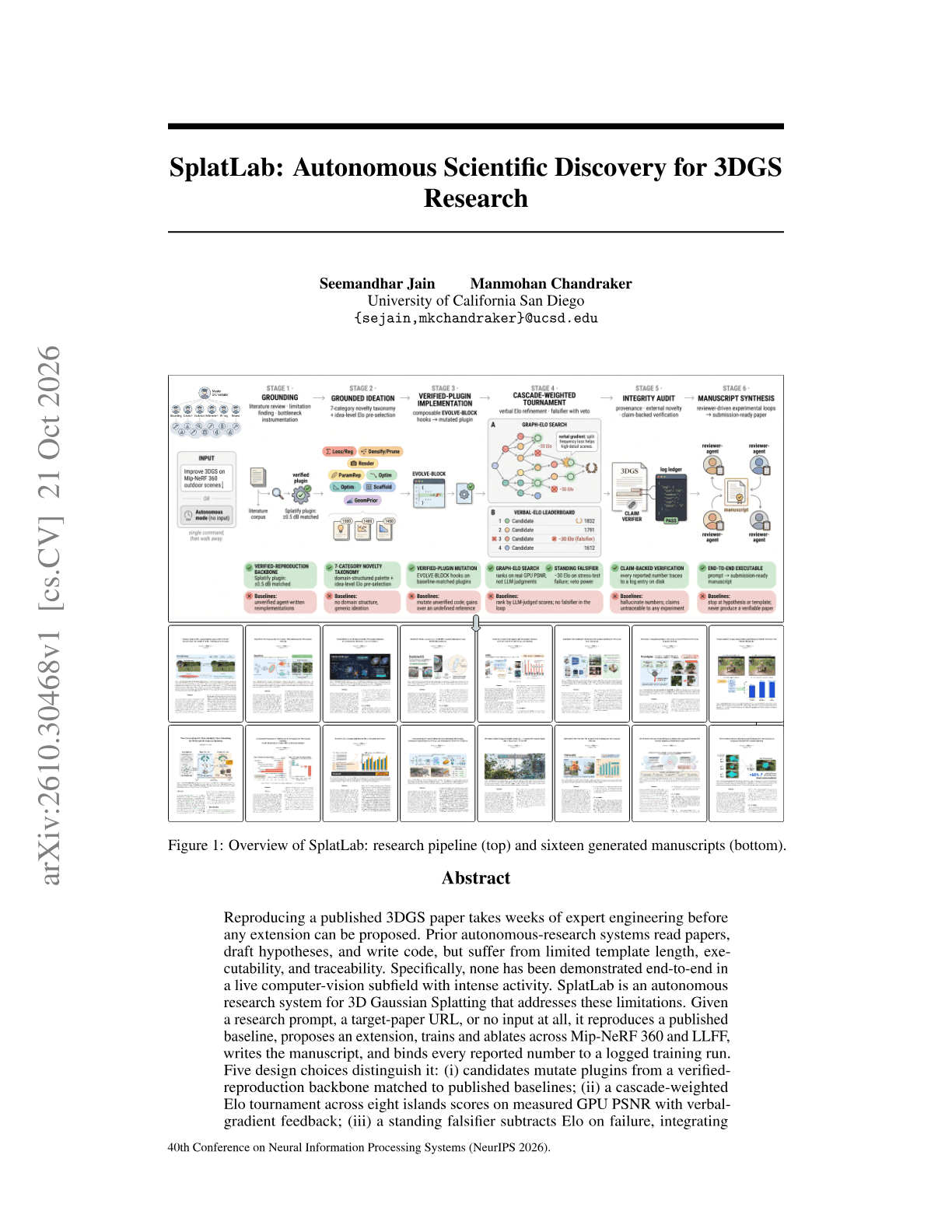
Seemandhar Jain and Manmohan Chandraker (UC San Diego) present SplatLab, an autonomous research system for 3D Gaussian Splatting that reproduces a baseline, proposes and tests an extension, and writes the manuscript with every number tied to a logged run. Accepted at NeurIPS 2026.
Ask this paper
Search. Candidates mutate plugins on a verified-reproduction backbone, compete in a cascade-weighted Elo tournament across eight islands scored on measured PSNR, and receive verbal-gradient feedback.
Integrity rules. A standing falsifier subtracts Elo when a stress test fails, and a run cannot terminate while any reported claim lacks a logged training run behind it.
Result. On PSNR-targeted runs, SplatLab's manuscripts beat their reproduced targets by +0.18 to +3.78 dB, including +3.78 dB on astrophotographic nebula rendering, where no prior 3DGS method existed.
Speed. The cycle drops from months of graduate-student time to days of mostly autonomous compute; code, manuscripts and experiment ledgers are public.
Abstract
Reproducing a published 3DGS paper takes weeks of expert engineering before any extension can be proposed. Prior autonomous-research systems read papers, draft hypotheses, and write code, but are limited by short fixed templates, low executability, and weak traceability, and none has been demonstrated end-to-end in a live computer-vision subfield with intense activity. SplatLab is an autonomous research system for 3D Gaussian Splatting that addresses these limitations. Given a research prompt, a target-paper URL, or no input at all, it reproduces a published baseline, proposes an extension, trains and ablates across Mip-NeRF 360 and LLFF, writes the manuscript, and binds every reported number to a logged training run. Five design choices distinguish it: (i) candidates mutate plugins from a verified-reproduction backbone matched to published baselines; (ii) a cascade-weighted Elo tournament across eight islands scores candidates on measured GPU PSNR with verbal-gradient feedback; (iii) a standing falsifier subtracts Elo on failure, integrating stress-test survival into selection; (iv) every reported number is bound to a logged training run, and the run cannot terminate while any claim is unbacked; (v) a seven-category 3DGS taxonomy wraps EVOLVE-BLOCK markers in domain-aligned scaffolds transferable across 3DGS repositories. On PSNR-targeted runs, SplatLab's manuscripts beat their reproduced targets by +0.18 to +3.78 dB, including +3.78 dB on astrophotographic nebula rendering, for which no prior 3DGS method exists. The research cycle compresses from months of graduate-student time to days of mostly autonomous compute. Code, all manuscripts, experiment ledgers, and the cross-run paper store are available on the project page.