Stable and Low-Precision Training for Large-Scale Vision-Language Models
Methods for accelerating and stabilizing large VLM training.
Ask this paper
Mixed-precision techniques: Introduces stable training strategies for bfloat16/float16 mixed precision of large VLMs.
Training speedup: Significantly accelerates VLM training while avoiding common instabilities (loss spikes, NaN).
Scale-friendly: Scales to the largest open-source VLMs, enabling more research at serious scale.
Infrastructure contribution: Practical infrastructure advances that benefited the entire VLM research community.
Abstract
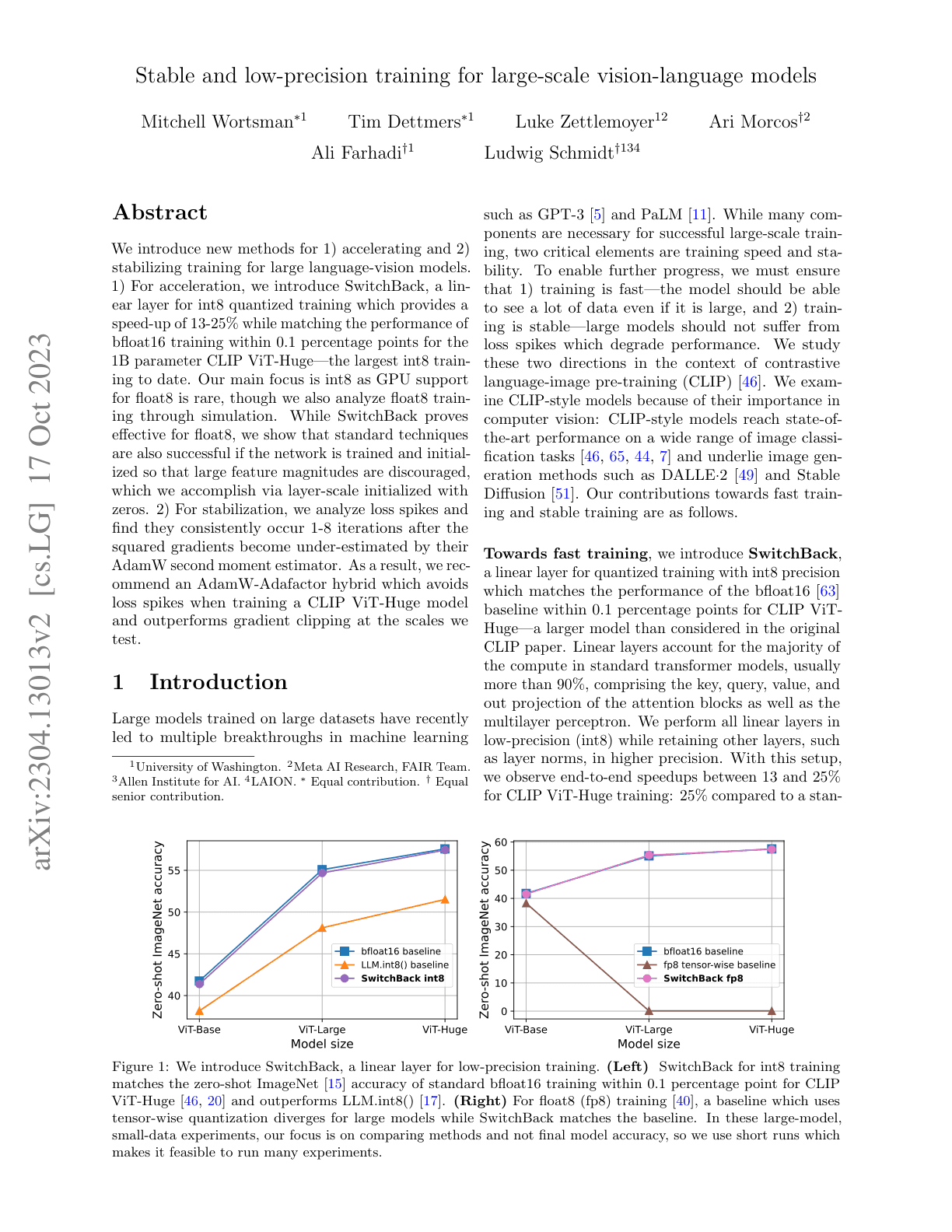
We introduce new methods for 1) accelerating and 2) stabilizing training for large language-vision models. 1) For acceleration, we introduce SwitchBack, a linear layer for int8 quantized training which provides a speed-up of 13-25% while matching the performance of bfloat16 training within 0.1 percentage points for the 1B parameter CLIP ViT-Huge -- the largest int8 training to date. Our main focus is int8 as GPU support for float8 is rare, though we also analyze float8 training through simulation. While SwitchBack proves effective for float8, we show that standard techniques are also successful if the network is trained and initialized so that large feature magnitudes are discouraged, which we accomplish via layer-scale initialized with zeros. 2) For stability, we analyze loss spikes and find they consistently occur 1-8 iterations after the squared gradients become under-estimated by their AdamW second moment estimator. As a result, we recommend an AdamW-Adafactor hybrid which avoids loss spikes when training a CLIP ViT-Huge model and outperforms gradient clipping at the scales we test.