Step Back to Leap Forward
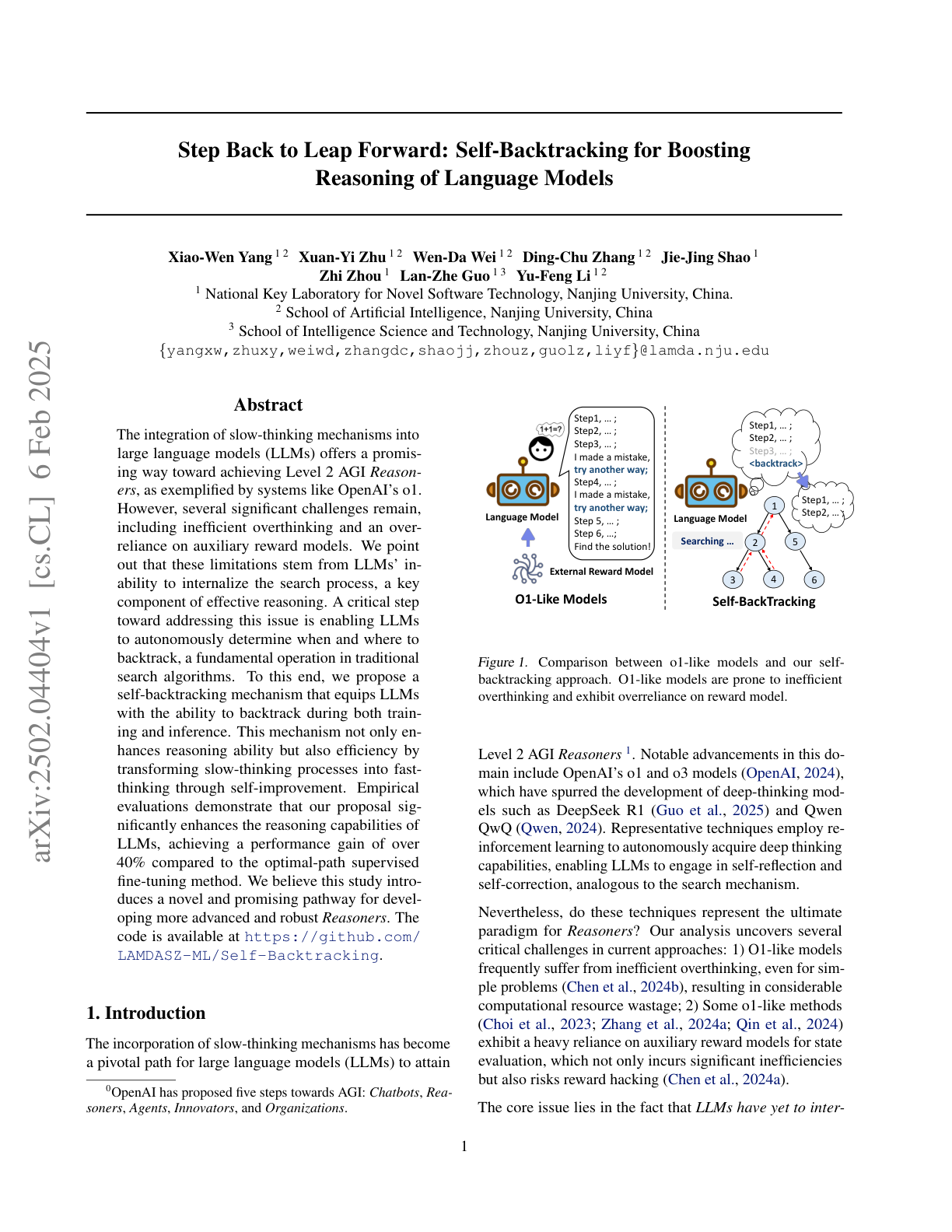
To boost the reasoning robustness of LLMs, researchers propose a “self-backtracking” mechanism that lets models revisit and revise their own intermediate reasoning steps. Key details:
Ask this paper
Inspiration from search algorithms: Traditional problem-solving backtracks when a path hits a dead-end. This approach gives LLMs a similar ability – during reasoning, the model can identify when its current CoT is likely wrong and backtrack to a previous step to try a different approach.
Implementation: The team trained an LLM with signals to decide when to backtrack during both training and inference. This helps the model internalize an iterative search process, rather than strictly following a single chain-of-thought that might be flawed.
Huge reasoning gains: Empirically, adding self-backtracking led to 40%+ improvement on complex reasoning benchmarks compared to standard fine-tuning. The model learns to correct its own mistakes mid-stream, resulting in more reliable and accurate solutions.
Towards resilient reasoners: By reducing “overthinking” loops and reliance on external feedback, this technique makes LLMs more autonomous and robust in reasoning. It points to a future where LLMs can more rigorously self-evaluate and refine their reasoning, much like humans reflecting on and correcting their thought process.