TableRAG
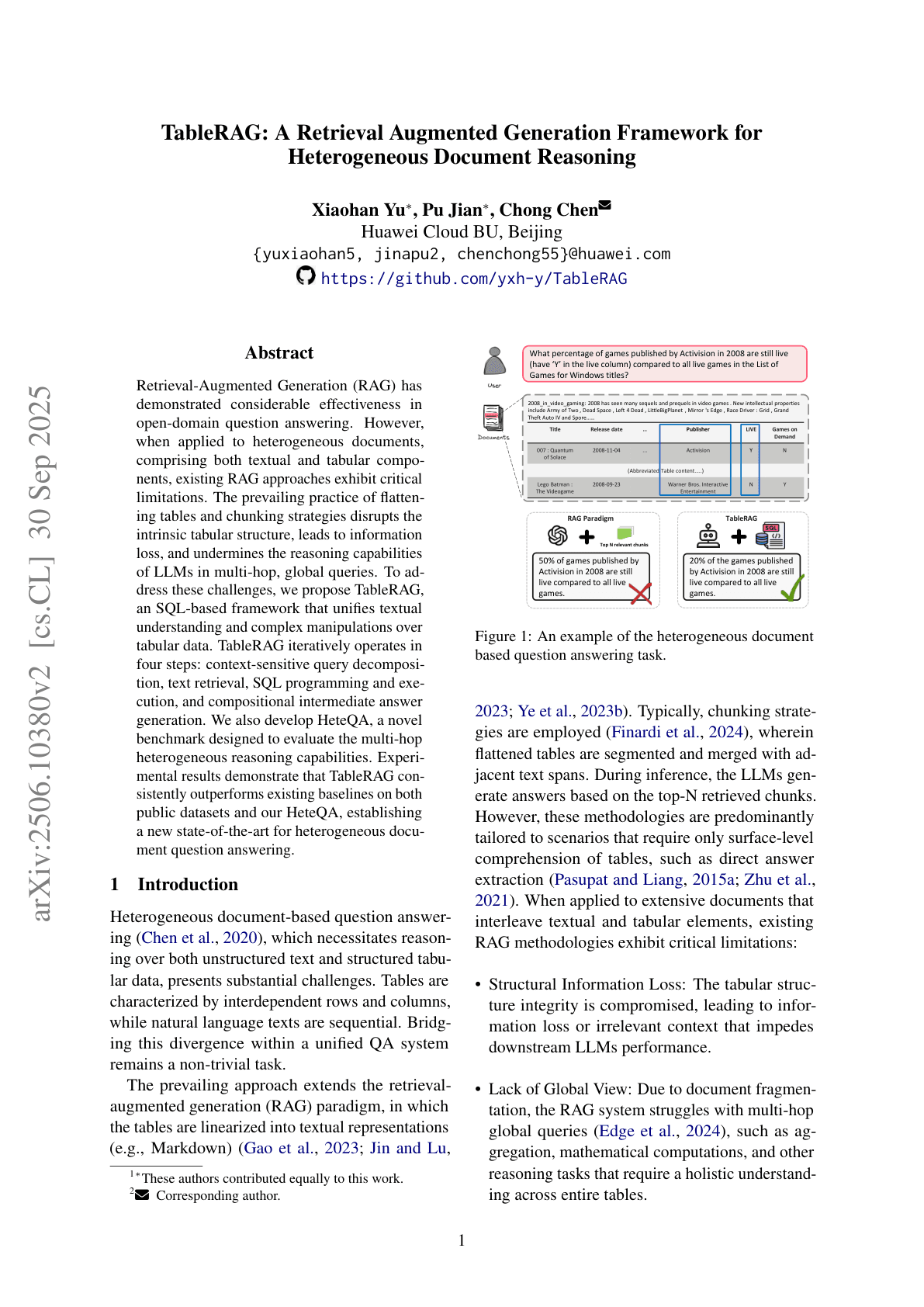
TableRAG tackles a core limitation of existing RAG approaches: their inability to reason effectively over heterogeneous documents that combine both unstructured text and structured tables. Typical RAG pipelines flatten tables and intermix them with surrounding text, losing essential structural information and hampering multi-hop reasoning. TableRAG overcomes this by introducing a hybrid system that integrates SQL-based symbolic execution with text retrieval in a unified, iterative reasoning framework.
Ask this paper
TableRAG operates in four iterative stages: (1) context-sensitive query decomposition, (2) text retrieval, (3) SQL programming and execution, and (4) intermediate answer generation. This design allows it to preserve tabular structure and leverage both symbolic and neural reasoning paths.
A new benchmark, HeteQA, was developed to evaluate heterogeneous reasoning across 304 multi-hop QA examples covering nine domains and five types of tabular operations (e.g., aggregation, filtering, grouping).
Experiments on HeteQA and existing benchmarks (HybridQA, WikiTableQuestions) show that TableRAG consistently outperforms prior methods like NaiveRAG, ReAct, and TableGPT2, achieving >10% gains in accuracy over the strongest baseline.
Ablations reveal that all major components of TableRAG contribute significantly. Notably, SQL execution is critical for nested reasoning tasks, while textual retrieval is crucial for entity and numeric references.
TableRAG achieves greater reasoning efficiency, solving over 90% of HeteQA tasks in five or fewer steps and exhibiting the lowest failure rate among evaluated methods. Its robustness holds across multiple LLM backbones (Claude, DeepSeek, Qwen).
Abstract
Retrieval-Augmented Generation (RAG) has demonstrated considerable effectiveness in open-domain question answering. However, when applied to heterogeneous documents, comprising both textual and tabular components, existing RAG approaches exhibit critical limitations. The prevailing practice of flattening tables and chunking strategies disrupts the intrinsic tabular structure, leads to information loss, and undermines the reasoning capabilities of LLMs in multi-hop, global queries. To address these challenges, we propose TableRAG, an SQL-based framework that unifies textual understanding and complex manipulations over tabular data. TableRAG iteratively operates in four steps: context-sensitive query decomposition, text retrieval, SQL programming and execution, and compositional intermediate answer generation. We also develop HeteQA, a novel benchmark designed to evaluate the multi-hop heterogeneous reasoning capabilities. Experimental results demonstrate that TableRAG consistently outperforms existing baselines on both public datasets and our HeteQA, establishing a new state-of-the-art for heterogeneous document question answering. We release TableRAG at https://github.com/yxh-y/TableRAG/tree/main.