The Danger of Overthinking
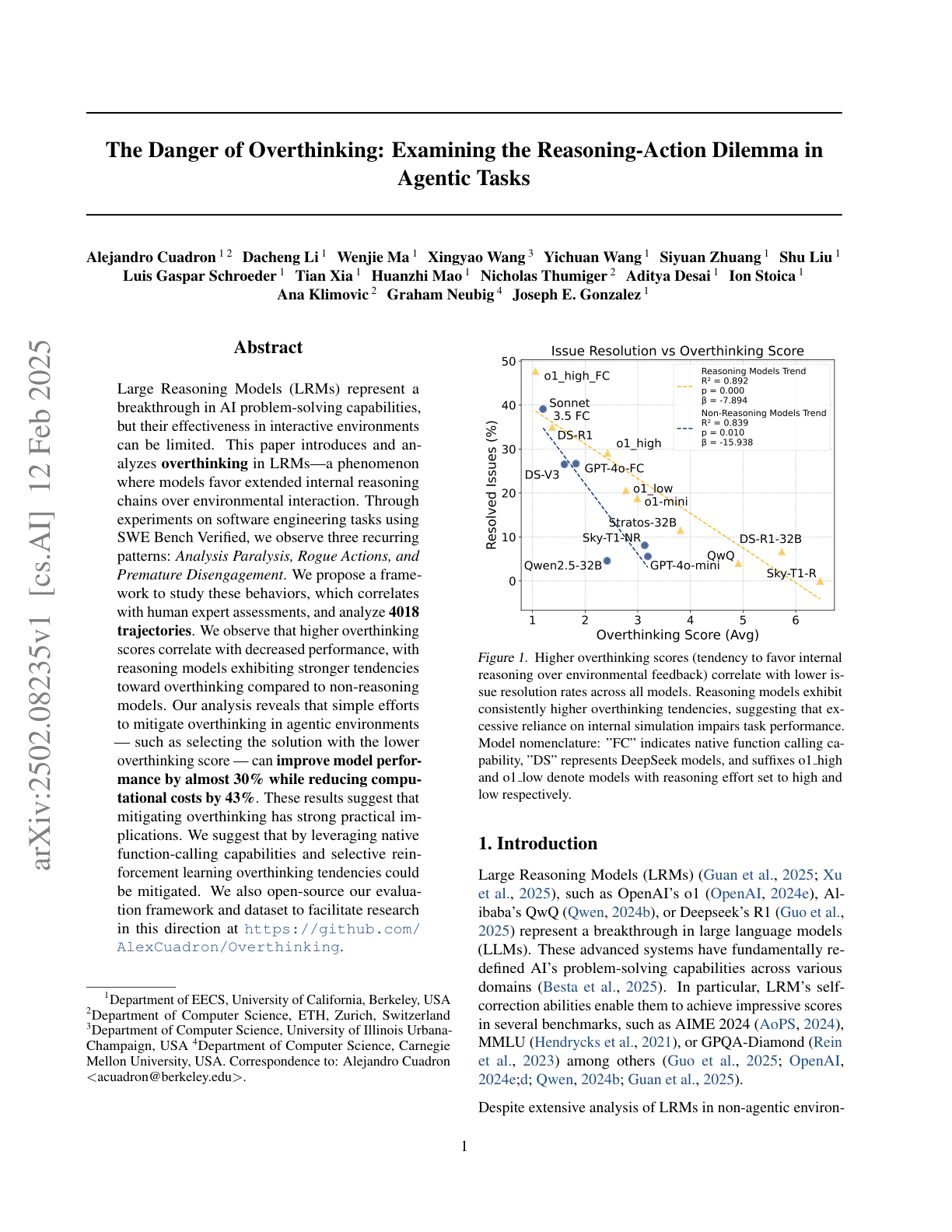
This paper investigates overthinking in Large Reasoning Models (LRMs)—a phenomenon where models prioritize extended internal reasoning over interacting with their environment. Their study analyzes 4,018 software engineering task trajectories to understand how reasoning models handle decision-making in agentic settings. Key findings:
Ask this paper
Overthinking reduces task performance – Higher overthinking scores (favoring internal reasoning over real-world feedback) correlate with lower issue resolution rates, especially in reasoning-optimized models. Simple interventions, like selecting solutions with the lowest overthinking scores, improve performance by 30% while reducing compute costs by 43%.
Three failure patterns identified – The study categorizes overthinking into:
Reasoning models are more prone to overthinking – Compared to non-reasoning models, LRMs exhibit 3× higher overthinking scores on average, despite their superior reasoning capabilities.
Function calling mitigates overthinking – Models with native function-calling support show significantly lower overthinking scores, suggesting structured execution pathways improve efficiency in agentic environments.
Scaling and mitigation strategies – The researchers propose reinforcement learning adjustments and function-calling optimizations to curb overthinking while maintaining strong reasoning capabilities.