The Era of Agentic Organization
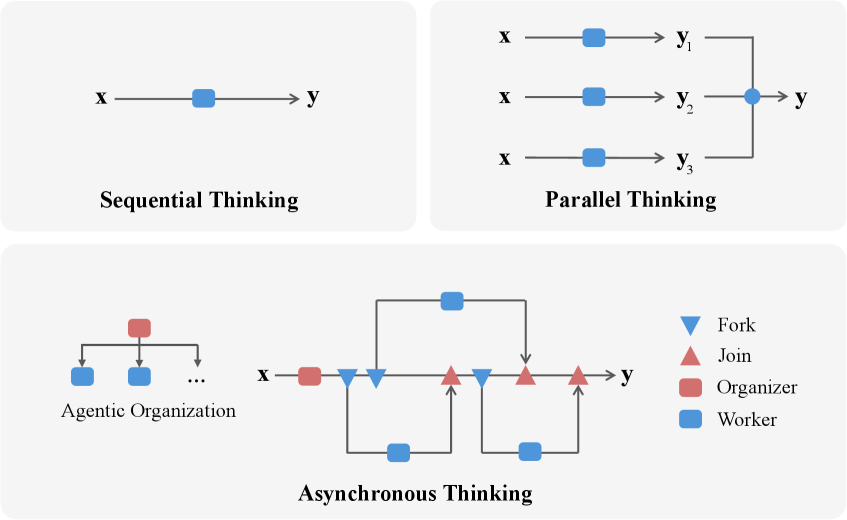
Microsoft Research introduces asynchronous thinking (AsyncThink), a new reasoning paradigm where language models learn to organize their internal thinking into concurrently executable structures through an organizer-worker protocol, achieving 28% lower inference latency than parallel thinking while improving accuracy on mathematical reasoning and demonstrating zero-shot generalization to unseen tasks. - Organizer-worker thinking protocol: Proposes a novel protocol where an LLM plays dual roles - an organizer that dynamically structures reasoning through Fork and Join actions, and workers that execute sub-queries concurrently. Workers execute independently and return results which the organizer integrates to produce coherent solutions. - Learning to organize through two-stage training: First performs cold-start format fine-tuning on GPT-4o-synthesized data teaching Fork-Join syntax. Then applies group relative policy optimization with three reward types: accuracy, format compliance, and thinking concurrency. - Superior accuracy-latency frontier: On AMC-23 achieves 73.3% accuracy with 1459.5 critical-path latency versus parallel thinking's 72.8% at 2031.4 latency (28% reduction). On multi-solution countdown reaches 89.0% accuracy, substantially outperforming parallel thinking (68.6%) and sequential thinking (70.5%). - Remarkable zero-shot generalization: AsyncThink trained solely on countdown data generalizes to unseen domains including 4 by 4 Sudoku (89.4% accuracy), MMLU-Pro graph theory, and genetics problems. Case studies reveal emergent patterns like concurrent exploration and iterative Fork-Join cycles.
Ask this paper
Organizer-worker thinking protocol: Proposes a novel protocol where an LLM plays dual roles - an organizer that dynamically structures reasoning through Fork and Join actions, and workers that execute sub-queries concurrently. Workers execute independently and return results that the organizer integrates to produce coherent solutions.
Learning to organize through two-stage training: First performs cold-start format fine-tuning on GPT-4o-synthesized data, teaching Fork-Join syntax. Then, it applies group relative policy optimization with three reward types: accuracy, format compliance, and thinking concurrency.
Superior accuracy-latency frontier: On AMC-23, achieves 73.3% accuracy with 1459.5 critical-path latency versus parallel thinking’s 72.8% at 2031.4 latency (28% reduction). On multi-solution, the countdown reaches 89.0% accuracy, substantially outperforming parallel thinking (68.6%) and sequential thinking (70.5%).
Remarkable zero-shot generalization: AsyncThink trained solely on countdown data generalizes to unseen domains, including 4 by 4 Sudoku (89.4% accuracy), MMLU-Pro graph theory, and genetics problems. Case studies reveal emergent patterns like concurrent exploration and iterative Fork-Join cycles.
Abstract
We envision a new era of AI, termed agentic organization, where agents solve complex problems by working collaboratively and concurrently, enabling outcomes beyond individual intelligence. To realize this vision, we introduce asynchronous thinking (AsyncThink) as a new paradigm of reasoning with large language models, which organizes the internal thinking process into concurrently executable structures. Specifically, we propose a thinking protocol where an organizer dynamically assigns sub-queries to workers, merges intermediate knowledge, and produces coherent solutions. More importantly, the thinking structure in this protocol can be further optimized through reinforcement learning. Experiments demonstrate that AsyncThink achieves 28% lower inference latency compared to parallel thinking while improving accuracy on mathematical reasoning. Moreover, AsyncThink generalizes its learned asynchronous thinking capabilities, effectively tackling unseen tasks without additional training.