The Natural Language Interaction Protocol and Standard for AI Agents
Luyi Xing and a cross-industry group present NLIP, an application-layer protocol for AI-agent interaction standardized by Ecma International, aimed at the interoperability gap that MCP and A2A only partly cover.
Ask this paper
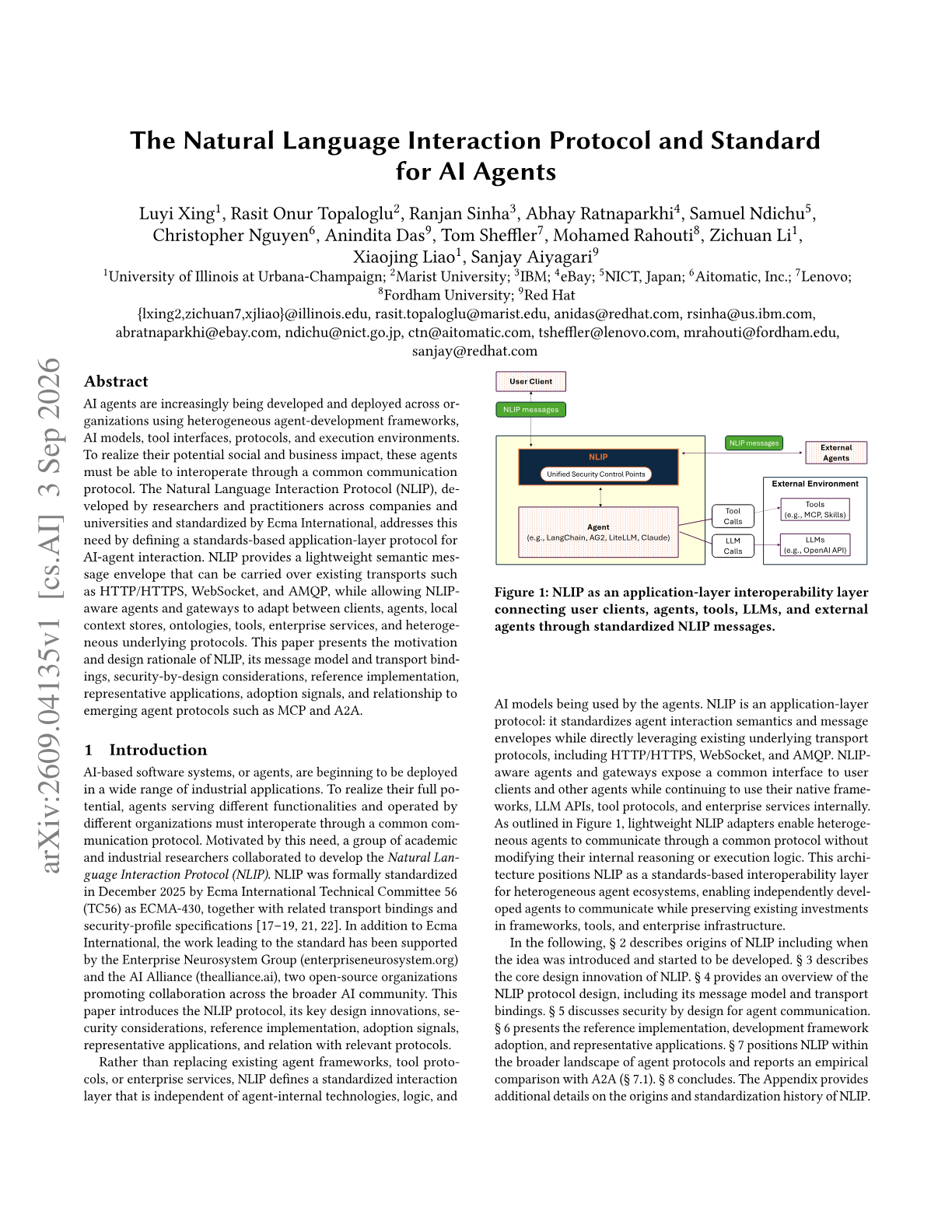
A lightweight semantic message envelope carried over existing transports including HTTP/HTTPS, WebSocket and AMQP, so it rides infrastructure organizations already run.
Gateways do the adapting: NLIP-aware agents and gateways translate between clients, agents, local context stores, ontologies, tools, enterprise services and heterogeneous underlying protocols.
Standardized, not proposed: Ecma International standardization is the differentiator against the pile of agent-protocol preprints, and the paper reports adoption signals and a reference implementation.
Security by design is part of the spec rather than a deployment note, which matters for a protocol whose whole job is crossing organizational boundaries.
Positioned explicitly against MCP and A2A: the paper's relationship section is the most useful part for anyone deciding what to build on.
Abstract
AI agents are increasingly being developed and deployed across organizations using heterogeneous agent-development frameworks, AI models, tool interfaces, protocols, and execution environments. To realize their potential social and business impact, these agents must be able to interoperate through a common communication protocol. The Natural Language Interaction Protocol (NLIP), developed by researchers and practitioners across companies and universities and standardized by Ecma International, addresses this need by defining a standards-based application-layer protocol for AI-agent interaction. NLIP provides a lightweight semantic message envelope that can be carried over existing transports such as HTTP/HTTPS, WebSocket, and AMQP, while allowing NLIP-aware agents and gateways to adapt between clients, agents, local context stores, ontologies, tools, enterprise services, and heterogeneous underlying protocols. This paper presents the motivation and design rationale of NLIP, its message model and transport bindings, security-by-design considerations, reference implementation, representative applications, adoption signals, and relationship to emerging agent protocols such as MCP and A2A.