The Self-Speculating Agent
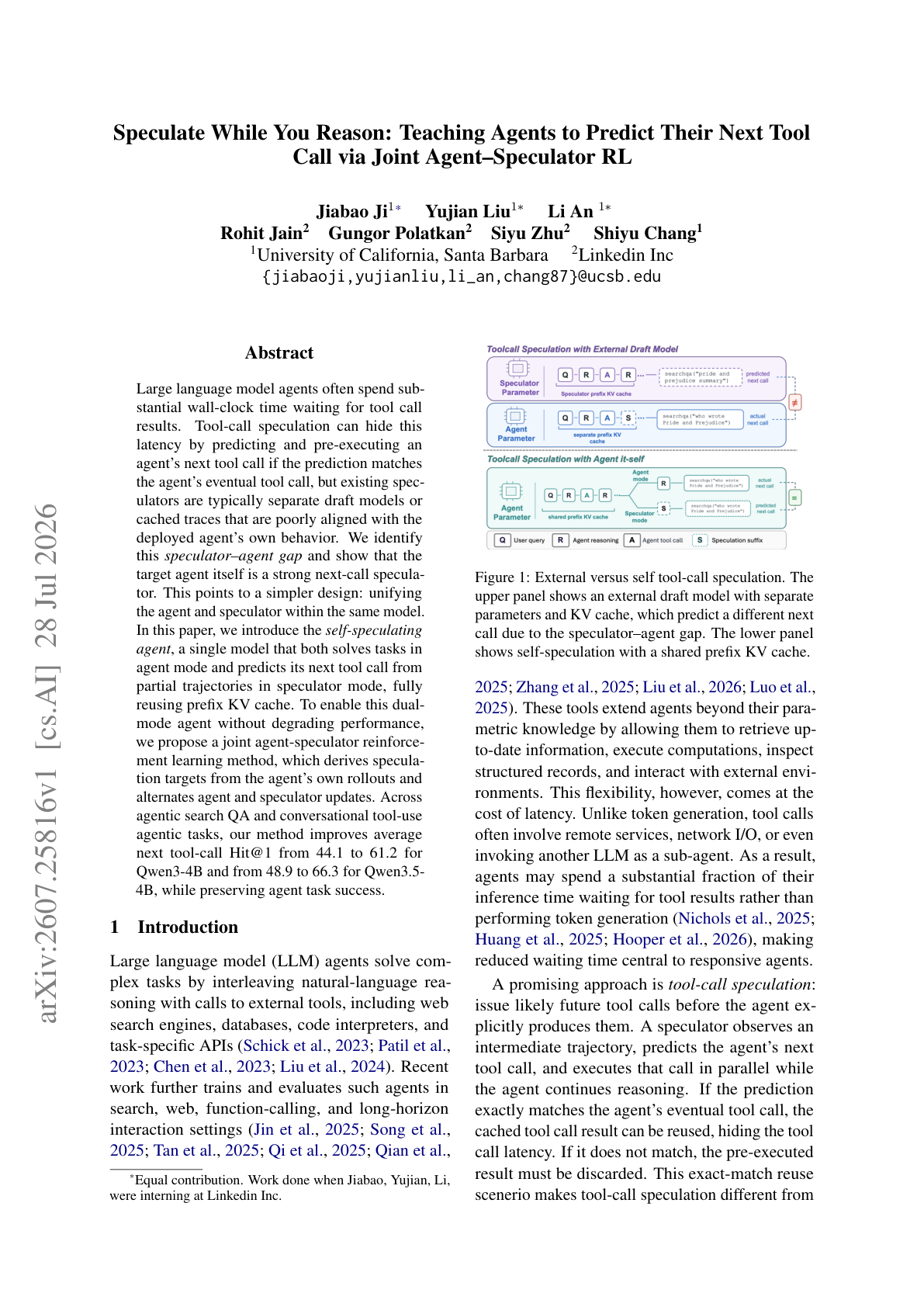
Agents spend a large share of wall-clock time waiting on tool results. Speculation hides that latency by predicting and pre-executing the next call, but external draft models and cached traces model a different policy, so they miss too often to help. UC Santa Barbara and LinkedIn identify this speculator-agent gap and unify both roles in one model. It runs in agent mode to solve the task and in speculator mode to predict its next tool call from a partial trajectory, fully reusing the prefix KV cache. Joint agent-speculator reinforcement learning derives speculation targets from the agent's own rollouts and alternates updates between the two modes. Next tool-call Hit@1 rises from 44.1 to 61.2 for Qwen3-4B and from 48.9 to 66.3 for Qwen3.5-4B, with agent task success preserved.