The Surprising Effectiveness of Test-Time Training for Abstract Reasoning
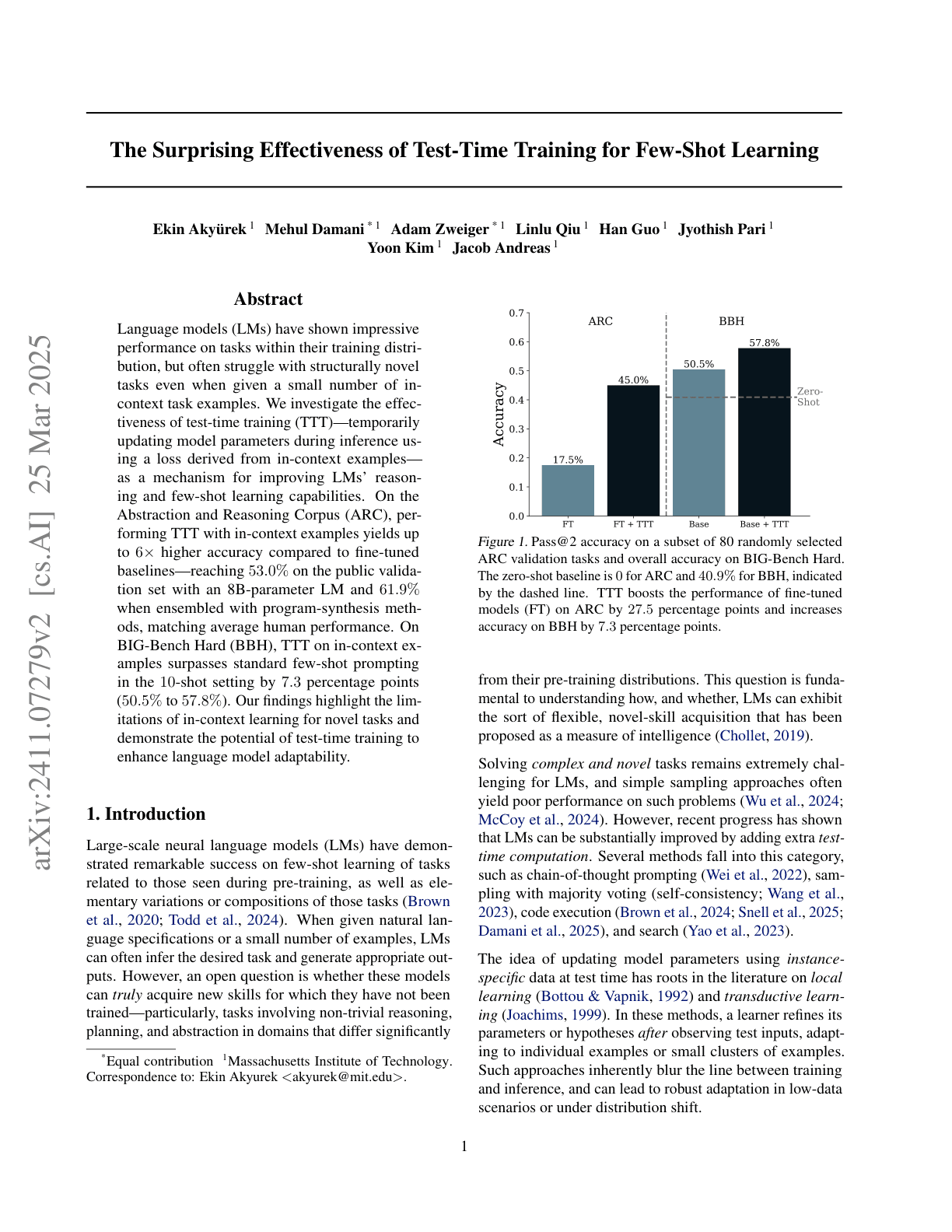
explores test-time training (TTT) - updating model parameters temporarily during inference - for improving an LLM's abstract reasoning capabilities using the ARC benchmark; identifies three crucial components: initial fine-tuning on similar tasks, auxiliary task format and augmentations, and per-instance training; TTT significantly improves performance, achieving up to 6x improvement in accuracy compared to base fine-tuned models; when applying TTT to an 8B LLM, they achieve 53% accuracy on ARC's public validation set, improving the state-of-the-art for neural approaches by nearly 25%; by ensembling their method with program generation approaches, they achieve state-of-the-art public validation accuracy of 61.9%, matching average human performance; the findings suggest that explicit symbolic search is not the only path to improved abstract reasoning in LLMs; test-time training applied to continued training on few-shot examples can be highly effective.
Ask this paper
Abstract
Language models (LMs) have shown impressive performance on tasks within their training distri- bution, but often struggle with structurally novel tasks even when given a small number of in- context task examples. We investigate the effec- tiveness of test-time training (TTT)—temporarily updating model parameters during inference us- ing a loss derived from in-context examples— as a mechanism for improving LMs’ reason- ing and few-shot learning capabilities. On the Abstraction and Reasoning Corpus (ARC), per- forming TTT with in-context examples yields up to 6× higher accuracy compared to fine-tuned baselines—reaching 53.0% on the public valida- tion set with an 8B-parameter LM and 61.9% when ensembled with program-synthesis meth- ods, matching average human performance. On BIG-Bench Hard (BBH), TTT on in-context ex- amples surpasses standard few-shot prompting in the 10-shot setting by 7.3 percentage points (50.5% to 57.8%). Our findings highlight the lim- itations of in-context learning for novel tasks and demonstrate the potential of test-time training to enhance language model adaptability.