Token Superposition Training
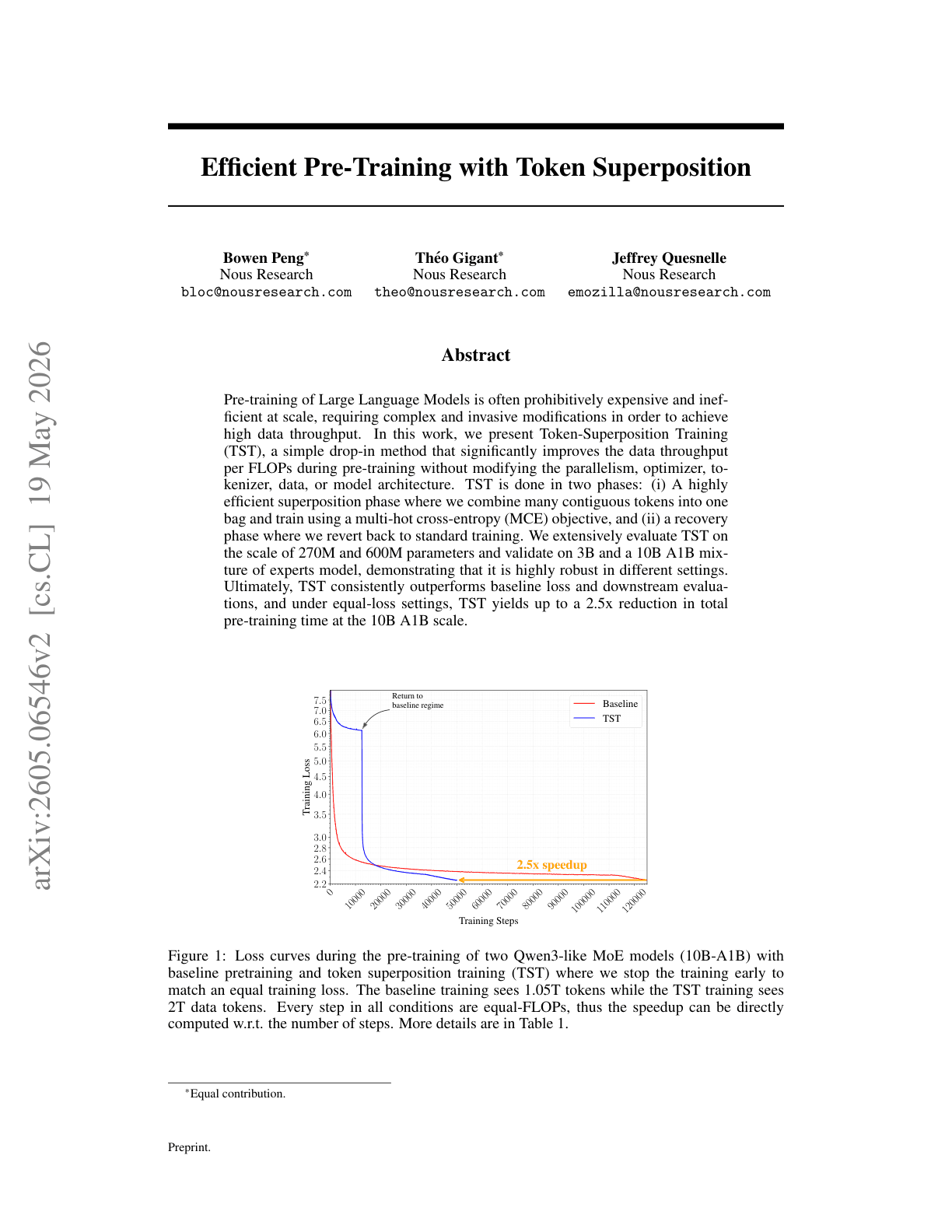
Nous Research's second pretraining paper of the week. Token Superposition Training (TST) is a modification to the standard LLM pretraining loop that produces a 2 to 3x wall-clock speedup at matched FLOPs without changing the model architecture, optimizer, tokenizer, or training data. During the first third of training, the model reads and predicts contiguous bags of tokens, averaging their embeddings on the input side and predicting the next bag with a modified cross-entropy on the output side. For the remainder of the run, training reverts to standard next-token prediction. The inference-time model is identical to one produced by conventional pretraining. TST was validated at 270M, 600M, and 3B dense scales, and at a 10B-A1B mixture-of-experts model where it reaches a lower final loss while consuming 4,768 B200-GPU-hours versus the baseline's 12,311. Together with Lighthouse Attention, this is the second pretraining-loop modification from the same lab this week reporting substantial speedups without architecture changes.
Ask this paper
Abstract
Pre-training of Large Language Models is often prohibitively expensive and inefficient at scale, requiring complex and invasive modifications in order to achieve high data throughput. In this work, we present Token-Superposition Training (TST), a simple drop-in method that significantly improves the data throughput per FLOPs during pre-training without modifying the parallelism, optimizer, tokenizer, data, or model architecture. TST is done in two phases: (i) A highly efficient superposition phase where we combine many contiguous tokens into one bag and train using a multi-hot cross-entropy (MCE) objective, and (ii) a recovery phase where we revert back to standard training. We extensively evaluate TST on the scale of 270M and 600M parameters and validate on 3B and a 10B A1B mixture of experts model, demonstrating that it is highly robust in different settings. Ultimately, TST consistently outperforms baseline loss and downstream evaluations, and under equal-loss settings, TST yields up to a 2.5x reduction in total pre-training time at the 10B A1B scale.