Tool-Augmented Unified Retrieval Agent for AI Search
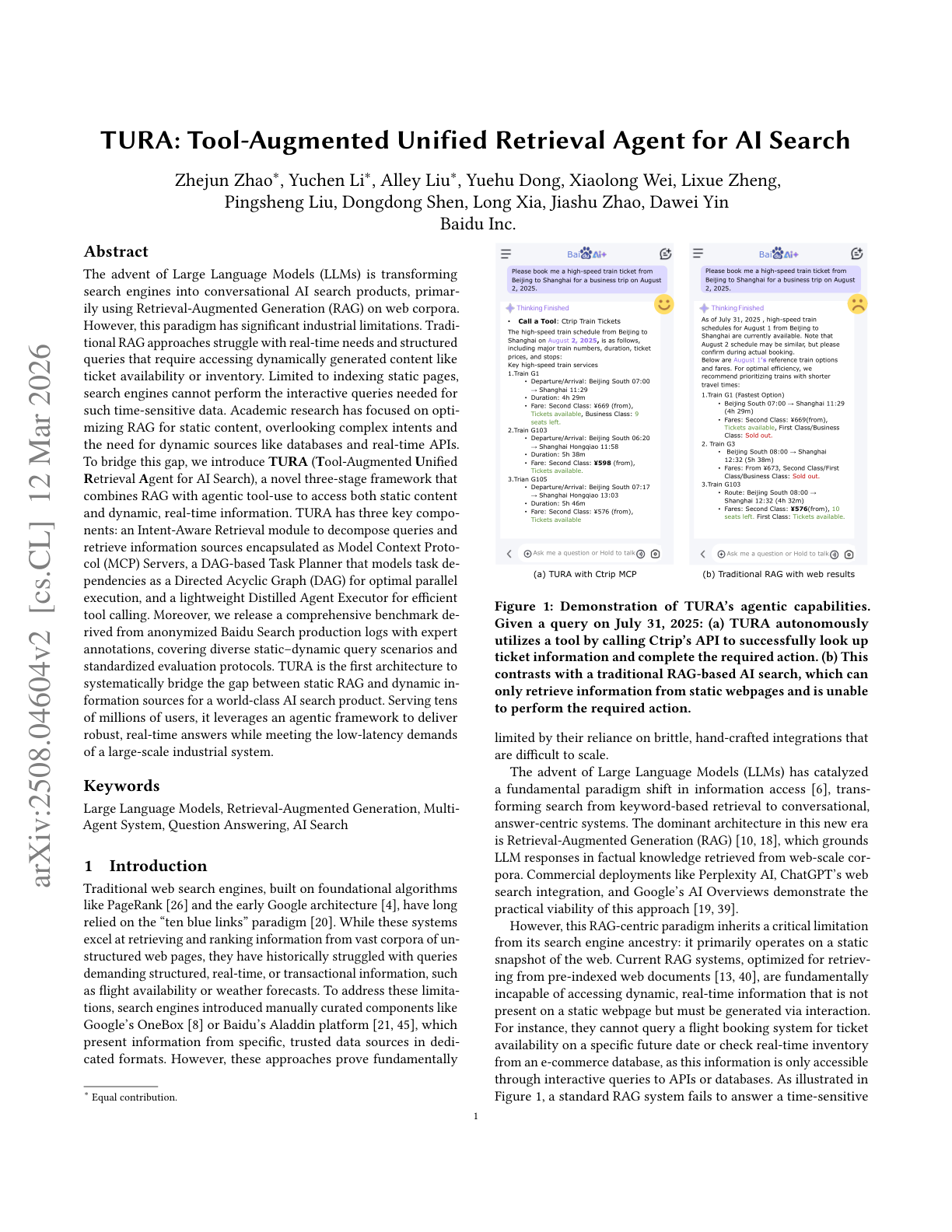
Presents a production-ready framework that extends the RAG (Retrieval-Augmented Generation) paradigm to support real-time, dynamic, and transactional queries through agentic tool use. Unlike conventional RAG systems that rely on static web snapshots, TURA enables LLM-based systems to interact with external APIs and databases, addressing user intents that require up-to-date or structured information (e.g., train schedules, weather forecasts).
Ask this paper
Intent-Aware MCP Server Retrieval decomposes complex user queries into atomic intents using an LLM, then retrieves relevant static or dynamic tools from a semantic server index augmented with diverse synthetic queries. This step ensures accurate tool selection even when user phrasing diverges from formal API documentation.
DAG-Based Task Planning generates parallelizable execution plans for the sub-intents using a graph-based structure. Tasks with data dependencies are ordered accordingly, while independent ones are executed in parallel to optimize latency. This planner uses a powerful LLM to build the DAG based on the query's structure and server capabilities.
Distilled Agent Executor uses a small, latency-optimized agent fine-tuned via a “mixed-rationale” method, training with chain-of-thought but inferring without it. This achieves near-teacher-level performance with dramatically lower cost. For example, a distilled Qwen3-4B model outperforms GPT-4o and its own teacher model (Deepseek-V3) in tool-use accuracy (88.3% vs. 81.7%) while reducing latency from 6.8s to 750ms.