Tunable Tool-Call Rates in LLM Agents via Representation Steering
Yuqi Chen, Vincent Siu, Dawn Song and Chenguang Wang show that whether an instruction-tuned model calls a tool is controlled by a single linear direction in its residual stream, extractable without training and steerable at inference.
Ask this paper
One direction, monotone control: Adding the direction with strength alpha moves call rate from near 0% to over 90% while keeping calls well-formed, with no prompt change and no post-training.
Steering is informative in both directions: Dialing up induces new calls that land precisely on questions the model cannot answer from parametric knowledge; dialing down suppresses calls.
Generalizes to unseen tools: The direction works on tools it was not extracted from, with strength comparable to each tool's own direction, and without biasing toward a specific tool choice.
Traces a cost/accuracy Pareto frontier: With live tool execution a single sweep nearly doubles open-domain QA accuracy (0.29 to 0.56), and transfers across dense, MoE and multimodal models. Code is public.
Abstract
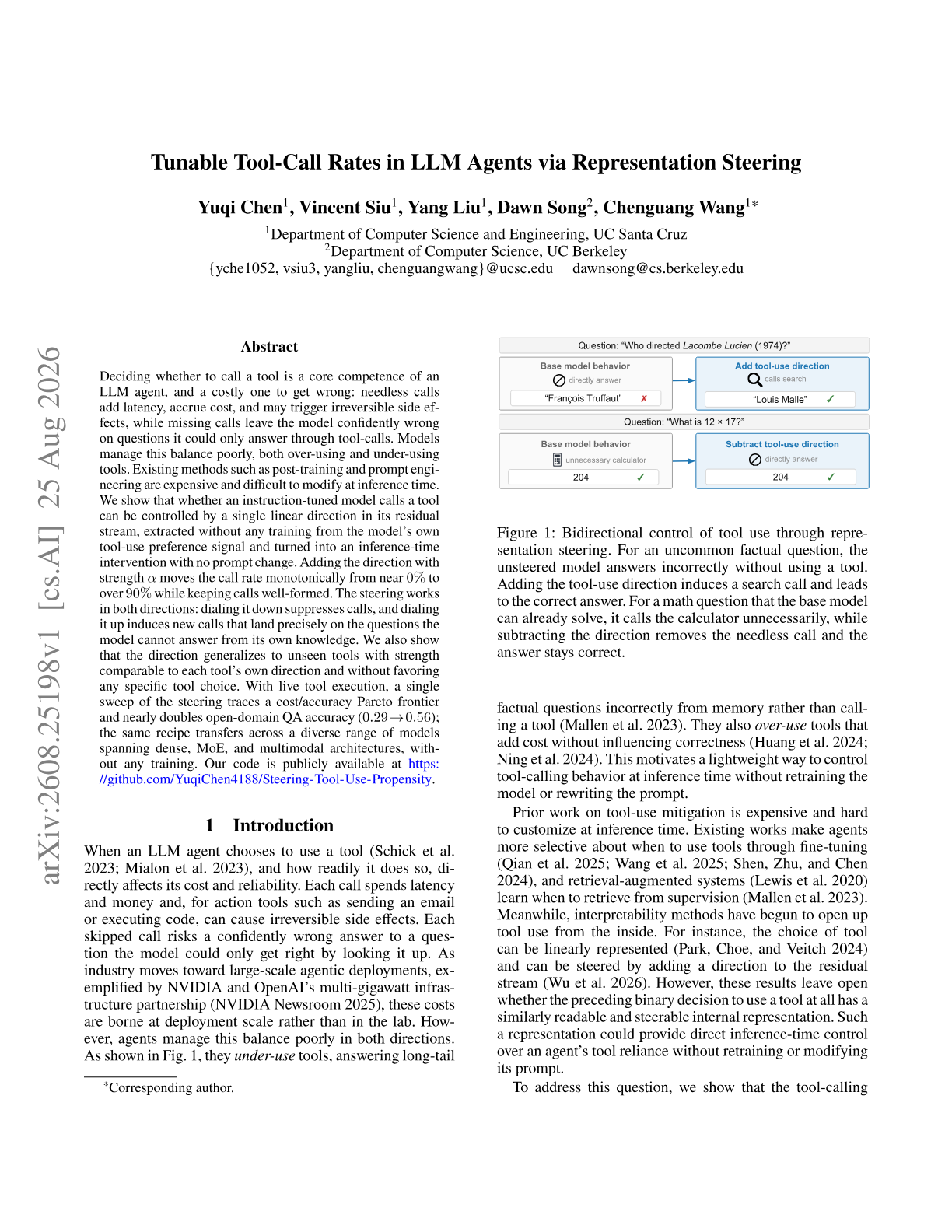
Deciding whether to call a tool is a core competence of an LLM agent, and a costly one to get wrong: needless calls add latency, accrue cost, and may trigger irreversible side effects, while missing calls leave the model confidently wrong on questions it could only answer through tool-calls. Models manage this balance poorly, both over-using and under-using tools. Existing methods such as post-training and prompt engineering are expensive and difficult to modify at inference time. We show that whether an instruction-tuned model calls a tool can be controlled by a single linear direction in its residual stream, extracted without any training from the model's own tool-use preference signal and turned into an inference-time intervention with no prompt change. Adding the direction with strength $α$ moves the call rate monotonically from near $0\% $ to over $90\%$ while keeping calls well-formed. The steering works in both directions: dialing it down suppresses calls, and dialing it up induces new calls that land precisely on the questions the model cannot answer from its own knowledge. We also show that the direction generalizes to unseen tools with strength comparable to each tool's own direction and without favoring any specific tool choice. With live tool execution, a single sweep of the steering traces a cost/accuracy Pareto frontier and nearly doubles open-domain QA accuracy ($0.29 \! \rightarrow \! 0.56$); the same recipe transfers across a diverse range of models spanning dense, MoE, and multimodal architectures, without any training. Our code is publicly available at https://github.com/YuqiChen4188/Steering-Tool-Use-Propensity.