Tool-to-Agent Retrieval
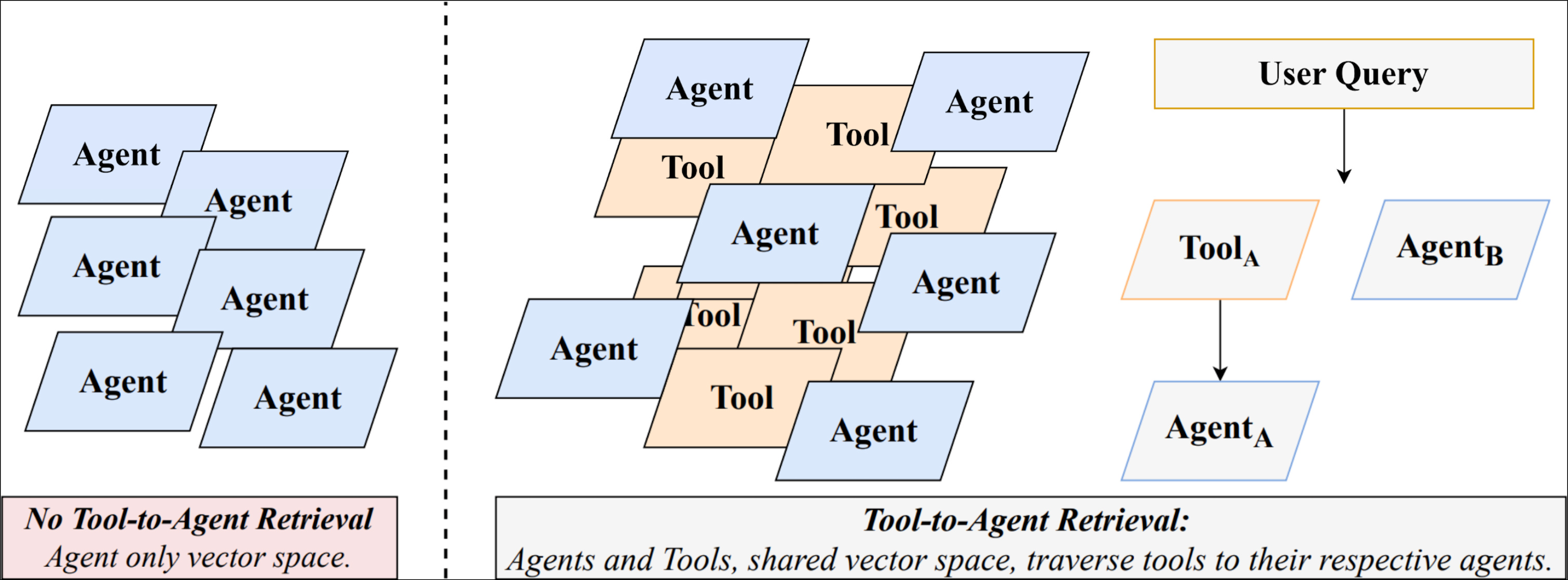
PwC researchers introduce a unified retrieval framework that embeds both tools and agents in a shared vector space with metadata relationships, enabling efficient routing in multi-agent systems coordinating hundreds of MCP servers and tools. - **Unified indexing approach**: Constructs joint tool-agent catalog as bipartite graph with metadata relationships, enabling traversal from tool matches to executable agent context. - **Granular retrieval mechanism**: Retrieves top-N entities using semantic similarity (dense vectors + BM25), then aggregates parent agents to select top-K unique agents, avoiding context dilution. - **Flexible query paradigms**: Supports direct querying (high-level questions) and step-wise querying (sub-task decomposition), with step-wise as primary evaluation for multi-step workflows. - **Consistent performance gains**: 19.4% improvement in Recall@5 and 17.7% in nDCG@5 over ScaleMCP/MCPZero on LiveMCPBench (70 servers, 527 tools). - **Architecture-agnostic improvements**: Stable gains across 8 embedding models (Vertex AI, Gemini, Titan, OpenAI, MiniLM) with 0.02 standard deviation in Recall@5, strongest lift on Titan v2 (+28%). - **Balanced retrieval distribution**: 39.13% of top-K from agent corpus, 34.44% of tools traced to agents, confirming framework preserves both tool precision and agent context.
Ask this paper
Unified indexing approach: Constructs a joint tool-agent catalog as a bipartite graph with metadata relationships, enabling traversal from tool matches to executable agent context.
Granular retrieval mechanism: Retrieves top-N entities using semantic similarity (dense vectors + BM25), then aggregates parent agents to select top-K unique agents, avoiding context dilution.
Flexible query paradigms: Supports direct querying (high-level questions) and step-wise querying (sub-task decomposition), with step-wise as the primary evaluation for multi-step workflows.
Consistent performance gains: 19.4% improvement in Recall@5 and 17.7% in nDCG@5 over ScaleMCP/MCPZero on LiveMCPBench (70 servers, 527 tools).
Architecture-agnostic improvements: Stable gains across 8 embedding models (Vertex AI, Gemini, Titan, OpenAI, MiniLM) with 0.02 standard deviation in Recall@5, strongest lift on Titan v2 (+28%).
Balanced retrieval distribution: 39.13% of top-K from agent corpus, 34.44% of tools traced to agents, confirming framework preserves both tool precision and agent context.
Abstract
Recent advances in LLM Multi-Agent Systems enable scalable orchestration of sub-agents, each coordinating hundreds or thousands of tools or Model Context Protocol (MCP) servers. However, existing retrieval methods typically match queries against coarse agent-level descriptions before routing, which obscures fine-grained tool functionality and often results in suboptimal agent selection. We introduce Tool-to-Agent Retrieval, a unified framework that embeds both tools and their parent agents in a shared vector space and connects them through metadata relationships. By explicitly representing tool capabilities and traversing metadata to the agent level, Tool-to-Agent Retrieval enables granular tool-level or agent-level retrieval, ensuring that agents and their underlying tools or MCP servers are equally represented without the context dilution that arises from chunking many tools together. Evaluating Tool-to-Agent Retrieval across eight embedding models, our approach achieves consistent improvements of 19.4% in Recall@5 and 17.7% in nDCG@5 over previous state-of-the-art agent retrievers on the LiveMCPBench benchmark.