TROVE: Adaptive Agent Skill Orchestration via Trace-Grounded Route Validation and Editing
Tianxing Wang and colleagues at Shanghai Jiao Tong argue that agent orchestration fails because the plan is committed before runtime evidence arrives, and propose revising only the part of a route that evidence has invalidated.
Ask this paper
The bottleneck named. Pre-execution commitment forces an agent to either run stale steps or replan broadly when intermediate evidence invalidates the pending continuation, compounding errors and discarding progress.
Offline half. Evaluated workflow-search traces are distilled into atomic and composite skills plus an outcome-conditioned transition graph that preserves stable fragments and exposes outcome-dependent decisions.
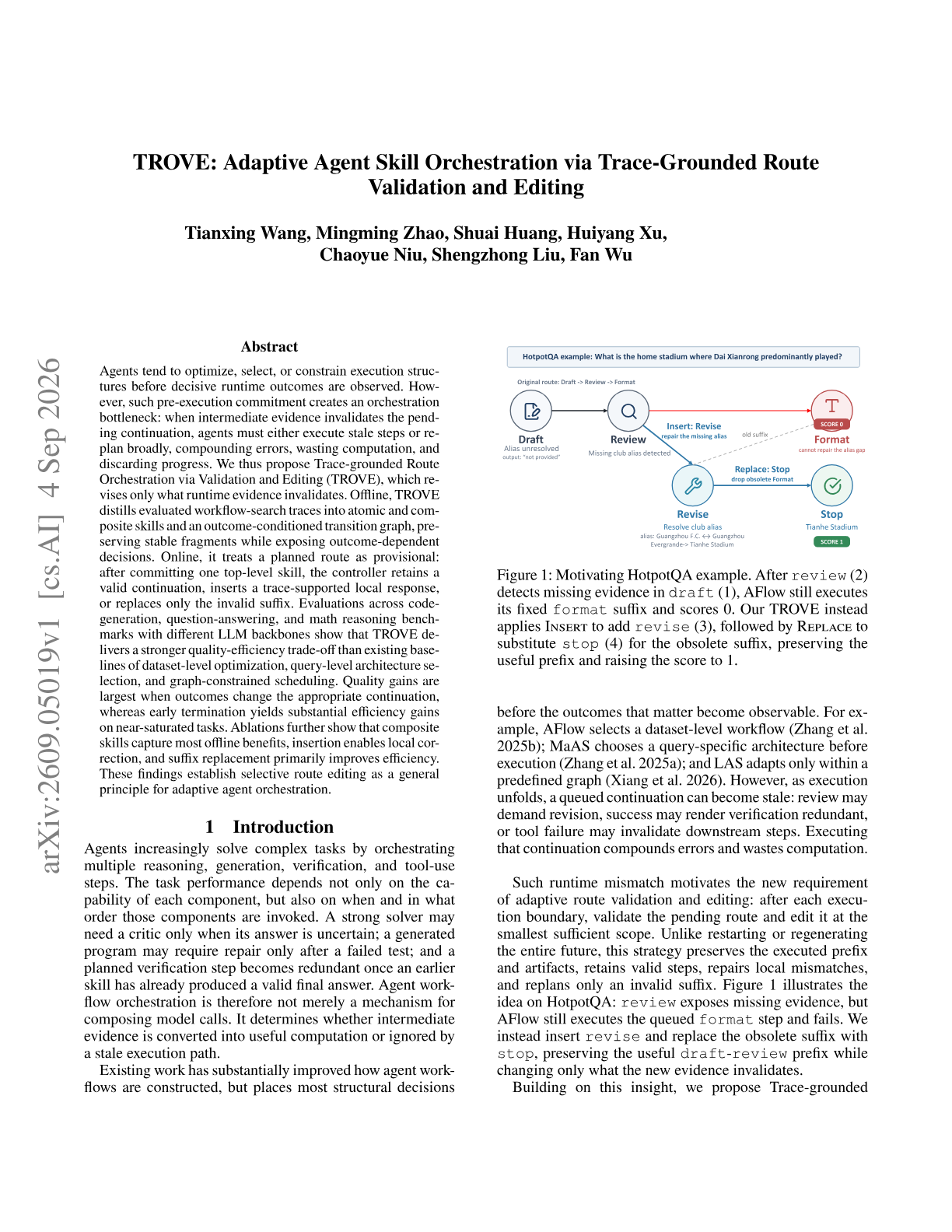
Online half. After committing one top-level skill the controller either keeps the remaining route, inserts a trace-supported local response, or replaces only the invalid suffix.
Where the gains come from. Quality gains are largest when outcomes change which continuation is appropriate; efficiency gains come from early termination on near-saturated tasks.
Ablations. Composite skills capture most of the offline benefit, insertion enables local correction, and suffix replacement mainly improves efficiency.
Abstract
Agents tend to optimize, select, or constrain execution structures before decisive runtime outcomes are observed. However, such pre-execution commitment creates an orchestration bottleneck: when intermediate evidence invalidates the pending continuation, agents must either execute stale steps or replan broadly, compounding errors, wasting computation, and discarding progress. We thus propose Trace-grounded Route Orchestration via Validation and Editing (TROVE), which revises only what runtime evidence invalidates. Offline, TROVE distills evaluated workflow-search traces into atomic and composite skills and an outcome-conditioned transition graph, preserving stable fragments while exposing outcome-dependent decisions. Online, it treats a planned route as provisional: after committing one top-level skill, the controller retains a valid continuation, inserts a trace-supported local response, or replaces only the invalid suffix. Evaluation across code-generation, question-answering, and math reasoning benchmarks with different LLM backbones show that TROVE delivers a stronger quality-efficiency trade-off than existing baselines of dataset-level optimization, query-level architecture selection, and graph-constrained scheduling. Quality gains are largest when outcomes change the appropriate continuation, whereas early termination yields substantial efficiency gains on near-saturated tasks. Ablations further show that composite skills capture most offline benefits, insertion enables local correction, and suffix replacement primarily improves efficiency. These findings establish selective route editing as a general principle for adaptive agent orchestration.