VideoRAG
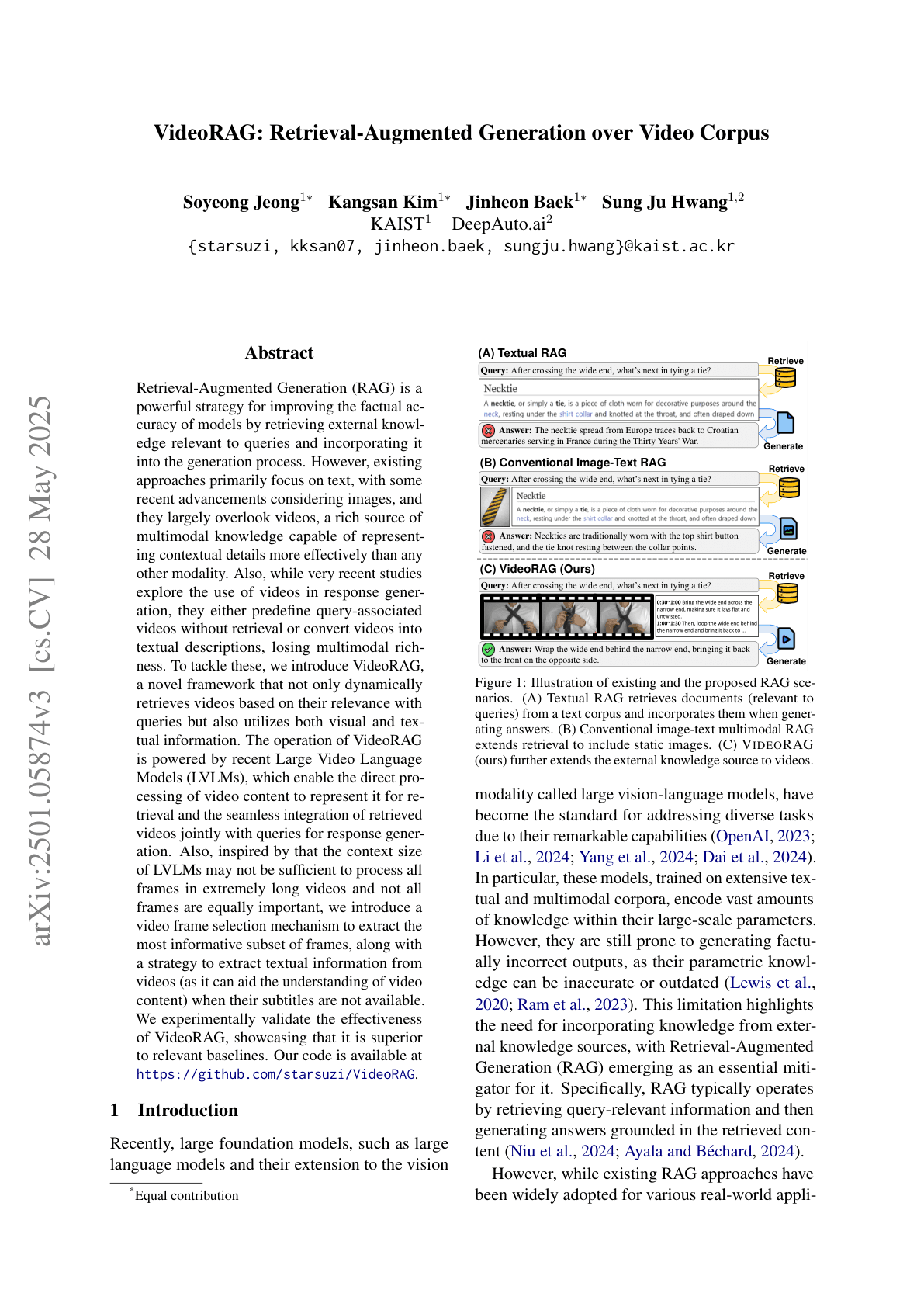
a framework that enhances RAG by leveraging video content as an external knowledge source; unlike existing RAG approaches that primarily focus on text or images, VideoRAG dynamically retrieves relevant videos based on queries and incorporates both their visual and textual elements into the generation process; the framework utilizes Large Video Language Models (LVLMs) to process video content directly, enabling more effective capture of temporal dynamics, spatial details, and multimodal cues that static modalities often fail to convey; for videos lacking textual descriptions, they propose using automatic speech recognition to generate transcripts, ensuring both visual and textual modalities can be leveraged.
Ask this paper
Abstract
Retrieval-Augmented Generation (RAG) is a powerful strategy for improving the factual accuracy of models by retrieving external knowledge relevant to queries and incorporating it into the generation process. However, existing approaches primarily focus on text, with some recent advancements considering images, and they largely overlook videos, a rich source of multimodal knowledge capable of representing contextual details more effectively than any other modality. While very recent studies explore the use of videos in response generation, they either predefine query-associated videos without retrieval or convert videos into textual descriptions losing multimodal richness. To tackle these, we introduce VideoRAG, a framework that not only dynamically retrieves videos based on their relevance with queries but also utilizes both visual and textual information. The operation of VideoRAG is powered by recent Large Video Language Models (LVLMs), which enable the direct processing of video content to represent it for retrieval and the seamless integration of retrieved videos jointly with queries for response generation. Also, inspired by that the context size of LVLMs may not be sufficient to process all frames in extremely long videos and not all frames are equally important, we introduce a video frame selection mechanism to extract the most informative subset of frames, along with a strategy to extract textual information from videos (as it can aid the understanding of video content) when their subtitles are not available. We experimentally validate the effectiveness of VideoRAG, showcasing that it is superior to relevant baselines. Code is available at https://github.com/starsuzi/VideoRAG.