Vision-Language Synergy Reasoning
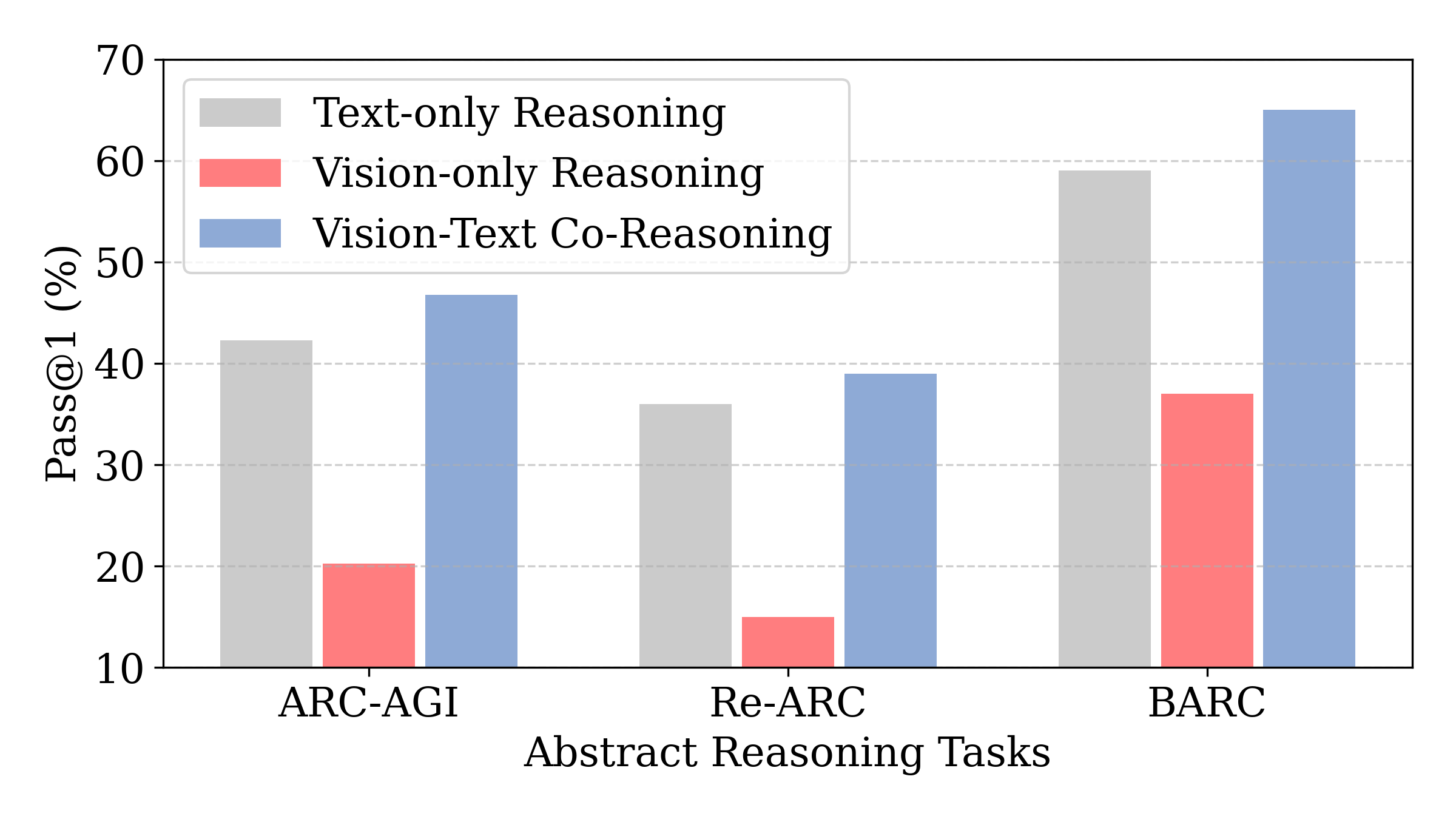
Researchers propose Vision-Language Synergy Reasoning (VLSR), a method that combines visual and textual reasoning to improve performance on ARC-AGI abstract reasoning tasks. The key insight is that vision excels at global pattern abstraction while language specializes in symbolic rule formulation. - **Modality strengths:** Vision supports pattern recognition and verification across the entire puzzle grid. Language handles precise rule formulation and step-by-step execution of transformations. - **VLSR decomposition:** The framework assigns subtasks to each modality based on their strengths - visual processing for pattern abstraction, text for symbolic reasoning and rule application. - **Modality-Switch Self-Correction:** MSSC uses visual verification to catch errors in text-based reasoning. When text execution fails, the system switches to visual mode to identify and fix mistakes. - **Results:** Achieves up to 4.33% improvement over text-only baselines on ARC-AGI tasks across multiple foundation models, demonstrating that unifying visual abstraction with linguistic reasoning advances generalizable AI.
Ask this paper
Modality strengths: Vision supports pattern recognition and verification across the entire puzzle grid. Language handles precise rule formulation and step-by-step execution of transformations.
VLSR decomposition: The framework assigns subtasks to each modality based on their strengths - visual processing for pattern abstraction, text for symbolic reasoning, and rule application.
Modality-Switch Self-Correction: MSSC uses visual verification to catch errors in text-based reasoning. When text execution fails, the system switches to visual mode to identify and fix mistakes.
Results: Achieves up to 4.33% improvement over text-only baselines on ARC-AGI tasks across multiple foundation models, demonstrating that unifying visual abstraction with linguistic reasoning advances generalizable AI.
Abstract
Abstract reasoning from minimal examples remains a core unsolved problem for frontier foundation models such as GPT-5 and Grok 4. These models still fail to infer structured transformation rules from a handful of examples, which is a key hallmark of human intelligence. The Abstraction and Reasoning Corpus for Artificial General Intelligence (ARC-AGI) provides a rigorous testbed for this capability, demanding conceptual rule induction and transfer to novel tasks. Most existing methods treat ARC-AGI as a purely textual reasoning task, overlooking the fact that humans rely heavily on visual abstraction when solving such puzzles. However, our pilot experiments reveal a paradox: naively rendering ARC-AGI grids as images degrades performance due to imprecise rule execution. This leads to our central hypothesis that vision and language possess complementary strengths across distinct reasoning stages: vision supports global pattern abstraction and verification, whereas language specializes in symbolic rule formulation and precise execution. Building on this insight, we introduce two synergistic strategies: (1) Vision-Language Synergy Reasoning (VLSR), which decomposes ARC-AGI into modality-aligned subtasks; and (2) Modality-Switch Self-Correction (MSSC), which leverages vision to verify text-based reasoning for intrinsic error correction. Extensive experiments demonstrate that our approach yields up to a 4.33\% improvement over text-only baselines across diverse flagship models and multiple ARC-AGI tasks. Our findings suggest that unifying visual abstraction with linguistic reasoning is a crucial step toward achieving generalizable, human-like intelligence in future foundation models. Source code is released at this https URL.