WebRL
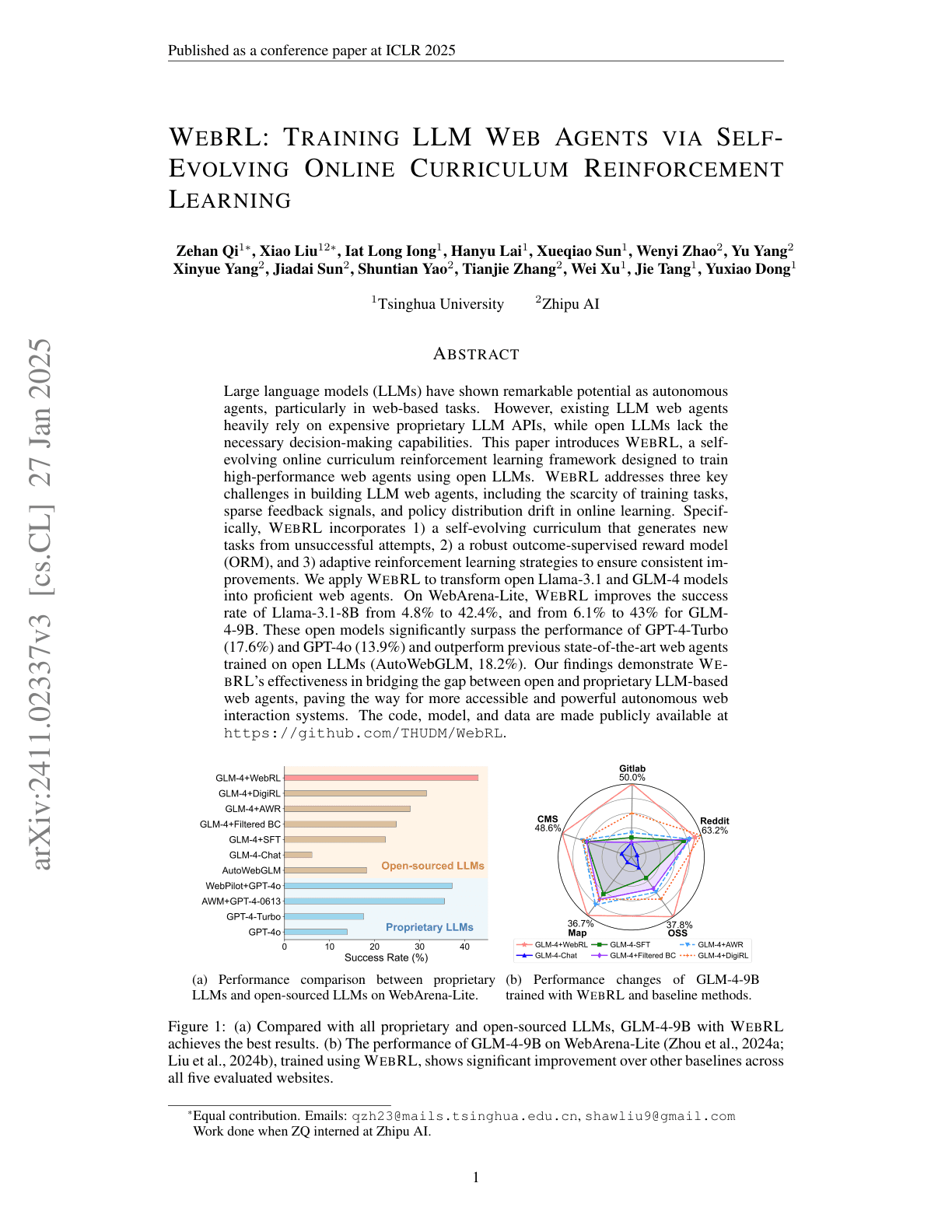
proposes a self-evolving online curriculum RL framework to bridge the gap between open and proprietary LLM-based web agents; it improves the success rate of Llama-3.1-8B from 4.8% to 42.4%, and from 6.1% to 43% for GLM4-9B; the open models significantly surpass the performance of GPT-4-Turbo (17.6%) and GPT-4o (13.9%); the self-evolving curriculum addresses the scarcity of web agent training tasks; this is underpinned by a robust outcome-supervised reward model to evaluate task success; an adaptive RL strategy helps to deal with distribution drift in online learning and ensures consistent improvements.
Ask this paper
Abstract
Large language models (LLMs) have shown remarkable potential as autonomous agents, particularly in web-based tasks. However, existing LLM web agents heavily rely on expensive proprietary LLM APIs, while open LLMs lack the necessary decision-making capabilities. This paper introduces WebRL, a self-evolving online curriculum reinforcement learning framework designed to train high-performance web agents using open LLMs. WebRL addresses three key challenges in building LLM web agents, including the scarcity of training tasks, sparse feedback signals, and policy distribution drift in online learning. Specifically, WebRL incorporates 1) a self-evolving curriculum that generates new tasks from unsuccessful attempts, 2) a robust outcome-supervised reward model (ORM), and 3) adaptive reinforcement learning strategies to ensure consistent improvements. We apply WebRL to transform open Llama-3.1 and GLM-4 models into proficient web agents. On WebArena-Lite, WebRL improves the success rate of Llama-3.1-8B from 4.8% to 42.4%, and from 6.1% to 43% for GLM-4-9B. These open models significantly surpass the performance of GPT-4-Turbo (17.6%) and GPT-4o (13.9%) and outperform previous state-of-the-art web agents trained on open LLMs (AutoWebGLM, 18.2%). Our findings demonstrate WebRL's effectiveness in bridging the gap between open and proprietary LLM-based web agents, paving the way for more accessible and powerful autonomous web interaction systems.