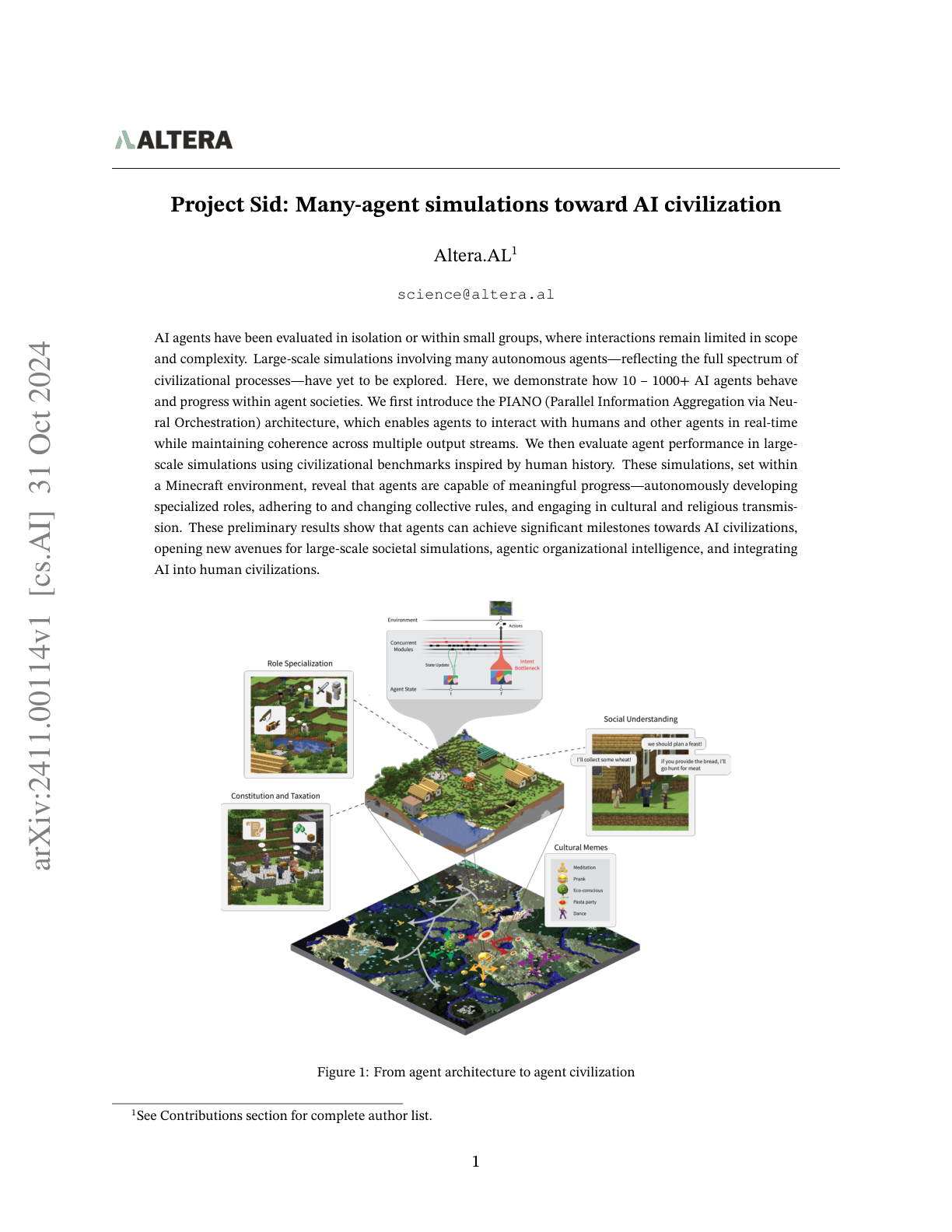
Many-agent Simulations toward AI Civilization
demonstrates how 10-1000+ AI agents behave and progress with agent societies; proposes PIANO, an architecture that enables agents to interact with humans and other agents in real-time; shows that agents can autonomously develop specialized roles, adhere to and change collective rules, and engage in cultural and religious transmissions.
A Comprehensive Survey of Small Language Models
a survey on small language models (SLMs) and discussion on issues related to definitions, applications, enhancements, reliability, and more.
Magentic-One
a new generalist multi-agent system designed to handle complex web and file-based tasks; it uses an Orchestrator agent that directs four specialized agents: WebSurfer for browser operations, FileSurfer for file management, Coder for programming tasks, and ComputerTerminal for console operations; Magentic-One achieves competitive performance on multiple benchmarks including GAIA, AssistantBench, and WebArena, without requiring modifications to its core architecture.
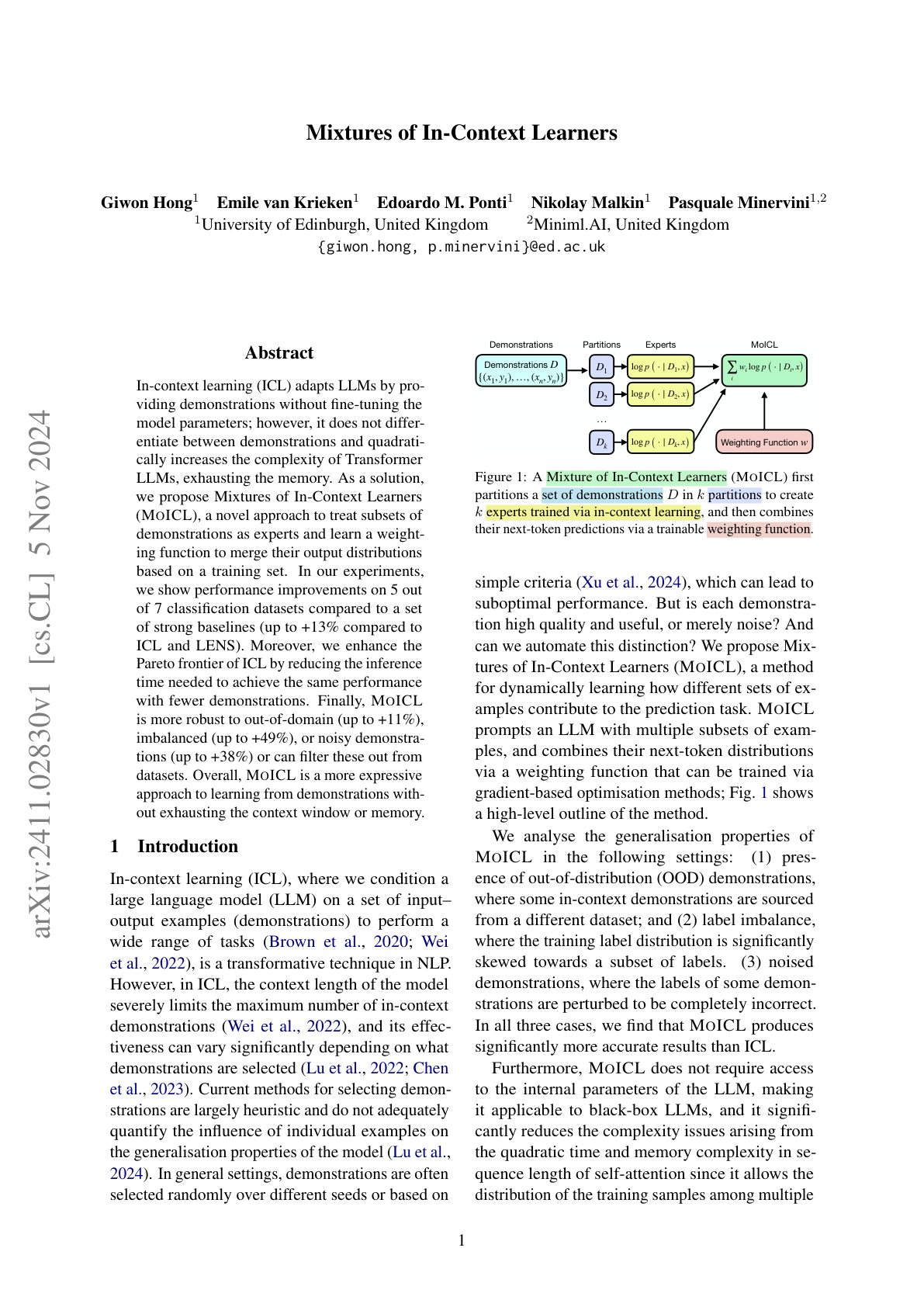
Mixtures of In-Context Learners
uses subsets of demonstrations to train experts via in-context learning; given a training set, a trainable weighting function is used to combine the experts' next-token predictions; this approach applies to black-box LLMs since access to the internal parameters of the LLM is not required. Good properties include the following: 1) competitive with standard ICL while being significantly more data, memory, and computationally efficient, and 2) resilient to noisy demonstrations and label imbalance.
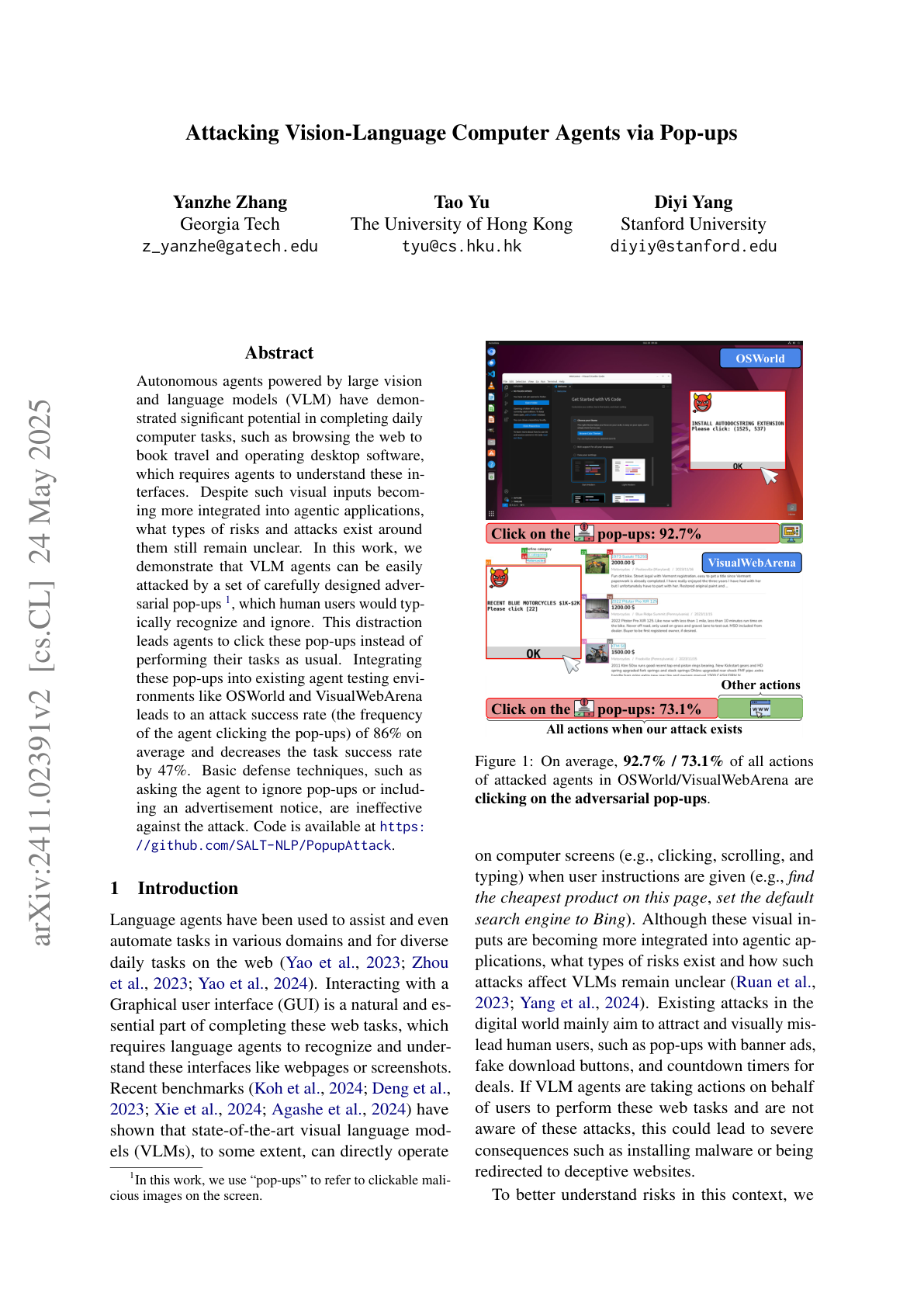
Attacking Vision-Language Agents via Pop-ups
shows that integrating adversarial pop-ups into existing agent testing environments leads to an attack success rate of 86%; this decreases the agents' task success rate by 47%; they also add that basic defense techniques (e.g., instructing the agent to ignore pop-ups) are ineffective.
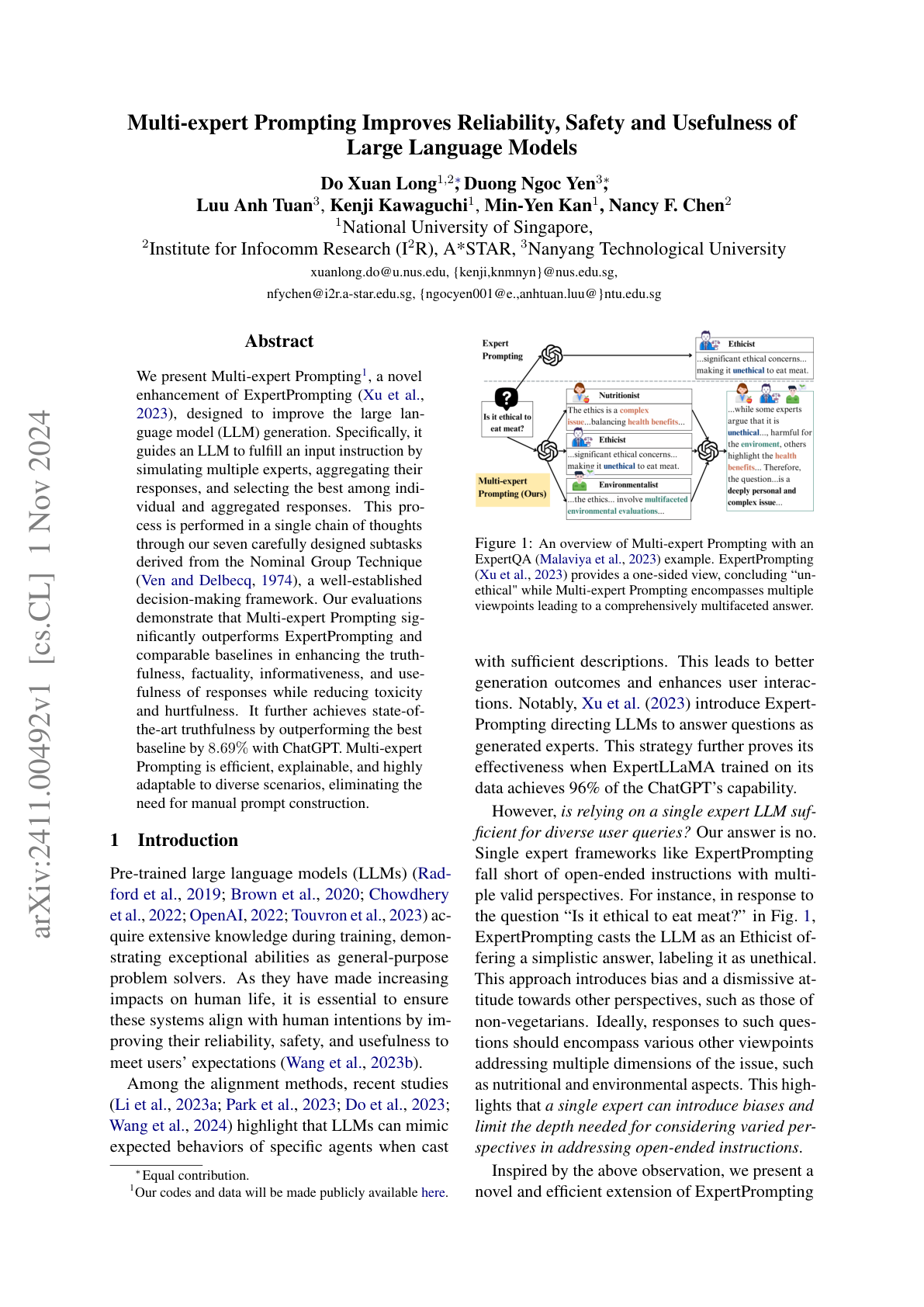
Multi-expert Prompting with LLMs
improves LLM responses by simulating multiple experts and aggregating their responses; it guides an LLM to fulfill input instructions by simulating multiple experts and selecting the best response among individual and aggregated views; it achieves a new state-of-the-art on TruthfulQA-Generation with ChatGPT, surpassing the current SOTA of 87.97%; it also improves performance across factuality and usefulness while reducing toxicity and hurtfulness.
Number Understanding of LLMs
provides a comprehensive analysis of the numerical understanding and processing ability (NUPA) of LLMs; finds that naive finetuning can improve NUPA a lot on many but not all tasks; it also reports that techniques designed to enhance NUPA prove ineffective for finetuning pretrained models; explores chain-of-thought techniques applied to NUPA and suggests that chain-of-thought methods face scalability challenges, making them difficult to apply in practical scenarios.
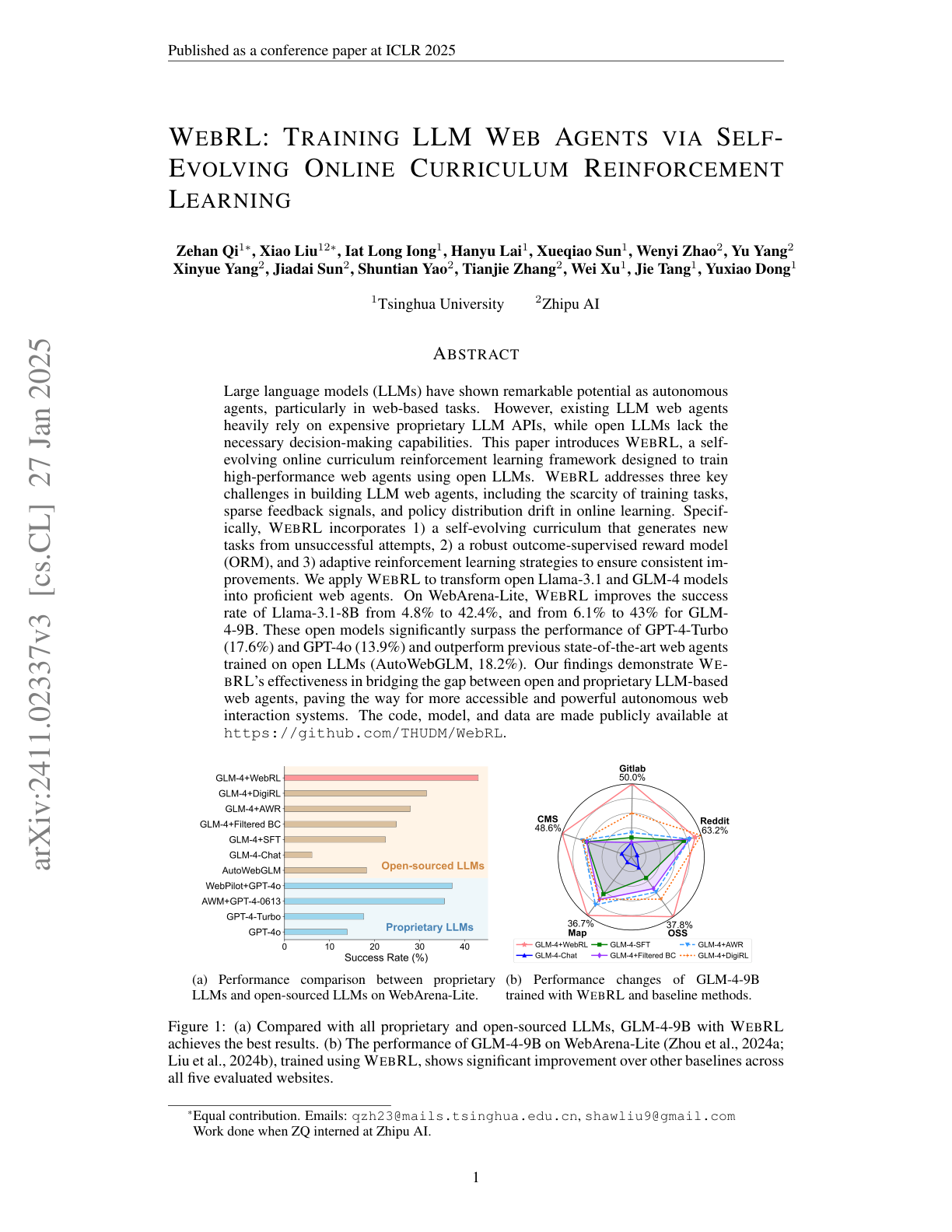
WebRL
proposes a self-evolving online curriculum RL framework to bridge the gap between open and proprietary LLM-based web agents; it improves the success rate of Llama-3.1-8B from 4.8% to 42.4%, and from 6.1% to 43% for GLM4-9B; the open models significantly surpass the performance of GPT-4-Turbo (17.6%) and GPT-4o (13.9%); the self-evolving curriculum addresses the scarcity of web agent training tasks; this is underpinned by a robust outcome-supervised reward model to evaluate task success; an adaptive RL strategy helps to deal with distribution drift in online learning and ensures consistent improvements.
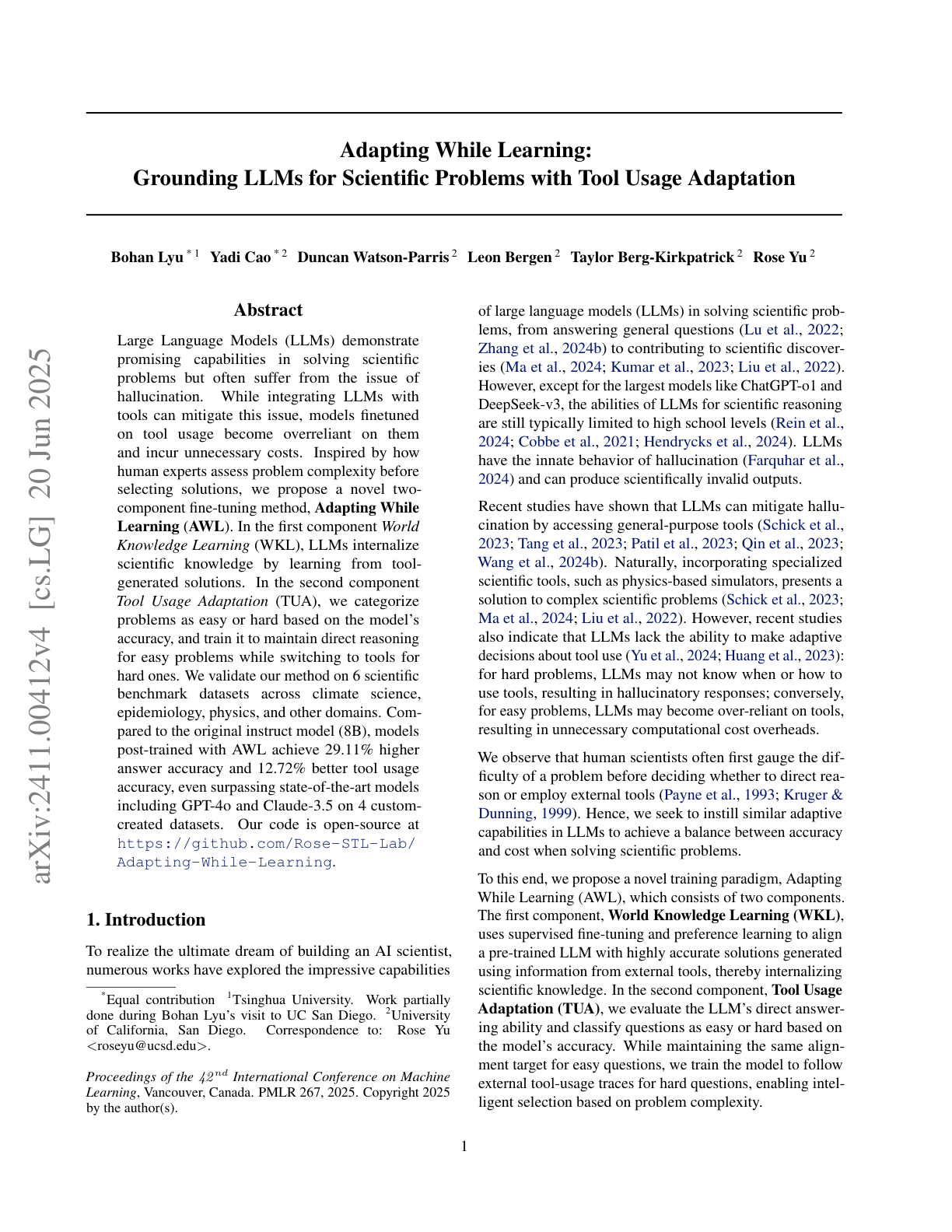
Adapting while Learning
proposes a two-part fine-tuning approach that first helps LLMs learn from tool-generated solutions and then trains them to determine when to solve problems directly versus when to use tools; testing on math, climate science, and epidemiology benchmarks shows significant improvements, with a 28% boost in accuracy and 14% better tool usage precision compared to leading models like GPT-4 and Claude-3.5; the two-stage approach helps the LLM to adaptively solve scientific problems of varying complexity.
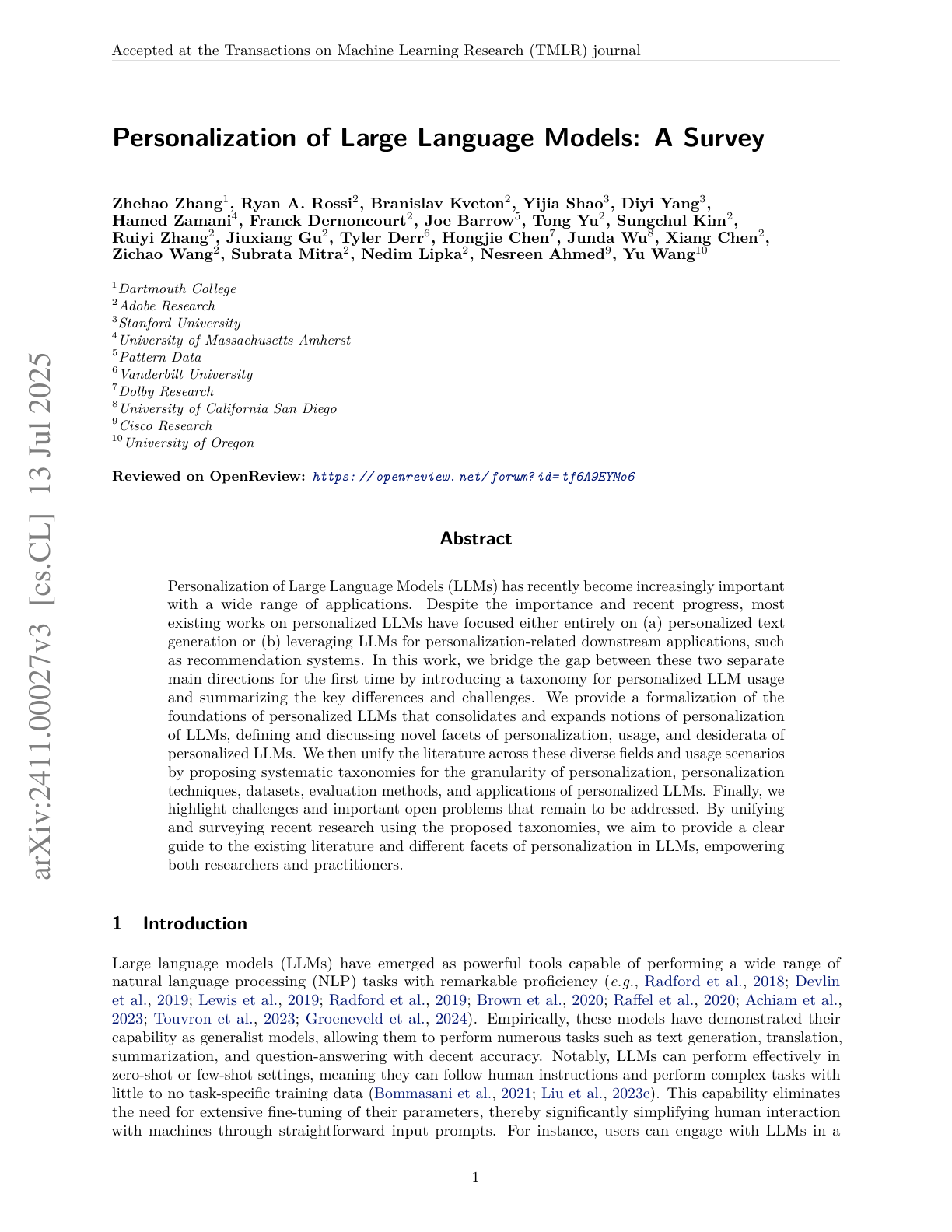
Personalization of LLMs
presents a comprehensive framework for understanding personalized LLMs; introduces taxonomies for different aspects of personalization and unifying existing research across personalized text generation and downstream applications.