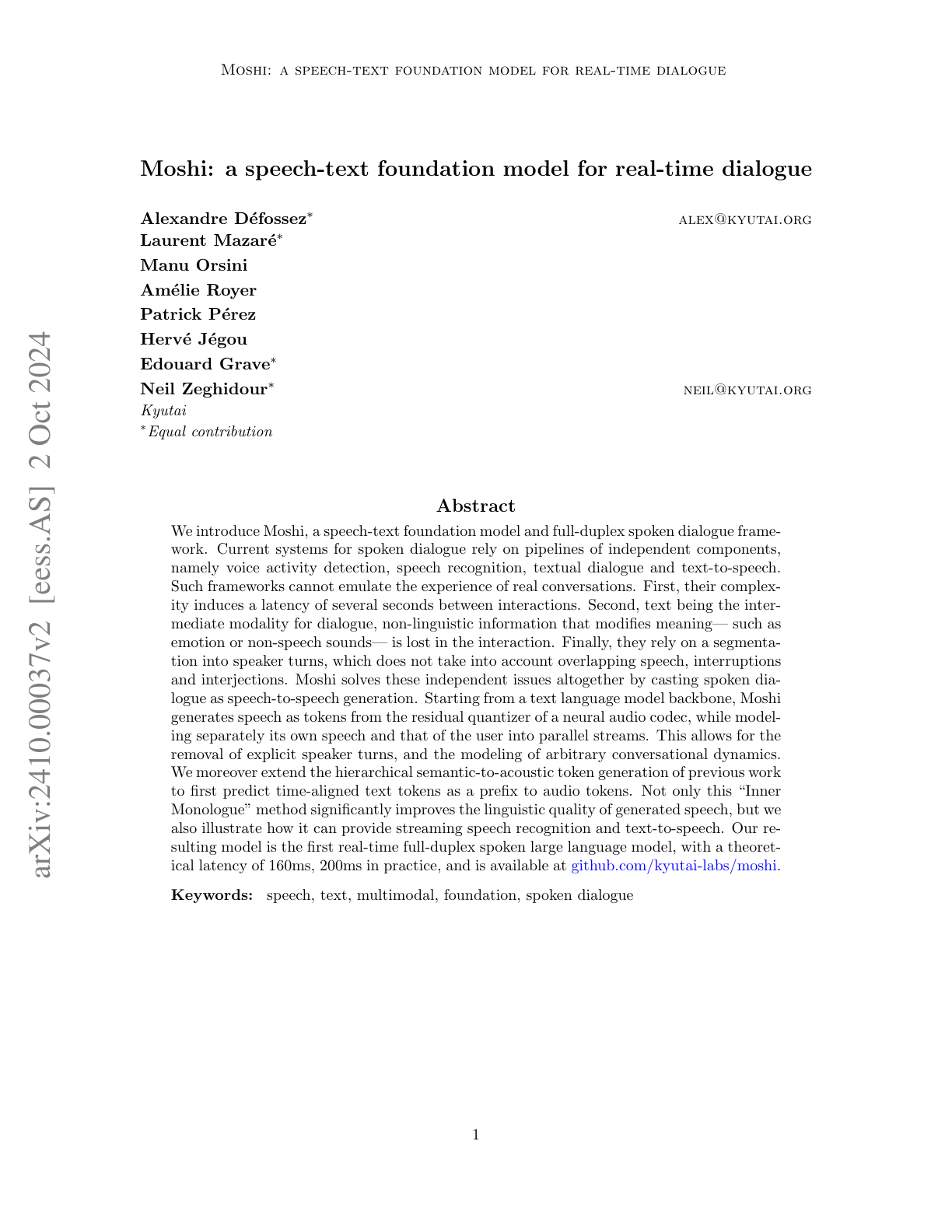
Moshi
introduces a speech-text foundation model and full-duplex spoken dialogue framework; they present several components of the systems; Helium is a 7B parameter text LLM; Mimi is a semantic-acoustic neural audio code with state-of-the-art performance on audio quality; a hierarchical multi-stream architecture that can generate arbitrary conversation in a speech-to-speech manner.
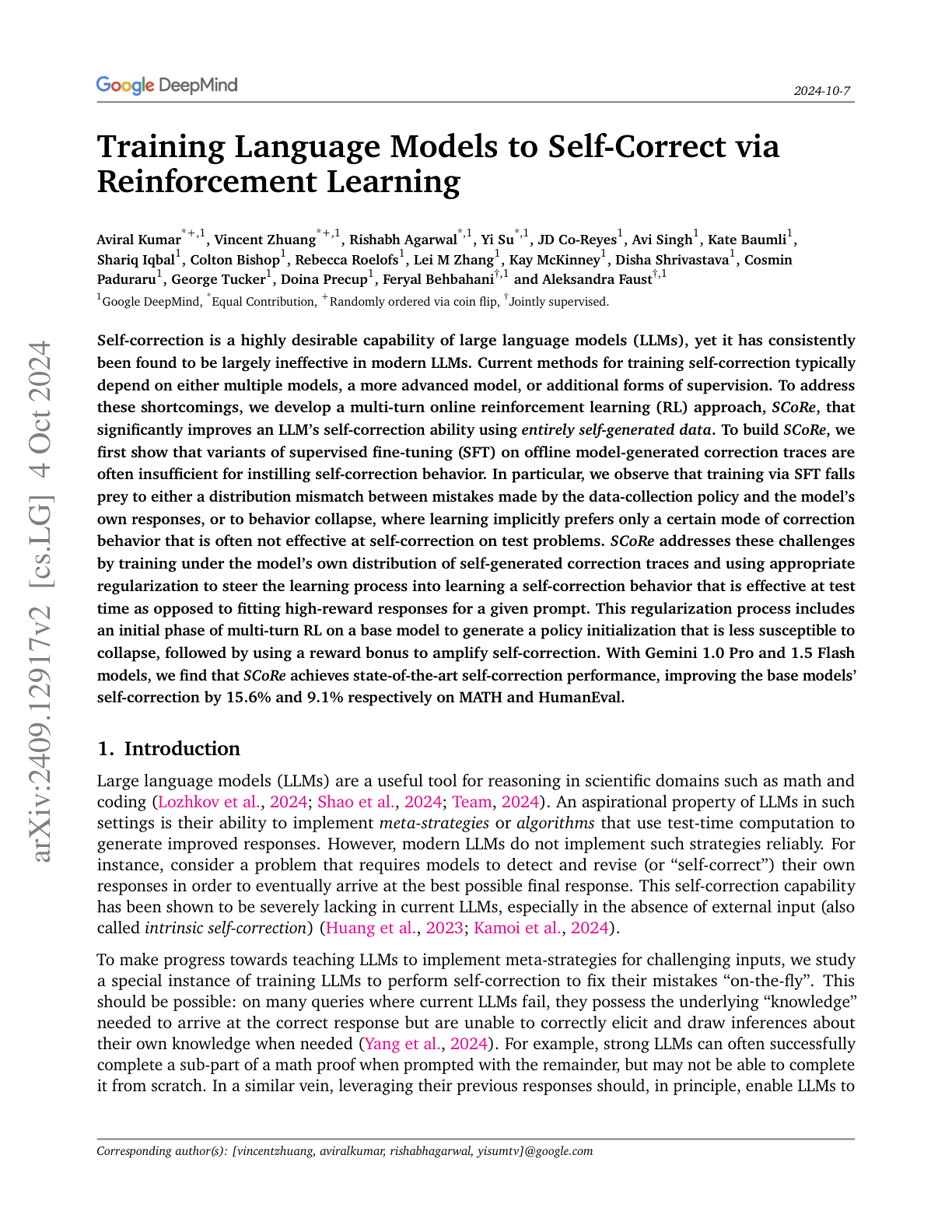
Training LLMs to Self-Correct via RL
develops a multi-turn online reinforcement learning to improve the capabilities of an LLM to self-correct; it’s based entirely on self-generated data; SFT is shown to be ineffective at learning self-correction and suffers from distribution mismatch between training data and model responses; proposes a two-stage approach that first optimizes correction behavior and then uses a reward bonus to amplify self-correction during training; when applied to Gemini 1.0 Pro and 1.5 Flash models, it achieves state-of-the-art self-correction performance, improving the base models’ self-correction by 15.6% and 9.1% respectively on the MATH and HumanEval benchmarks.
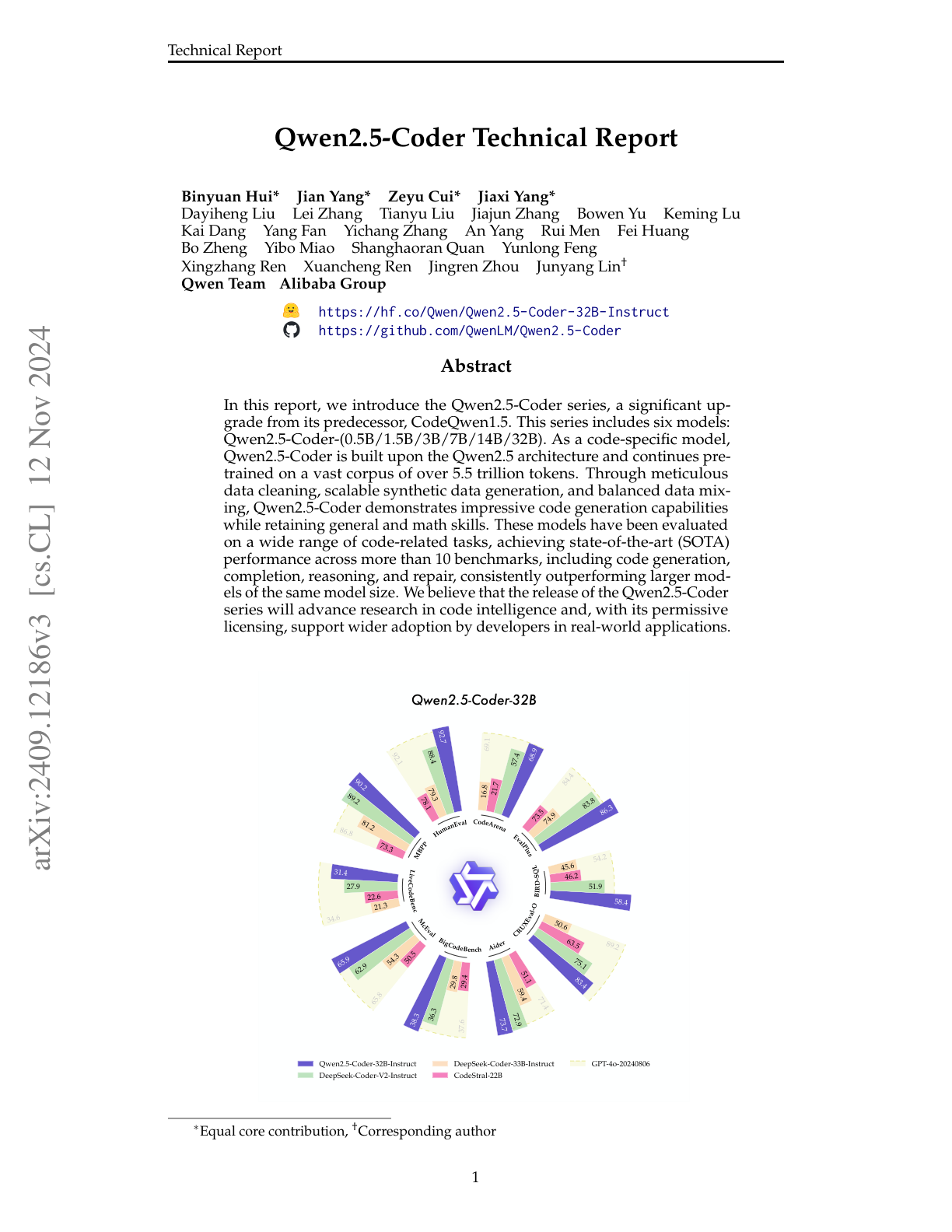
Qwen2.5 Coder
a series of models including 1.5B and 7B parameters; it’s built upon the Qwen2.5 architecture which is continuously pretrained on 5.5 trillion tokens; achieves state-of-the-art performance across more than 10 benchmarks; includes strong capabilities in code generation, completion, reasoning, and repairing.
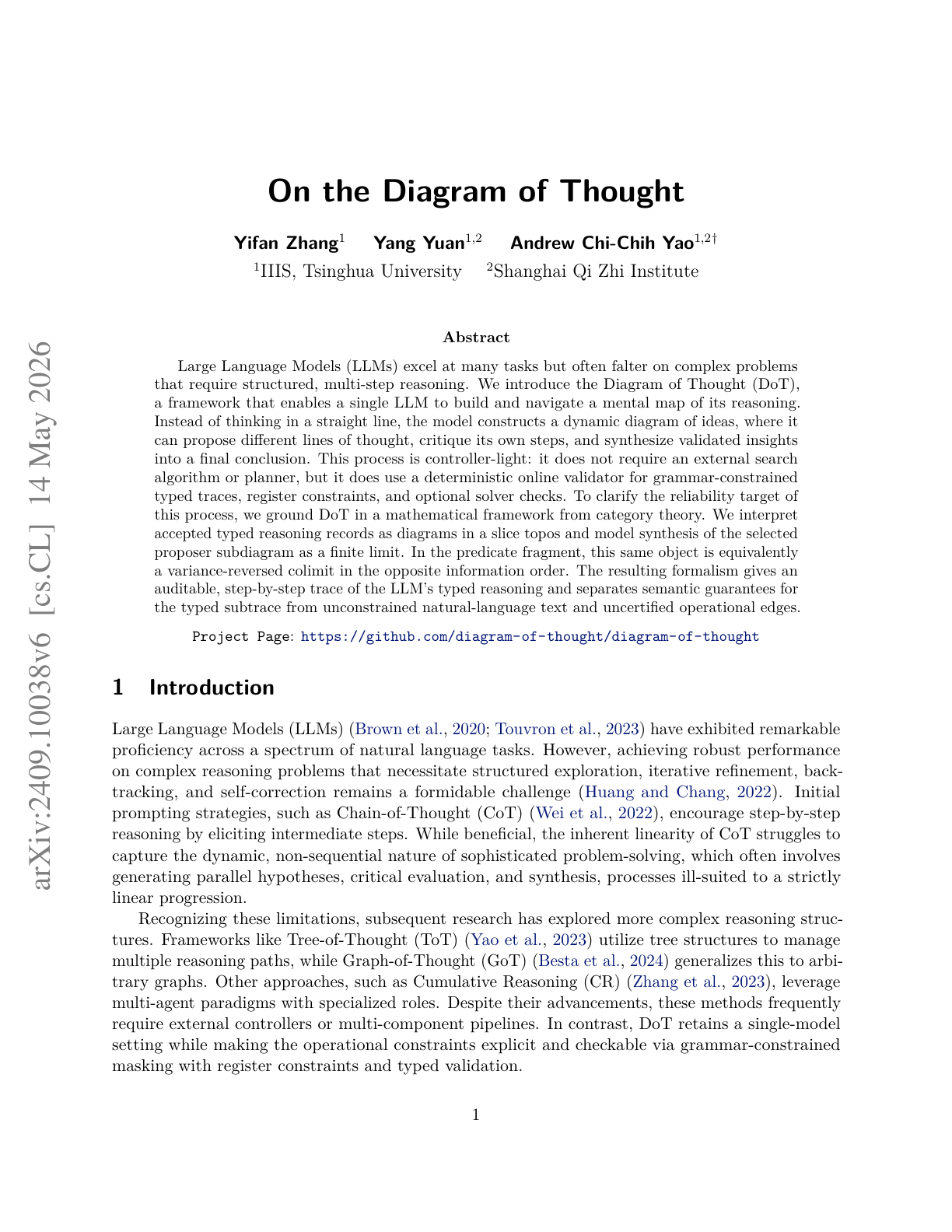
Diagram of Thought (DoT)
enhances the reasoning capabilities of LLMs through mathematical rigor; DAT models iterative reasoning in LLM as the construction of a directed acyclic graph; it integrates propositions, critiques, refinement, and verification into a unified DAG structure; this allows DoT to capture complex logical deduction beyond linear or tree-based approaches.
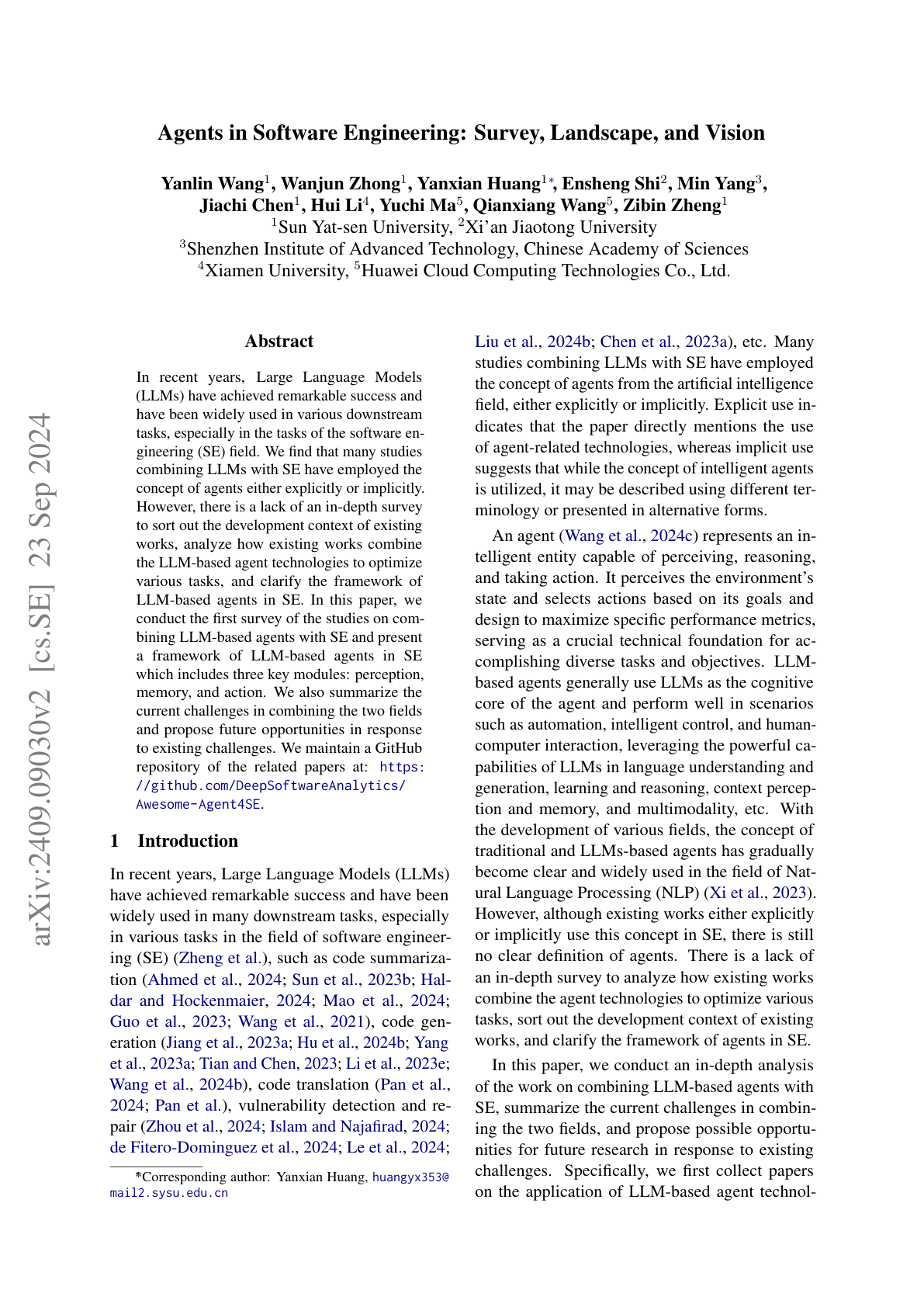
Agents in Software Engineering
provides a comprehensive overview of frameworks of LLM-based agents in software engineering.
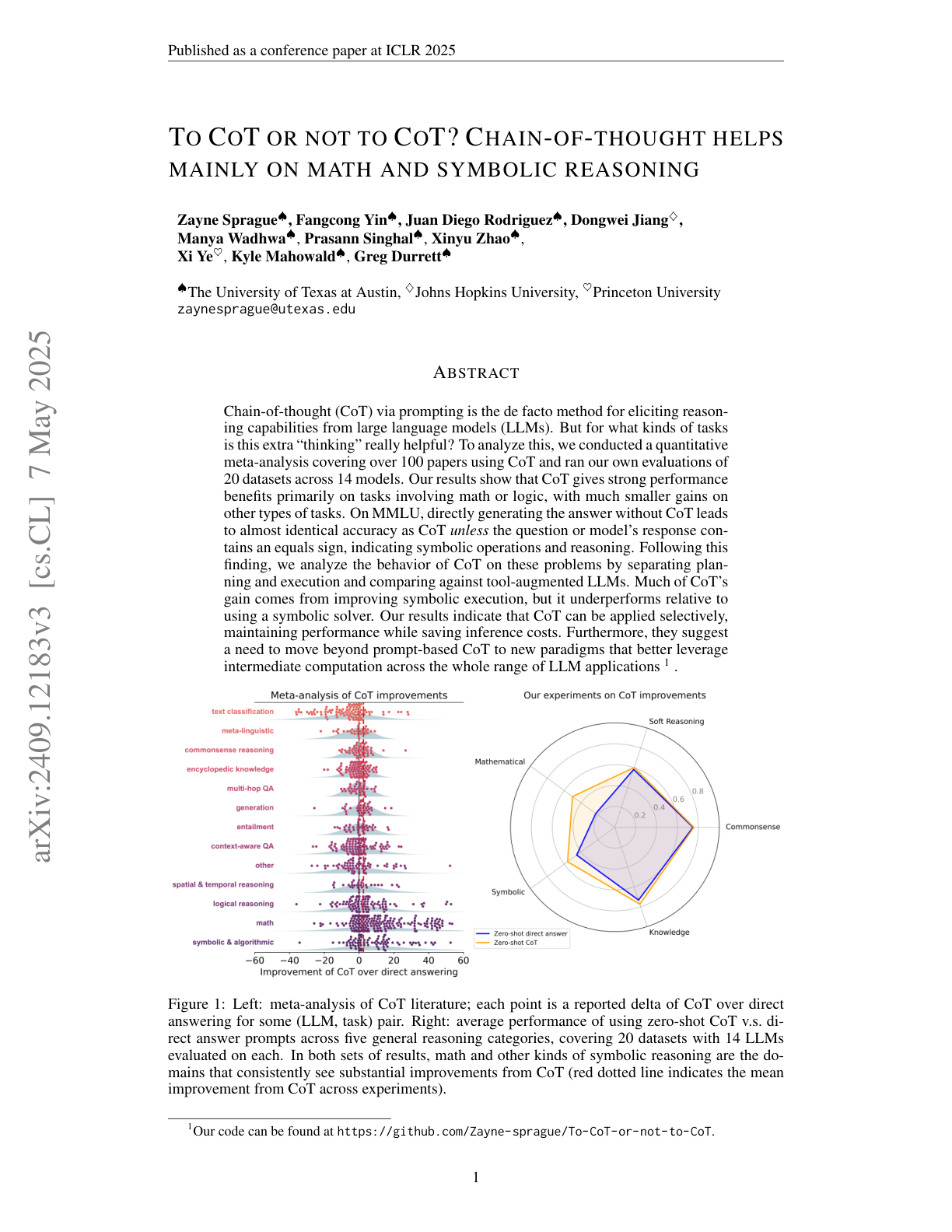
To CoT or not to CoT?
investigates what kinds of tasks benefit the most from chain-of-thought (CoT) prompting; after a meta-analysis on 100+ papers and several evaluations, it finds that CoT produces strong performance benefits primarily on tasks involving math and logic; they find that most of the CoT gain comes from improving symbolic execution, but a symbolic solver outperforms it.
A Comprehensive Evaluation of Quantized Instruction-Tuned LLMs
evaluates the performance of instruction-tuned LLMs across various quantization methods on models ranging from 7B to 405B; the key findings are 1) quantizing a larger LLM to a similar size as a smaller FP16 LLM generally performs better across most benchmarks, 2) performance varies significantly with different quantization methods, model size, and bit-width, with weight-only methods often yielding better results in larger models, and 3) task difficulty does not significantly impact accuracy degradation due to quantization.
Iteration of Thought
proposes the Iteration of Thought (IoT) framework to enhance the LLM responses and reasoning capabilities with adaptive reasoning paths; it leverages an inner dialogue agent, acting as a guide, to dynamically adjust reasoning paths which allows adaptive cross-path exploration and enhance response accuracy; it's different from CoT and ToT (both rigid processes) in that its prompt generation is a dynamic process that allows it to adapt.
Schrodinger’s Memory
uses the Universal Approximation Theorem to explain the memory mechanism of LLMs. It also proposes a new approach to evaluate LLM performance by comparing the memory capacities of different models; the Transformer architecture functions as a dynamic fitting UAT model, with a strong ability to adaptively fit inputs; this enables LLMs to recall entire content based on minimal input information.
Math Jailbreaking Prompts
uses GPT-4o to generate mathematically encoded prompts that serve as an effective jailbreaking technique; shows an average attack success rate of 73.6% across 13 state-of-the-art; this highlights the inability of existing safety training mechanisms to generalize to mathematically encoded inputs.