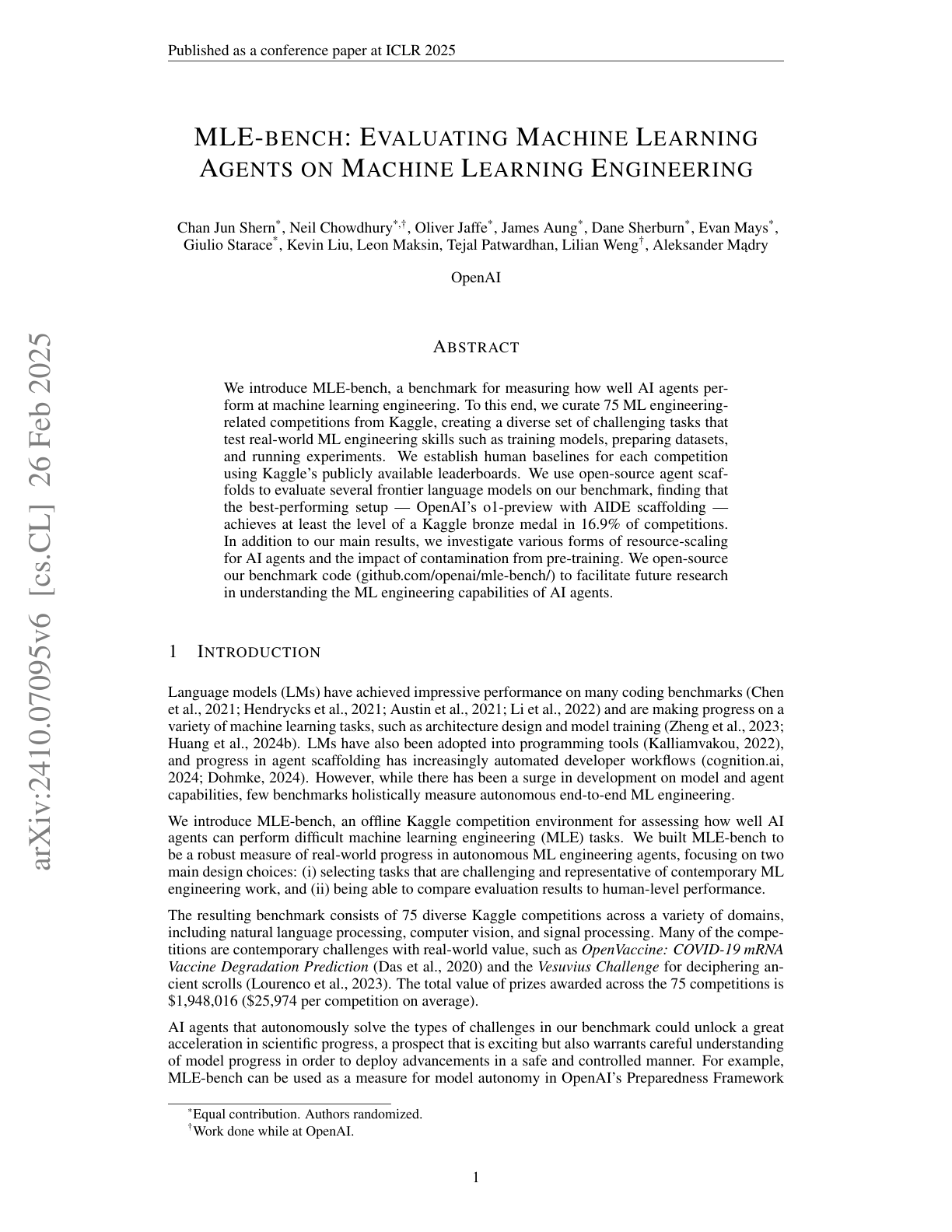
MLE-Bench
proposes a new benchmark for the evaluation of machine learning agents on machine learning engineering capabilities; includes 75 ML engineering-related competition from Kaggle testing on MLE skills such as training models, preparing datasets, and running experiments; OpenAI’s o1-preview with the AIDE scaffolding achieves Kaggle bronze medal level in 16.9% of competitions.
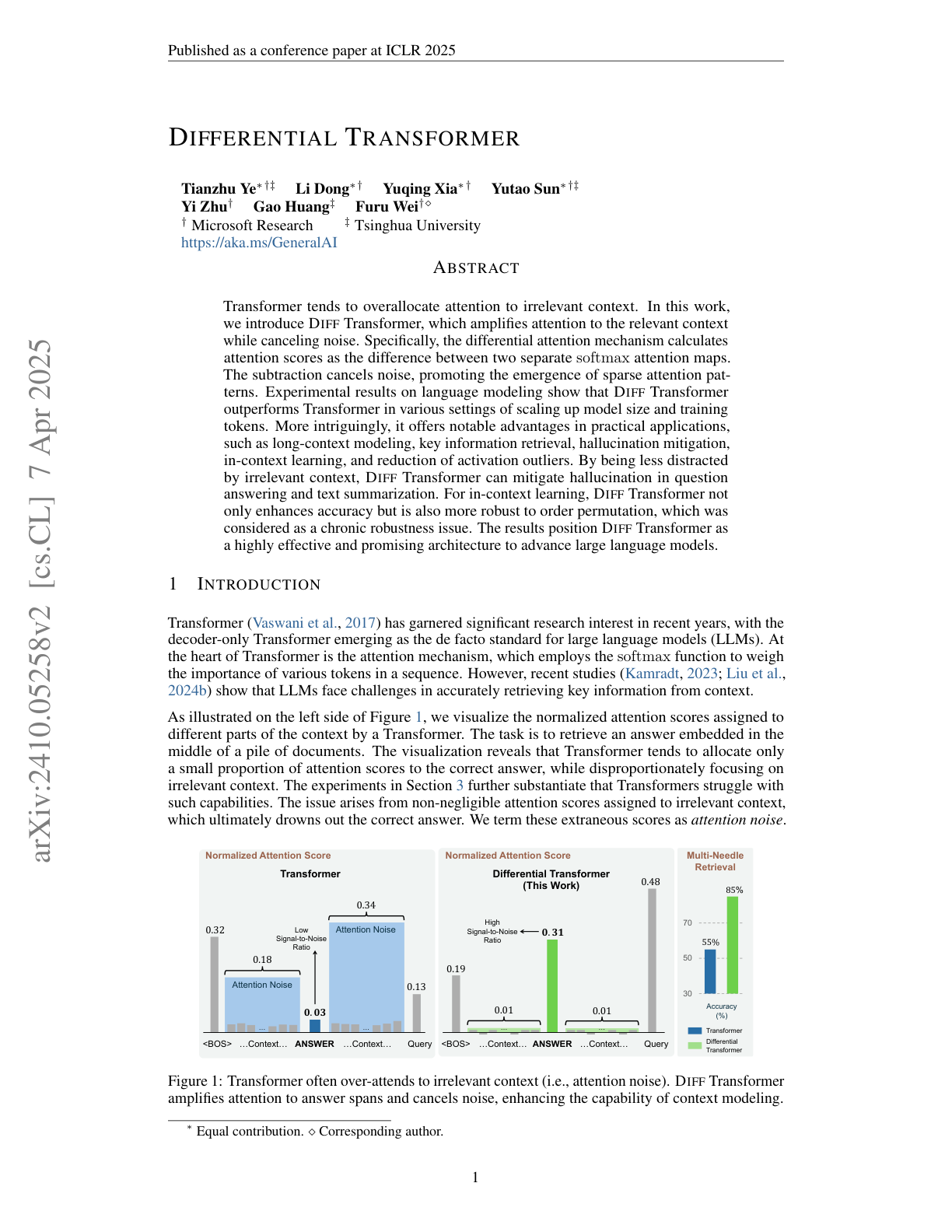
Differential Transformer
proposes a differential attention mechanism that amplifies attention to the relevant context while canceling noise; Differential Transformer outperforms Transformer when scaling up model size and training tokens; the authors claim that since this architecture gets less "distracted" by irrelevant context, it can do well in applications such as long-context modeling, key information retrieval, hallucination mitigation, in-context learning, and reduction of activation outliers.
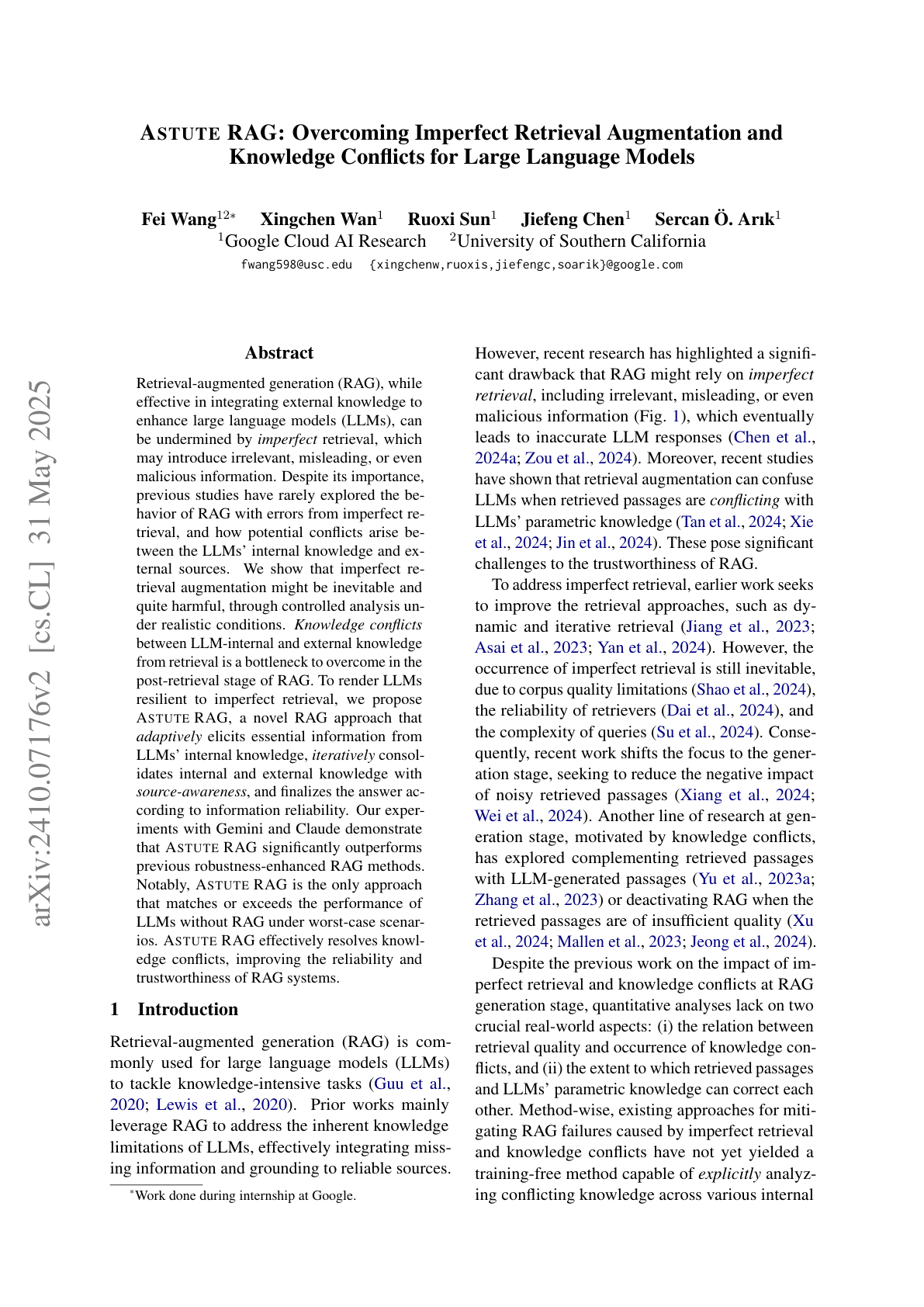
Astute RAG
proposes a novel RAG approach to deal with the imperfect retrieval augmentation and knowledge conflicts of LLMs; Astute RAG adaptively elicits essential information from LLMs' internal knowledge; then it iteratively consolidates internal and external knowledge with source awareness; Astute RAG is designed to better combine internal and external information through an interactive consolidation mechanism (i.e., identifying consistent passages, detecting conflicting information in them, and filtering out irrelevant information).
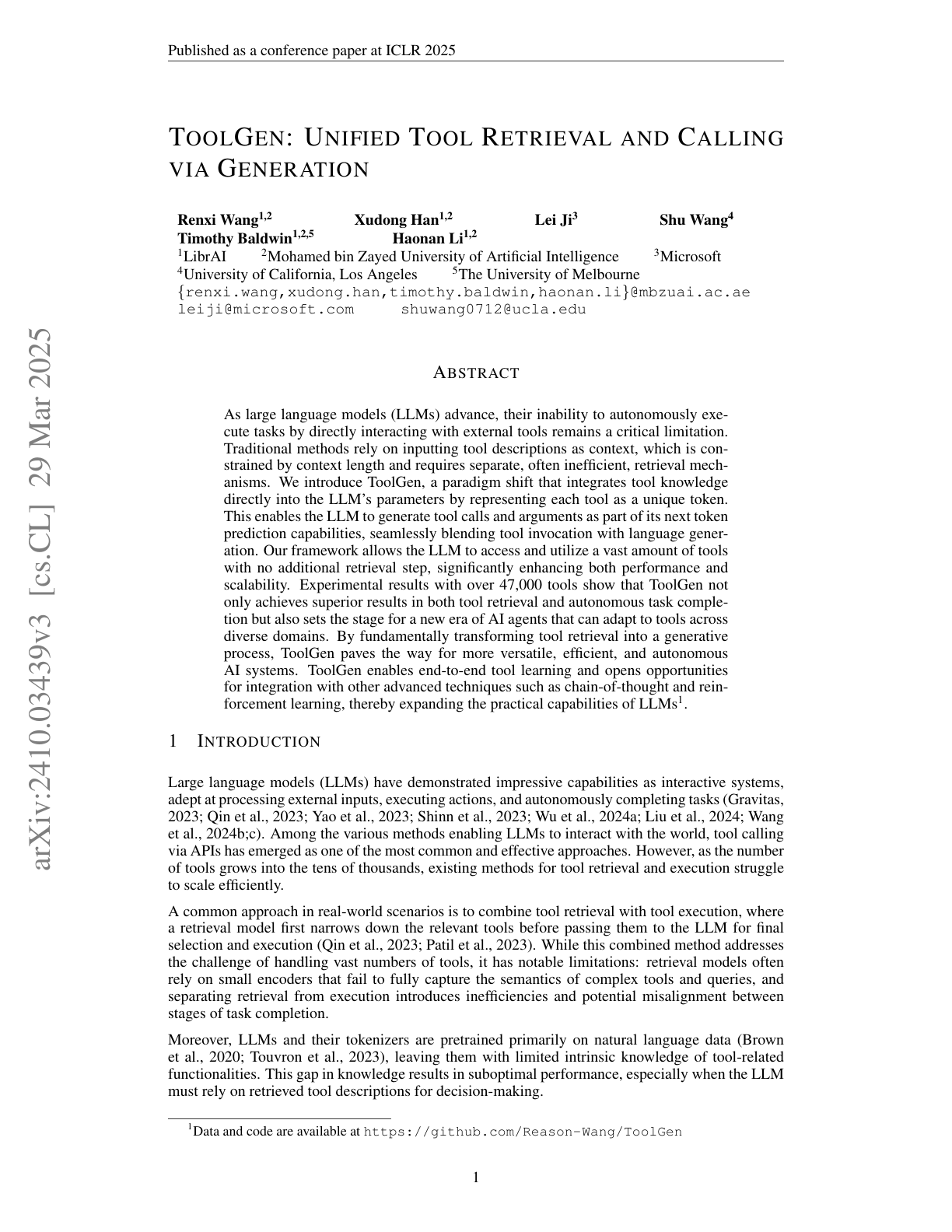
ToolGen
integrates tool knowledge directly into LLMs by representing tools as a unique token which allows the LLM to generate tool calls and arguments, enabling seamless tool invocation and language generation; experimental results with over 47,000 tools show that ToolGen achieves superior results in both tool retrieval and autonomous task completion.
Long-Context LLMs Meet RAG
finds that for many long-context LLMs, the quality of outputs declines as the number of passages increases; reports that the performance loss is due to retrieved hard negatives; they propose two ways to improve long-context LLM-based RAG: retrieval reordering and RAG-specific tuning with intermediate reasoning to help with relevance identification; that approaches demonstrate significant accuracy and robustness improvements on long-context RAG performance.
GSM-Symbolic
tests several SoTA models on a benchmark created with symbolic templates that enable diverse mathematical problems; they find that LLMs exhibit variance when responding to variations of the same questions; the performance of all the models declines by adjusting the numerical values in the question; as questions are made more challenging (e.g., increasing the number of clauses) the performance significantly deteriorates; the authors hypothesize that the observed decline in performance is due to a lack of logical reasoning in current LLMs.
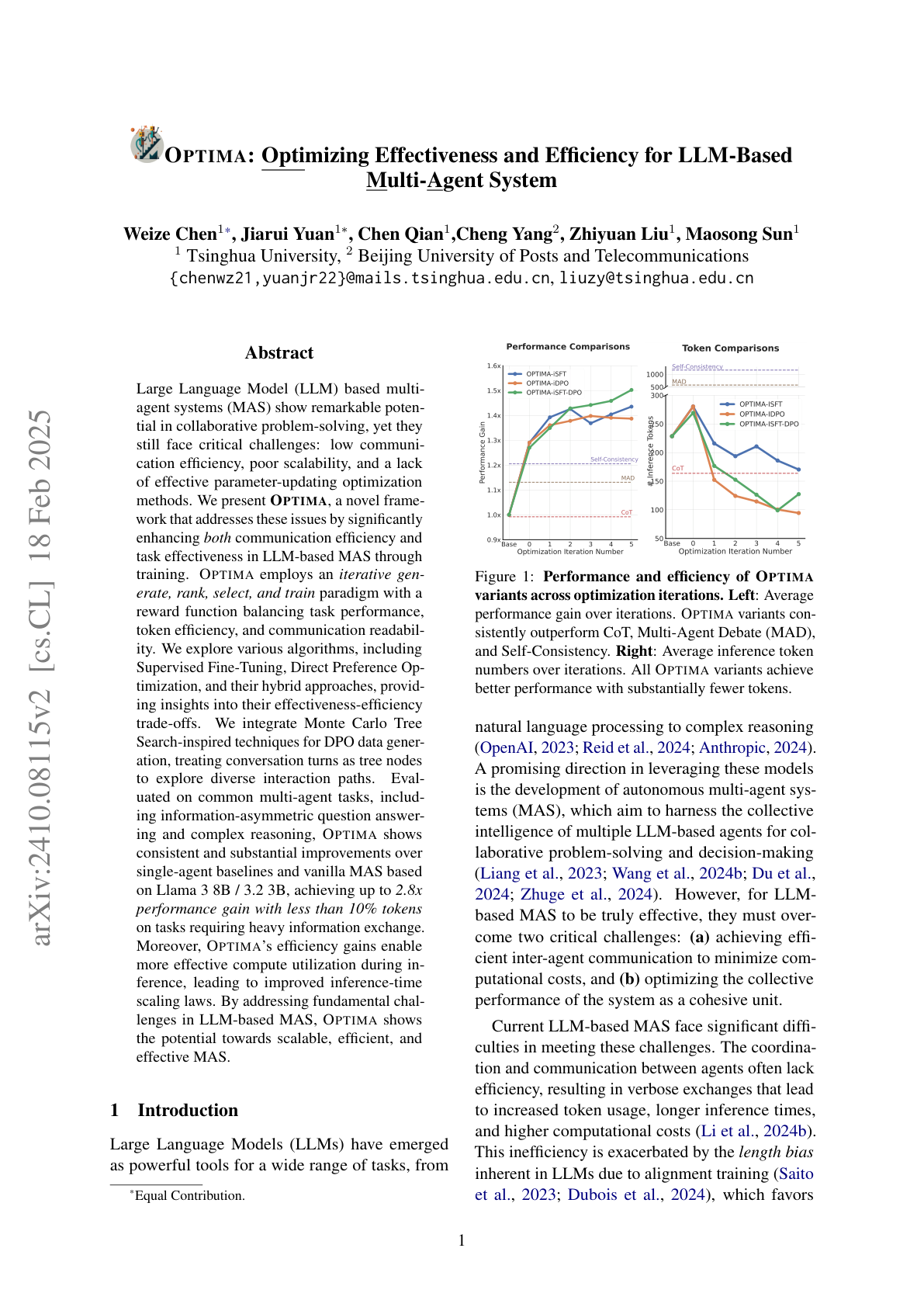
Optima
a novel framework to enhance both communication efficiency and task effectiveness in LLM-based multi-agent systems through LLM training; proposes an iterative generate, rank, select, and train paradigm with a reward function to improve performance, token use, and communication efficiency; integrates Monte Carlo Tree Search-inspired techniques for DPO data generation to encourage diverse exploration; shows consistent improvements over single-agent baselines and vanilla MAS based on Llama 3 8B, with 2.8x performance gain with less than 10% tokens on tasks requiring heavy information exchange.
ScienceAgentBench
a new benchmark to rigorously assess agents built for scientific workflows; after testing it on open-weight and proprietary LLMs, the best-performing agent can only solve 32.4% of the tasks independently and 34.3% with expert-provided knowledge.
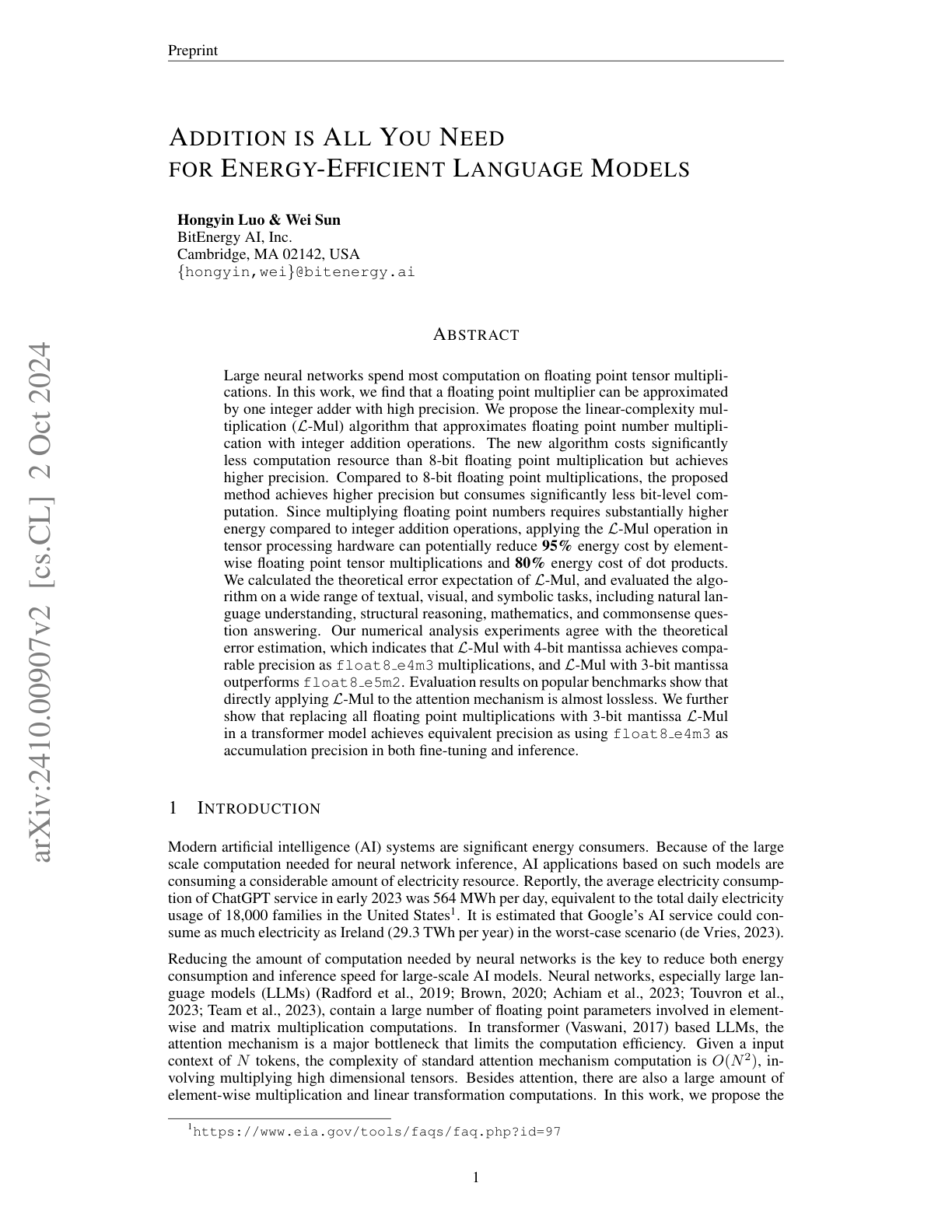
Addition Is All You Need
proposes an algorithm that approximates floating point multiplication with integer addition operations; it is less computationally intensive than 8-bit floating point but achieves higher precision; the authors report that applying the purposed L-Mul operation in tensor processing hardware can potentially reduce 95% energy cost by elementwise floating point tensor multiplications and 80% energy cost of dot products.
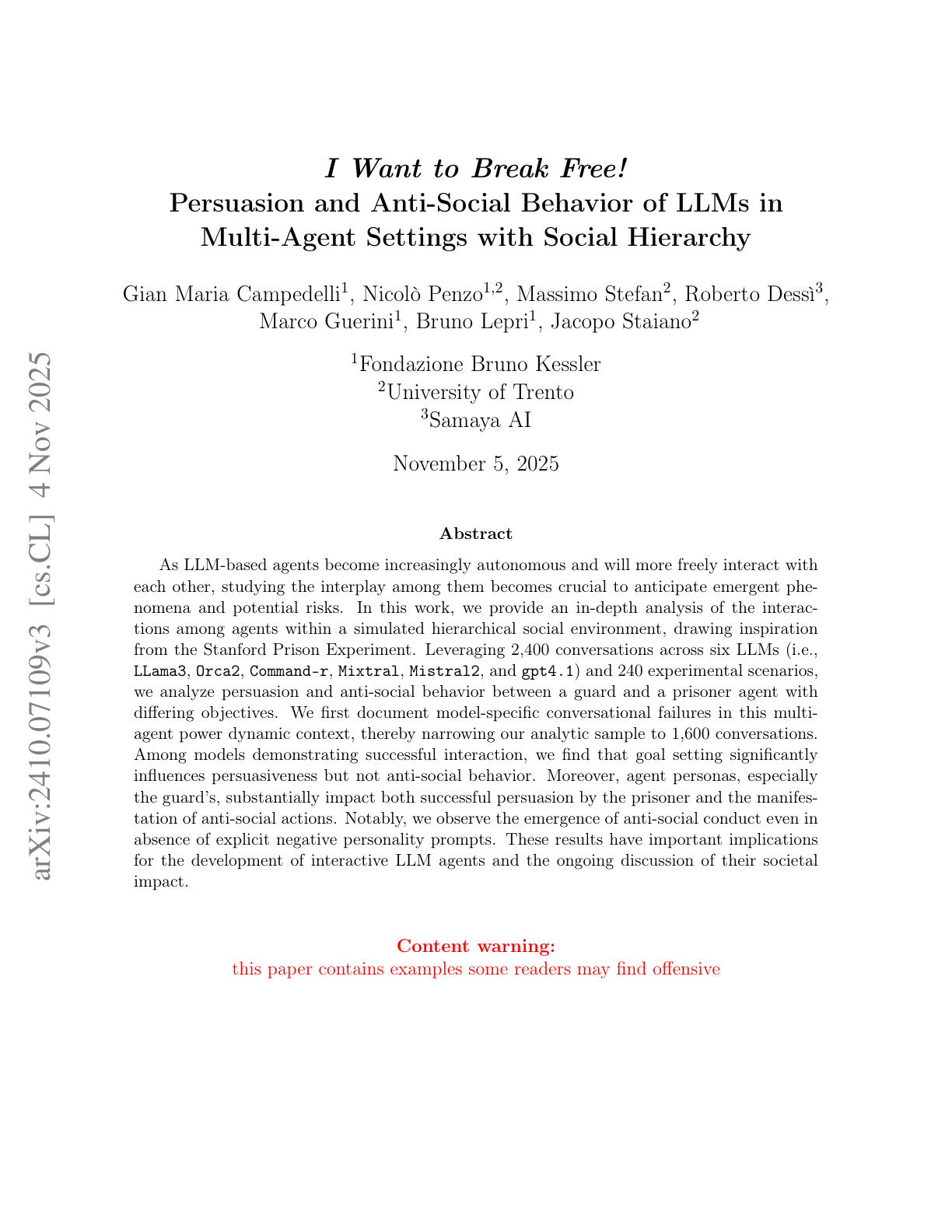
Persuasion and Anti-social Ability of LLMs
studies the interaction patterns of LLMs in a multi-agent setting with social hierarchy; the study was done in a specific setting involving a guard and a prisoner who seeks additional yard time or escaping from prison; finds that in the multi-agent setting where power dynamics are involved, the LLMs fail to have a conversation; they also report that agents' personas are critical in driving the behaviors of the agents. In addition, and without explicit prompting, simply assigning agents' roles lead to anti-social behavior.