Agentic Information Retrieval
provides an introduction to agentic information retrieval, which is shaped by the capabilities of LLM agents; discusses different types of cutting-edge applications of agentic information retrieval and challenges.
Aya Expanse
a family of open-weight foundation models for multilingual capabilities; releases an 8B and 32B parameter model, including one of the largest multilingual dataset collections to date, with 513 million examples; the release also includes Aya-101 which the authors claim is the most comprehensive multilingual models covering 101 languages; Aya Expanse 32B outperforms Gemma 2 27B, Mistral 8x22B, and Llama 3.1 70B, a model 2x its size.
A Theoretical Understanding of CoT
finds that adding correct and incorrect reasoning paths in demonstrations improves the accuracy of intermediate steps and CoT; the proposed method, Coherent CoT, significantly improves performance on several benchmarks; in the Tracking Shuffled Objects dataset, Gemini Pro shows a 6.60% improvement (from 58.20% to 64.80%), and in Penguins in a Table, DeepSeek 67B demonstrates an increase of 6.17% (from 73.97% to 80.14%).
A Survey on Data Synthesis and Augmentation for LLMs
provides a comprehensive summary of data generation techniques in the lifecycle of LLMs; includes discussions on data preparation, pre-training, fine-tuning, instruction-tuning, preference alignment, and applications.
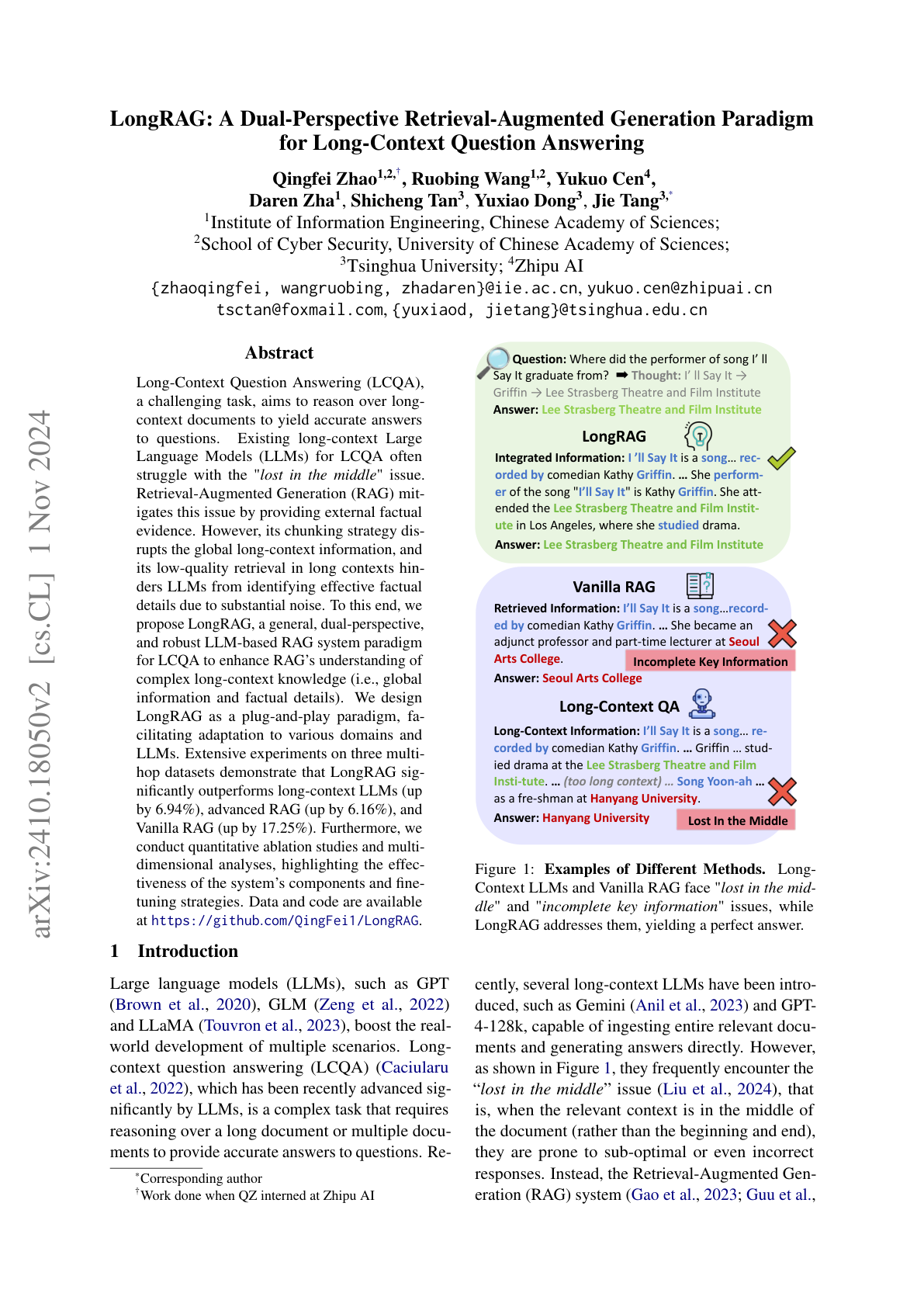
LongRAG
enhances RAG's understanding of long-context knowledge which includes global information and factual details; consists of a hybrid retriever, an LLM-augmented information extractor, a CoT-guided filter, and an LLM-augmented generator; these are key components that enable the RAG system to mine global long-context information and effectively identify factual details; LongRAG outperforms long-context LLMs (up by 6.94%), advanced RAG (up by 6.16%), and Vanilla RAG (up by 17.25%).
Evaluation Feature Steering in LLMs
evaluates featuring steering in LLMs using an experiment that artificially dials up and down various features to analyze changes in model outputs; it focused on 29 features related to social biases and study if feature steering can help mitigate social biases; among its findings, it reports that feature steering sometimes leads to off-target effects and that a neutrality feature can help decreases social biases in 9 social dimensions without negatively affecting text quality.
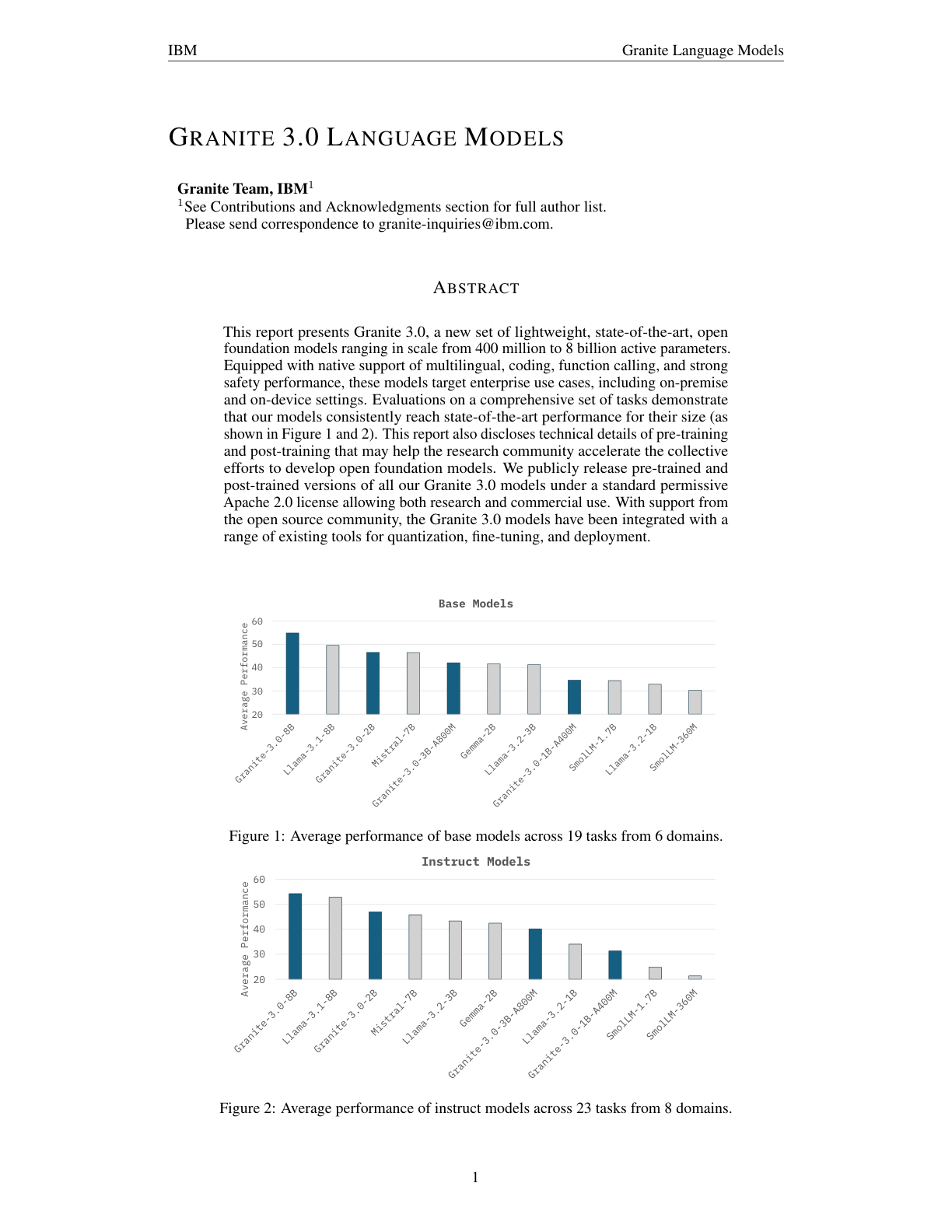
Granite 3.0
presents lightweight foundation models ranging from 400 million to 8B parameters; supports coding, RAG, reasoning, and function calling, focusing on enterprise use cases, including on-premise and on-device settings; demonstrates strong performance across academic benchmarks for language understanding, reasoning, coding, function calling, and safety.
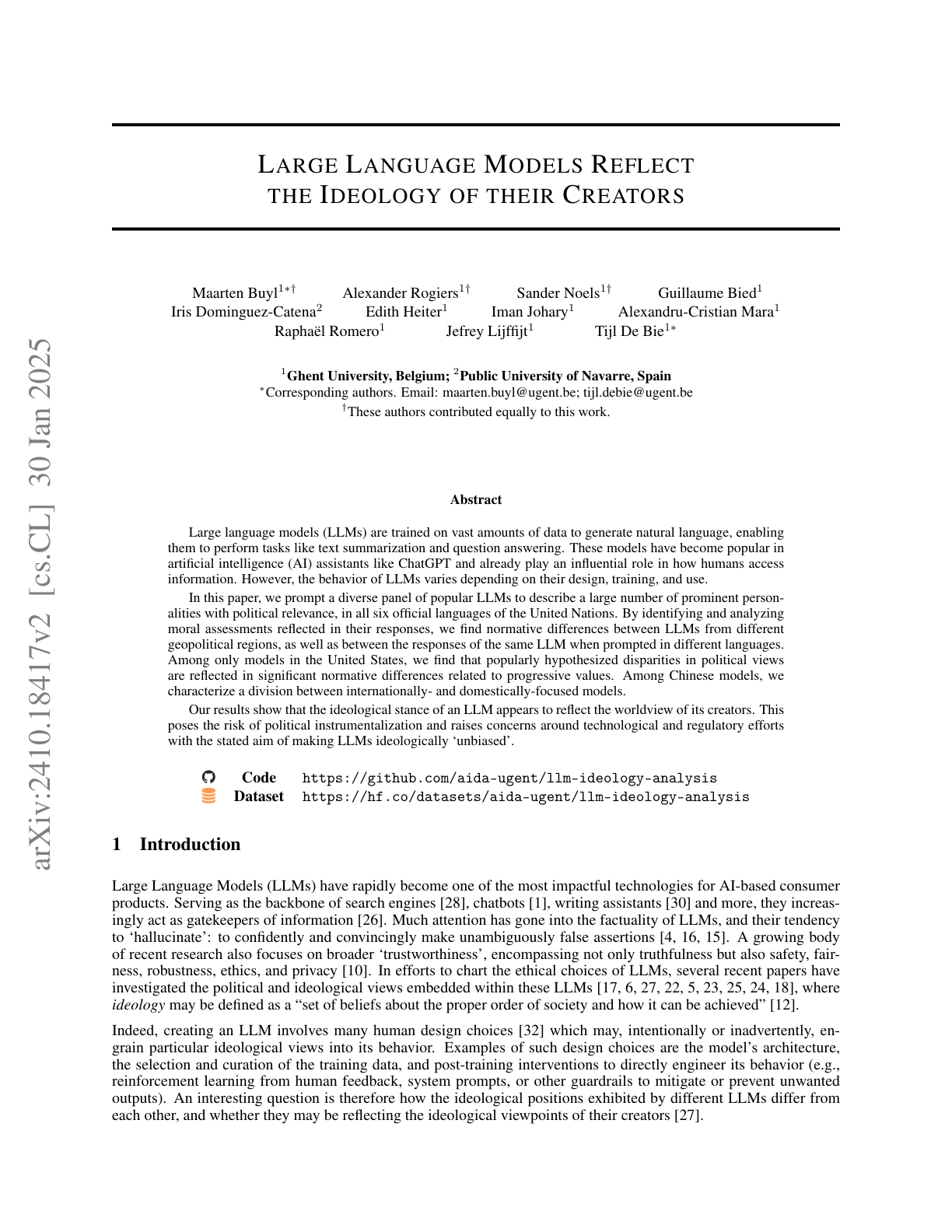
LLMs Reflect the Ideology of their Creators
finds that LLMs exhibit a diverse ideological stance which reflects the worldview of its creators; finds consistent normative differences between how the same LLM responds in Chinese compared to English; identifies normative disagreements between Western and non-Western LLMs about prominent actors in geopolitical conflicts.
Scalable Watermarking for LLMs
proposes SynthID-Text, a text-watermarking scheme that can preserve text quality in LLMs, enable high detection accuracy, and minimize latency overhead; it integrates watermarking with speculative sampling that consists of the final pattern of scores for a model’s word choices combined with the adjusted probability scores; the authors test the feasibility and scalability of the approach by assessing feedback on nearly 10 million Gemini responses.
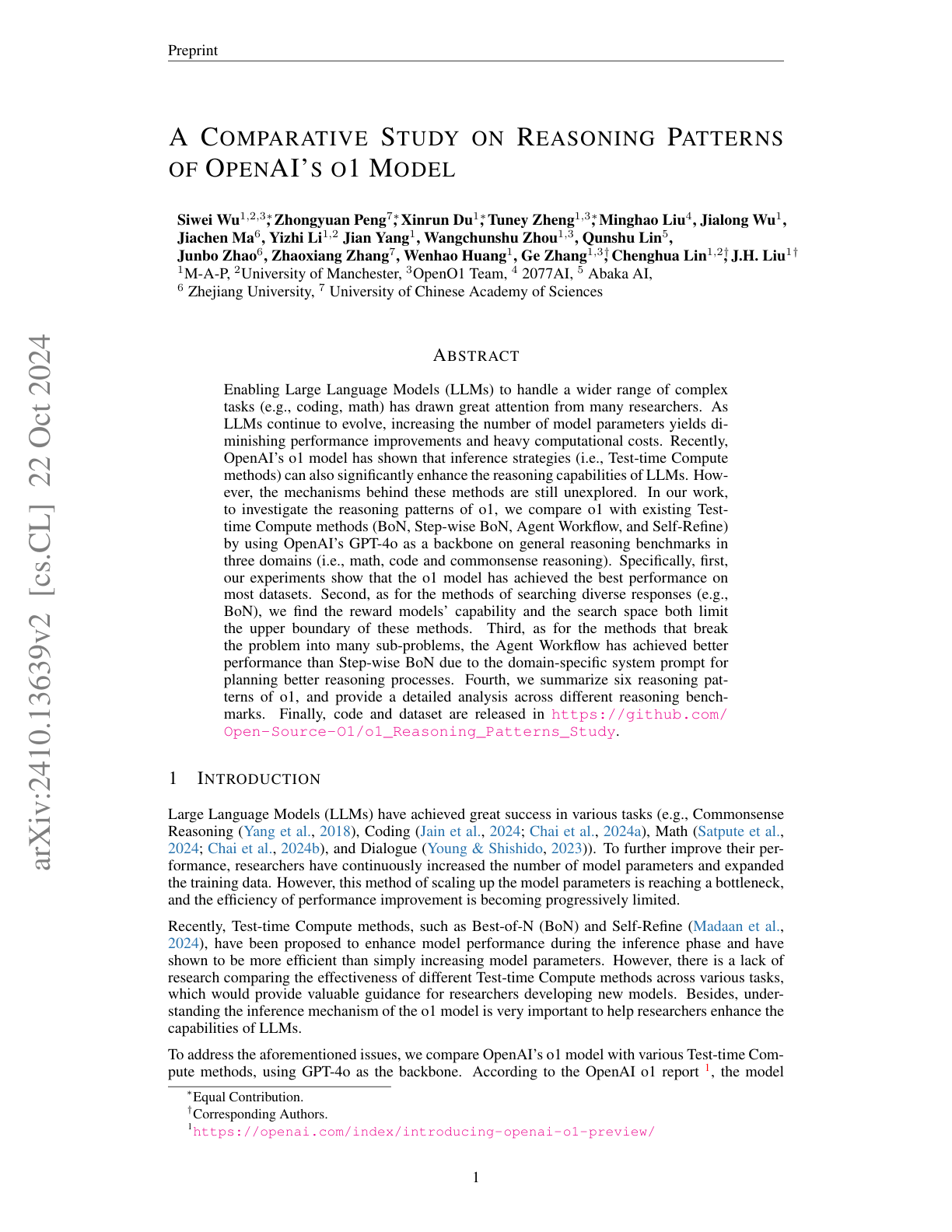
Reasoning Patterns of OpenAI’s o1 Model
when compared with other test-time compute methods, o1 achieved the best performance across most datasets; the authors observe that the most commonly used reasoning patterns in o1 are divide and conquer and self-refinement; o1 uses different reasoning patterns for different tasks; for commonsense reasoning tasks, o1 tends to use context identification and emphasize constraints; for math and coding tasks, o1 mainly relies on method reuse and divide and conquer.