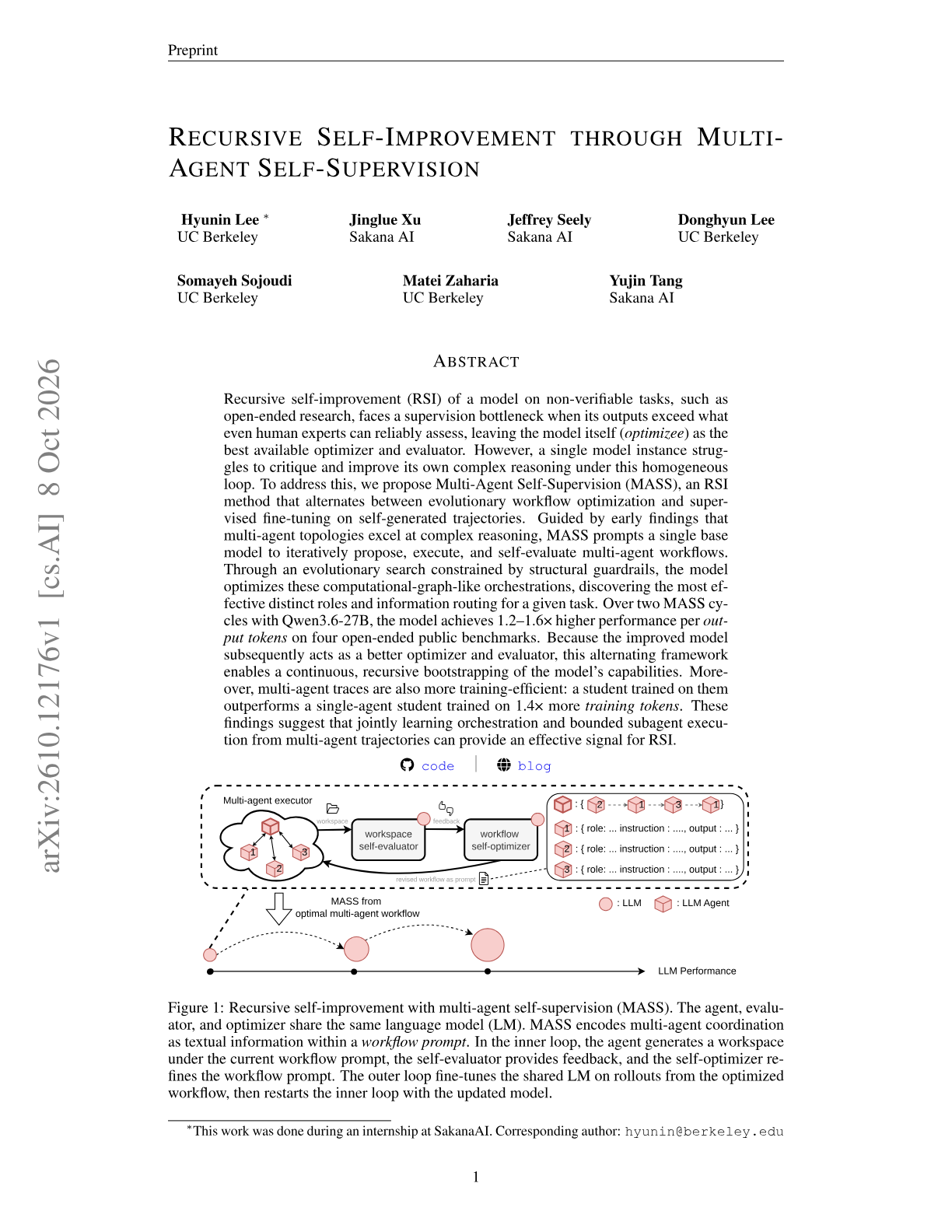
Recursive Self-Improvement through Multi-Agent Self-Supervision
Recursive self-improvement on open-ended tasks such as research runs into a supervision problem, because the outputs can exceed what even human experts can reliably assess and there is no external checker. Researchers from Sakana AI propose Multi-Agent Self-Supervision (MASS), where a single base model acts as the agent, the evaluator, and the optimizer.
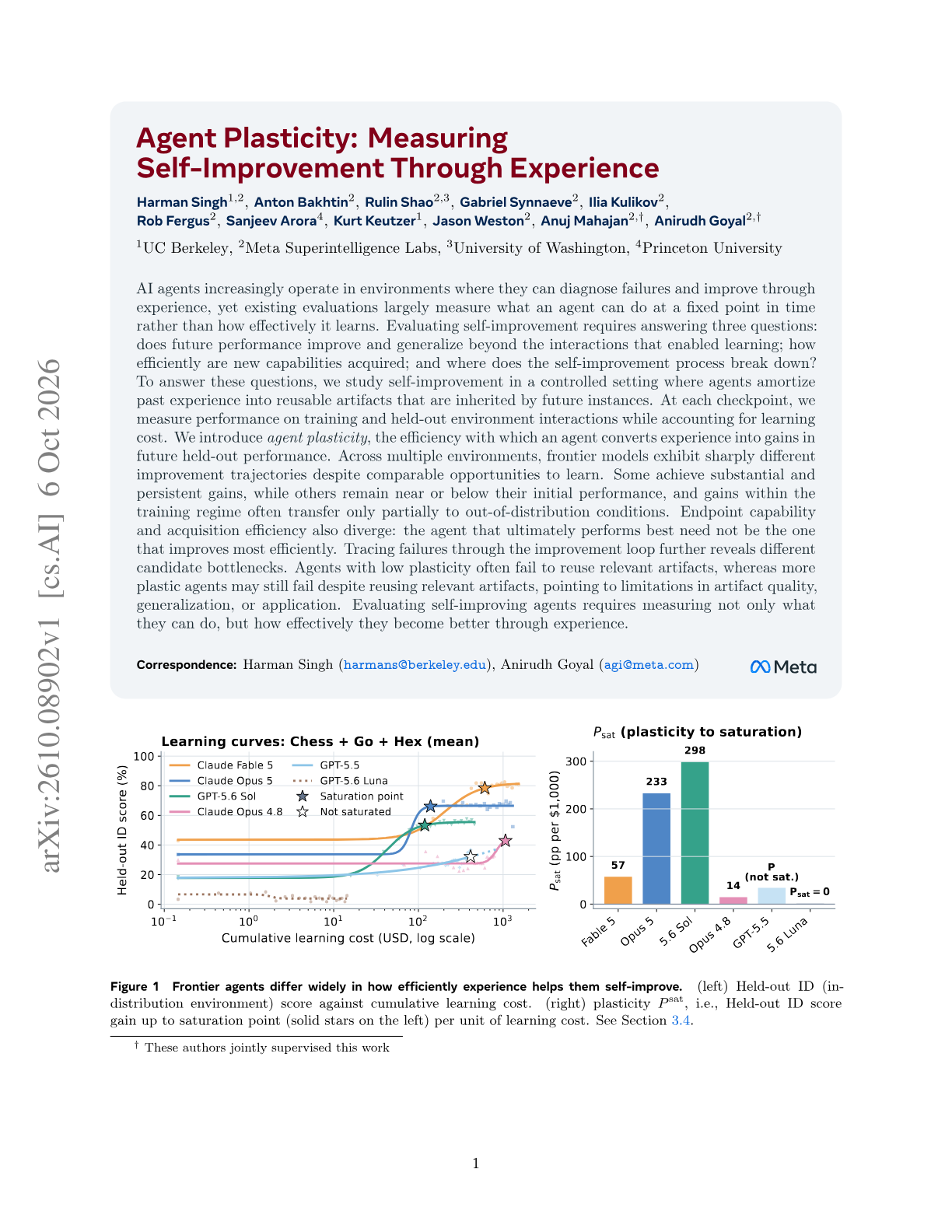
Agent Plasticity: Measuring Self-Improvement Through Experience
Researchers from Meta Superintelligence Labs introduce agent plasticity, a measure of how efficiently an agent converts experience into gains on held-out tasks per dollar spent on learning, with model weights frozen and each run starting from a fresh context while inheriting artifacts written by earlier runs. The model with the best final score is often a different model from the one that learns most efficiently. In chess, Go, and Hex, Claude Fable 5 reaches the highest final score while GPT-5.6 Sol gains the most per dollar, and in NetHack only Claude Opus 5.5 improves significantly, by 66 normalized points for about $1,073 of learning. Slow learners often ignore artifacts they already wrote, while faster learners reuse their artifacts and still fail when an artifact is low quality.
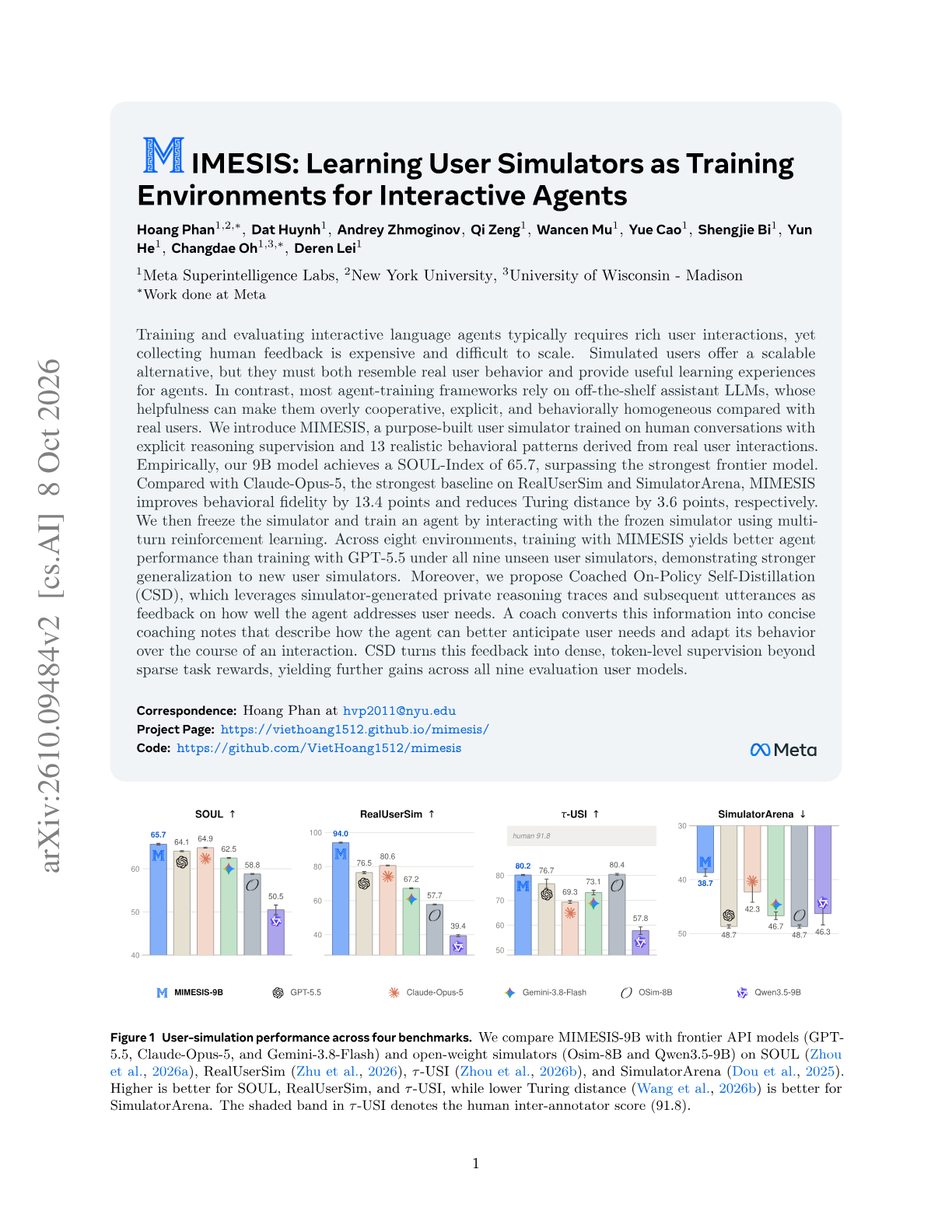
MIMESIS: Learning User Simulators as Training Environments for Interactive Agents
Agent RL setups usually let an assistant LLM play the user, which makes the simulated user overly cooperative and explicit, and a fixed GPT-5.5 agent finds tau-bench tasks easier with these users than with real people. Researchers from Meta Superintelligence Labs train MIMESIS, a 9B user simulator built from human conversations with explicit reasoning supervision and 13 behavioral patterns observed in real users, which beats Claude Opus 5 on behavioral fidelity by 13.4 points. Agents trained against the frozen simulator with multi-turn RL outperform agents trained against GPT-5.5 under all nine unseen user simulators, and a coaching step that turns the simulator's private reasoning into token-level feedback adds further gains.
Continuous Memory Machines
Sakana AI's Continuous Memory Machine gives a recurrent model two matrix-valued memories, a short-term store that tracks recent neuron activity and a long-term store for information needed later, with a Transformer reading and writing both at every step. Built on the Continuous Thought Machine, it beats LSTM, DNC, RMC, and CTM baselines on copy, associative recall, sorting, few-shot regression, and maze solving, and it generalizes to longer inputs than earlier memory-augmented networks. Its attention maps show it uses long-term memory for algorithmic and in-context tasks and skips it when a task does not need it.
Harness Engineering for Software Engineering via Modular Executable Dev-Primitives
Software engineering agents on long-horizon tasks keep reconstructing program state spread across source files, configurations, tests, and dependencies, which leads to long interaction histories and context explosion. HERMES is a harness that turns repository components into active participants in the task.
VERA: Scaling Verifiable Environments for Agentic co-Evolution
Long-horizon agents need environments that can be resumed at any stage and scored from observable evidence, yet most environments score only the final outcome. Researchers from NVIDIA present VERA, which builds such environments at scale and uses them to update both the model and its harness.
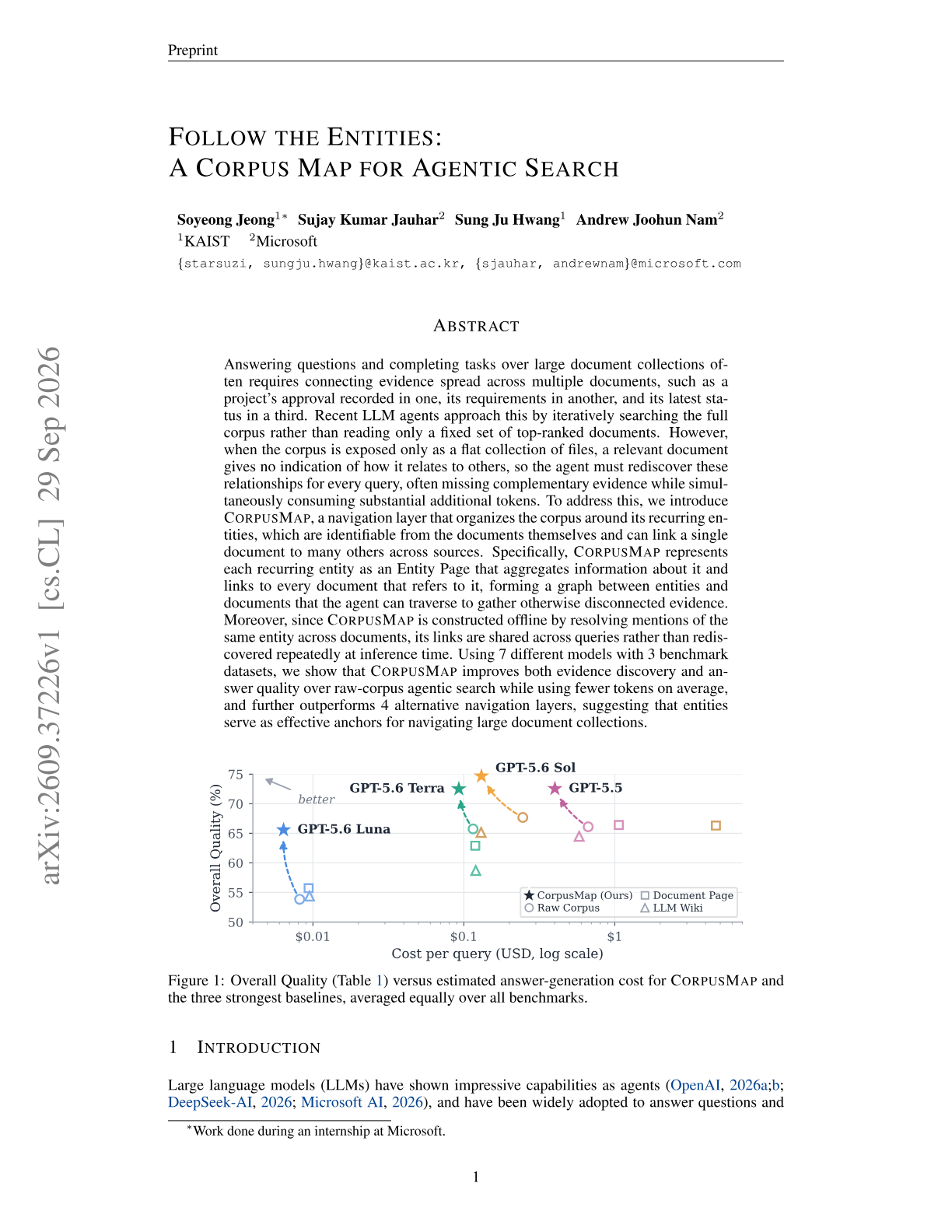
Follow the Entities: A Corpus Map for Agentic Search
Agents that search large document collections usually see the corpus as a flat set of files, so a relevant document gives no hint of how it connects to others. Researchers from Microsoft and colleagues introduce CorpusMap, a navigation layer built around the entities that recur across a collection.
Harness Learning Enables Generalizable Test-Time Adaptation
An agent is defined by its model and its harness, the program that organizes model calls, tool use, and information flow. Researchers from CMU train a proposer model to revise that harness from execution feedback, and the solver model's weights never change.
Sharpening Tax in Post-Training
A common hypothesis holds that RL post-training only sharpens behaviors the base model already has, raising single-shot accuracy at the cost of solution coverage. Researchers from Meta Superintelligence Labs test whether this holds for agentic tasks, where multi-turn tool use might need capabilities learned during post-training.
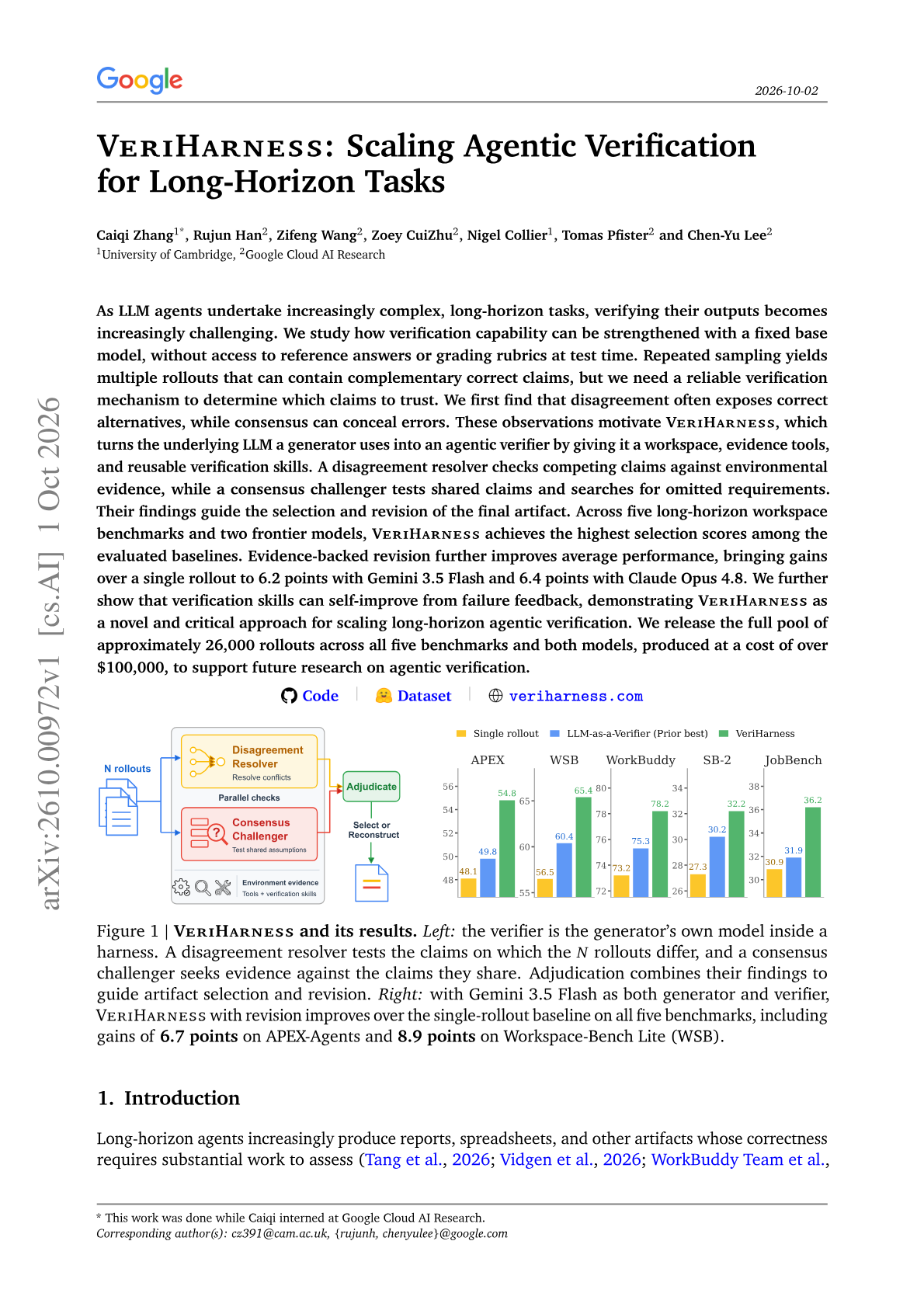
VeriHarness: Scaling Agentic Verification for Long-Horizon Tasks
A common practice with long-horizon agents is to sample several rollouts and trust the answers they agree on. Researchers from Google show that agreement can hide shared errors while disagreement often points to the correct alternative, and they build VeriHarness to verify rollouts with the same base model.