Discovering state-of-the-art quantum circuits with large language models
Many quantum algorithms spend most of their resources on a small set of computational primitives, and compiling those primitives into quantum circuits is hard because the computation must be reversible. Researchers from Anthropic, Harvard, and QuEra Computing pair an LLM that proposes circuit designs with an independent evaluator that verifies and scores every candidate.
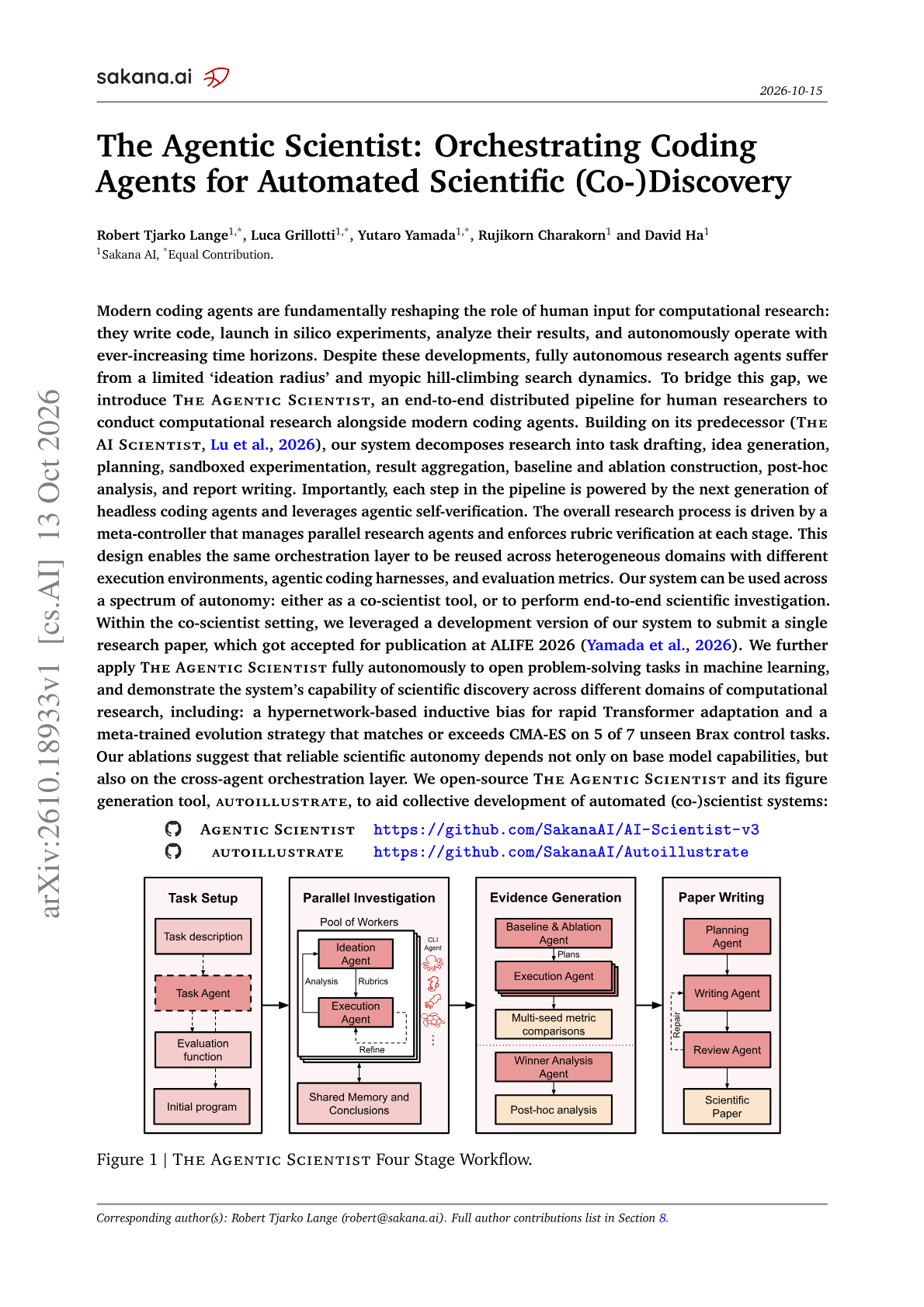
The Agentic Scientist: Orchestrating Coding Agents for Automated Scientific (Co-)Discovery
Fully autonomous research agents tend to have a narrow range of ideas and hill-climb myopically. Researchers from Sakana AI introduce The Agentic Scientist, an end-to-end distributed pipeline that lets human researchers run computational research alongside modern coding agents.
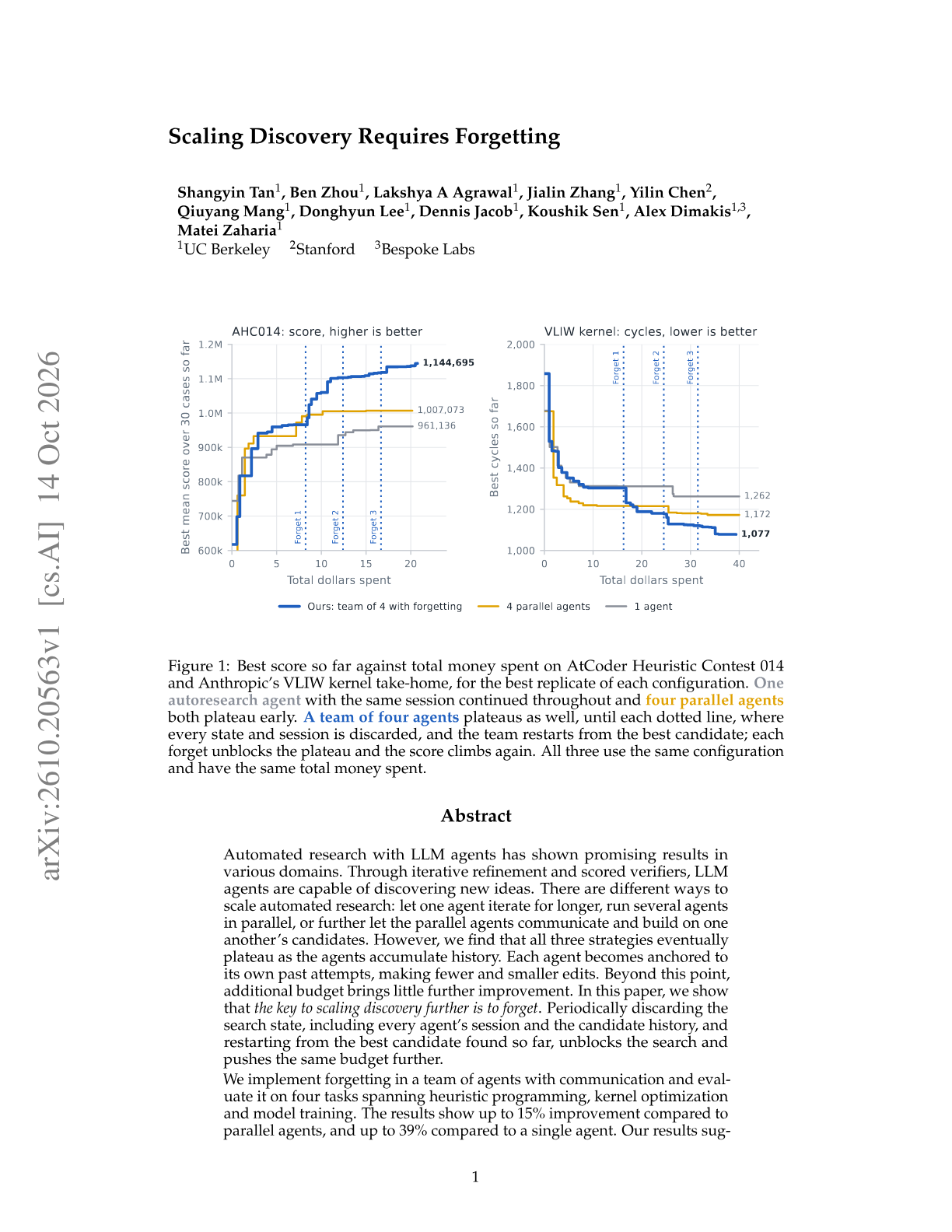
Scaling Discovery Requires Forgetting
Automated research with coding agents can now run for days on a single problem, yet the search often stops improving early. Researchers from UC Berkeley, Stanford, and Bespoke Labs show that the fix is to make the agents forget.
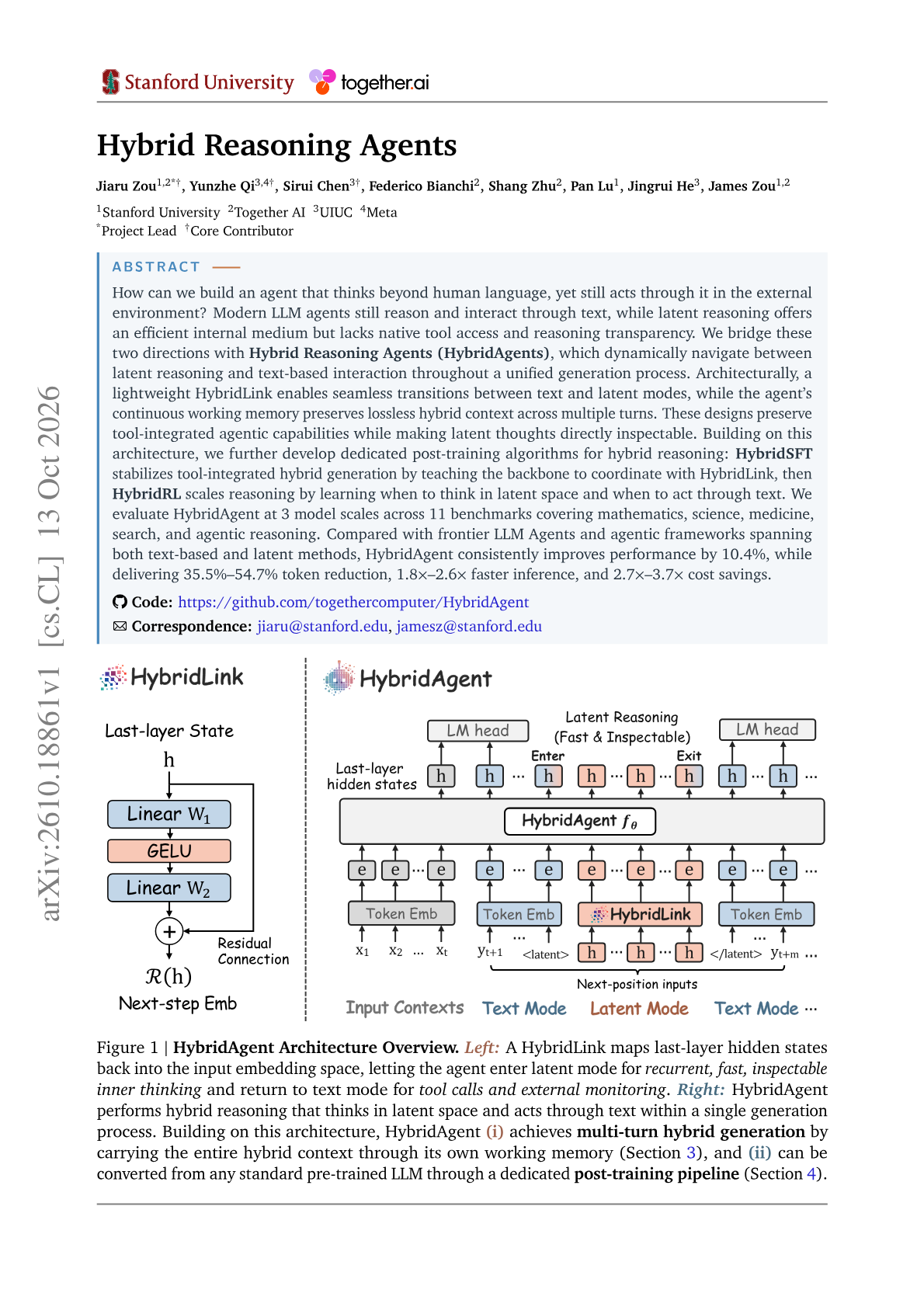
Hybrid Reasoning Agents
Today's LLM agents write out every reasoning step as text before they search, run code, or take an action, and those steps cost tokens and time. Researchers from Stanford, Together AI, and colleagues introduce Hybrid Reasoning Agents, which reason internally in latent space and switch to text only to call a tool or give an answer.
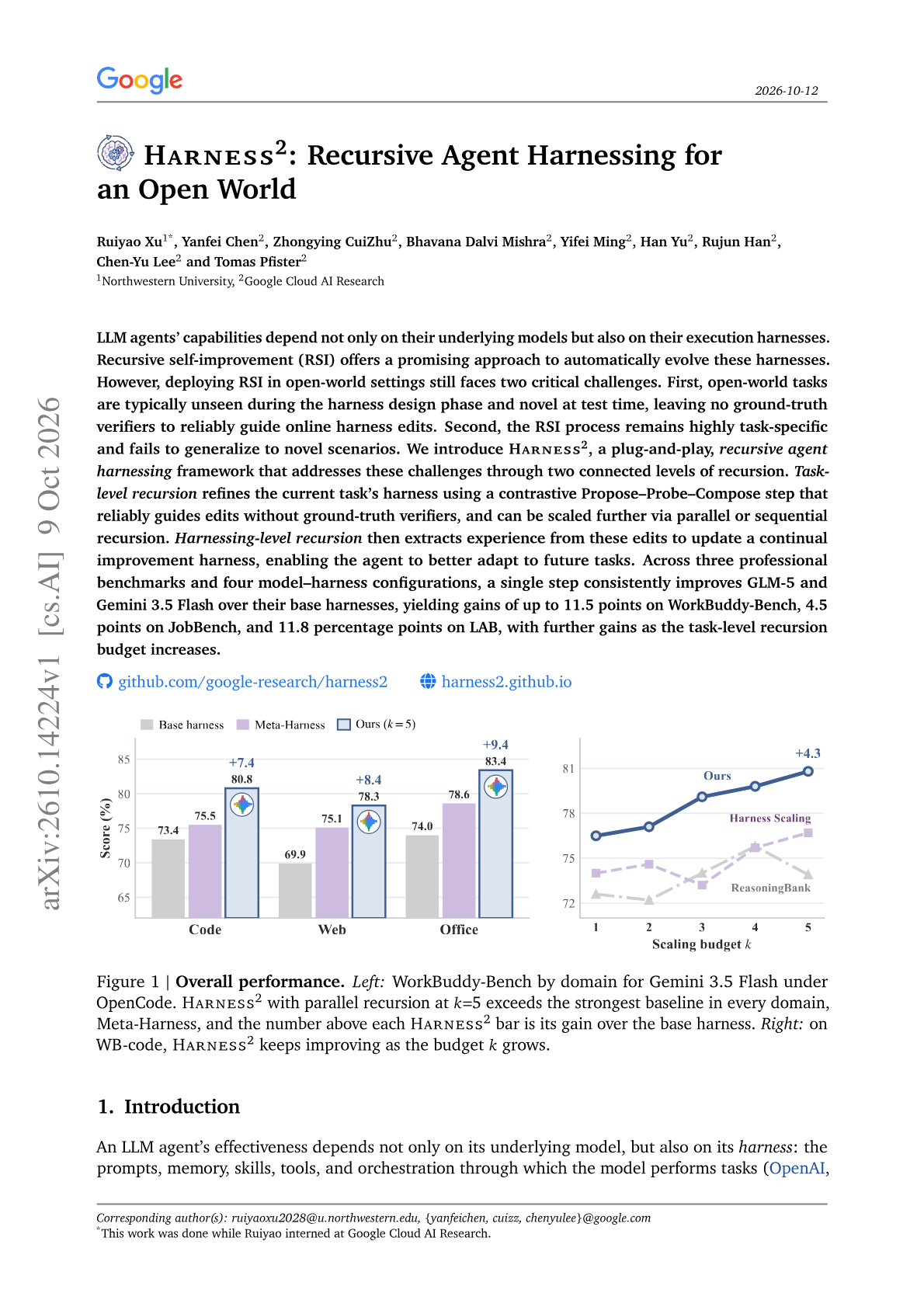
Harness^2: Recursive Agent Harnessing for an Open World
Recursive self-improvement of agent harnesses usually depends on a verifier, and open-world tasks are new at test time, so no ground-truth checker exists. Researchers from Google Cloud AI Research and Northwestern University introduce Harness^2, a plug-and-play framework that improves the harness at test time through two connected levels of recursion.
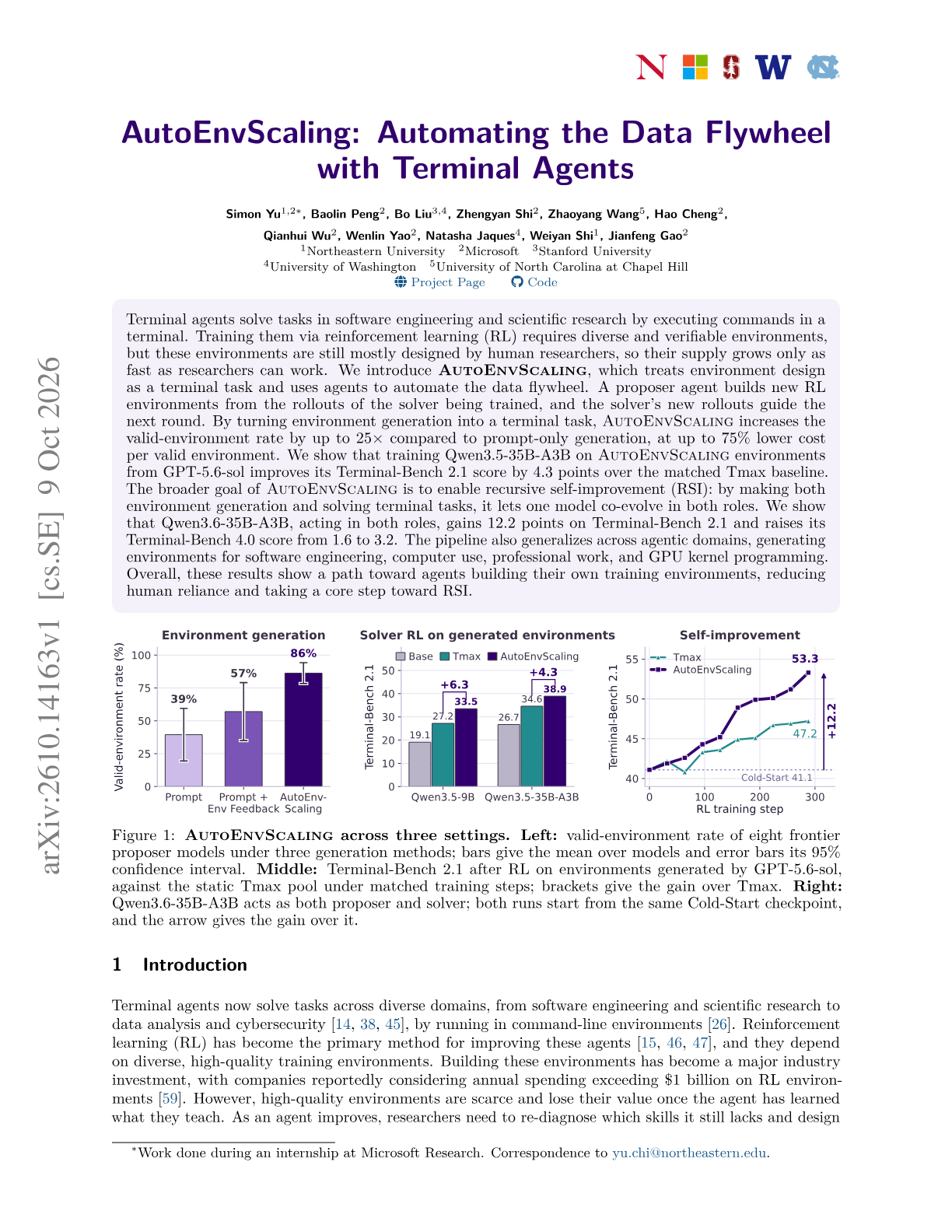
AutoEnvScaling: Automating the Data Flywheel with Terminal Agents
Researchers from Microsoft and collaborators hand RL environment design to a proposer agent that works in a terminal, studies the rollouts of the model being trained, and builds new environments from them, with each round of rollouts guiding the next. Building environments in a terminal raises the share of valid environments up to 25 times over prompt-only generation at up to 75% lower cost per valid environment. With Qwen3.6-35B-A3B acting as both proposer and solver, Terminal-Bench 2.1 rises from 41.1 to 53.3, and the pipeline also generates environments for software engineering, computer use, and GPU kernel work.
Recurrent Harness for Agentic Continual Learning
Agent memory harnesses usually only write forward, so a lesson goes into the bank and is never checked against whether it helped. Researchers from MIT, Meta, and Yale propose ReHarness, a recurrent harness for agentic continual learning that adds backward revision to the usual forward read and write.
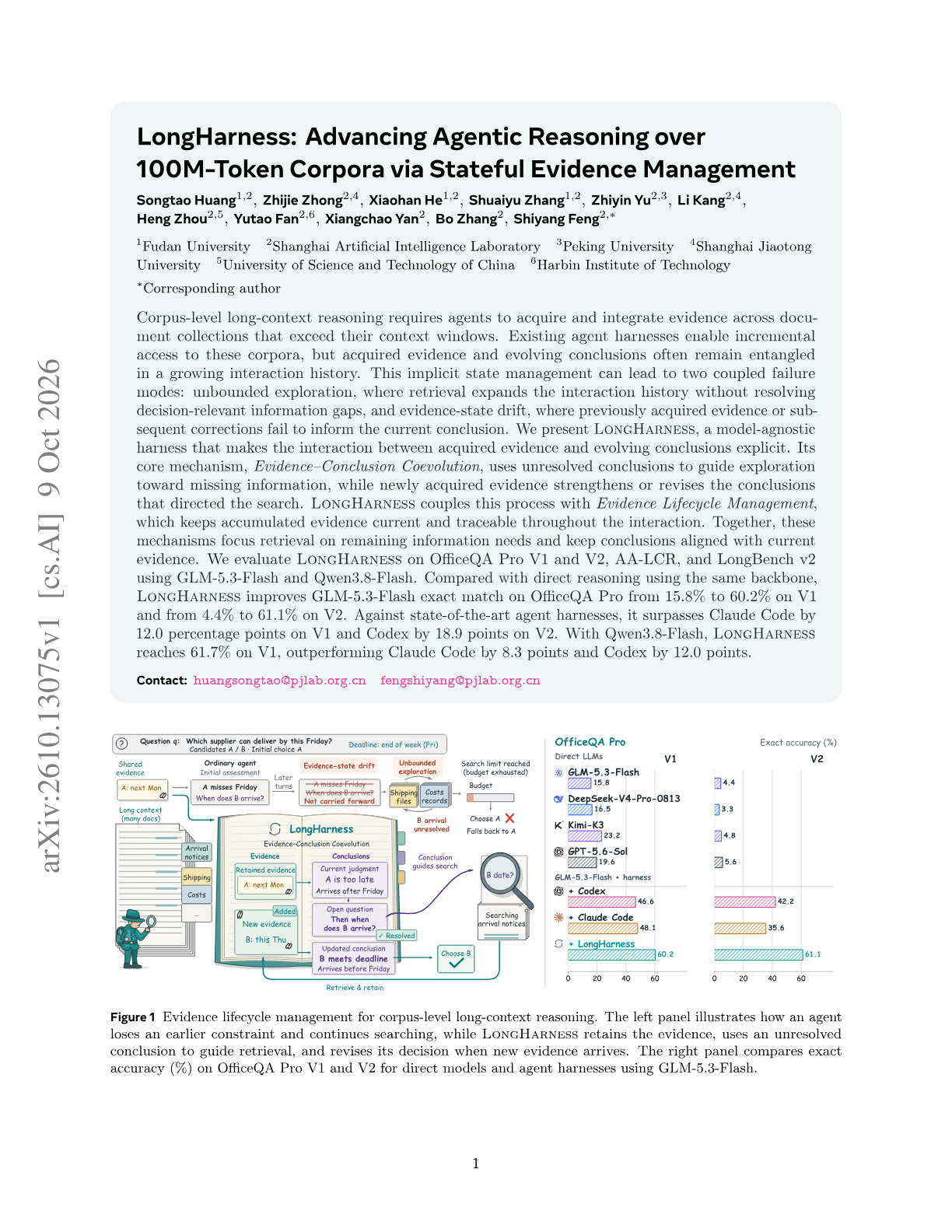
LongHarness: Advancing Agentic Reasoning over 100M-Token Corpora via Stateful Evidence Management
Agents that reason over document collections larger than their context window usually keep retrieved evidence and their evolving conclusions mixed into one growing interaction history. Researchers from Shanghai AI Laboratory, Fudan University, and colleagues present LongHarness, a model-agnostic harness for corpora of 100M tokens and more that keeps evidence and conclusions as explicit state.
LoGRA: Scaling LLM Reinforcement Learning with Low-Rank Gradient Sketches
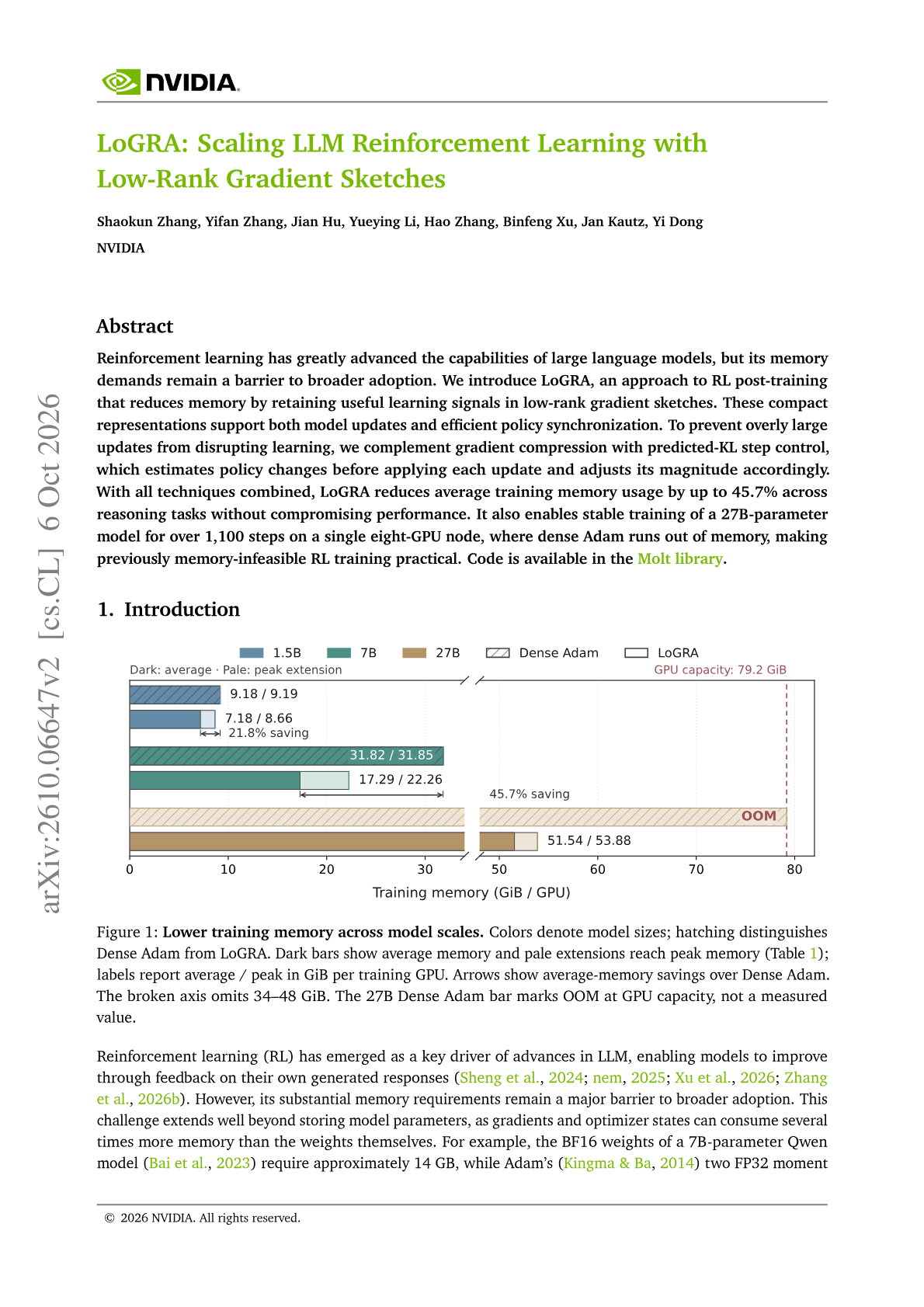
NVIDIA researchers present LoGRA, an RL post-training method that updates all of a model's weights while using less memory than LoRA, by compressing each weight gradient into a low-rank sketch that is redrawn every step and adding predicted-KL step control to keep updates within a budget. At 1.5B it averages 7.2 GiB of training memory against 13.2 GiB for rank-256 LoRA with similar Pass@4, and at 7B it cuts average training memory per GPU by 45.7% with peak accuracy close to dense Adam. It also trains a 27B model for more than 1,100 steps on a single eight-GPU node, where dense Adam runs out of memory.
GitSwarm: Decentralized Compounding Inference
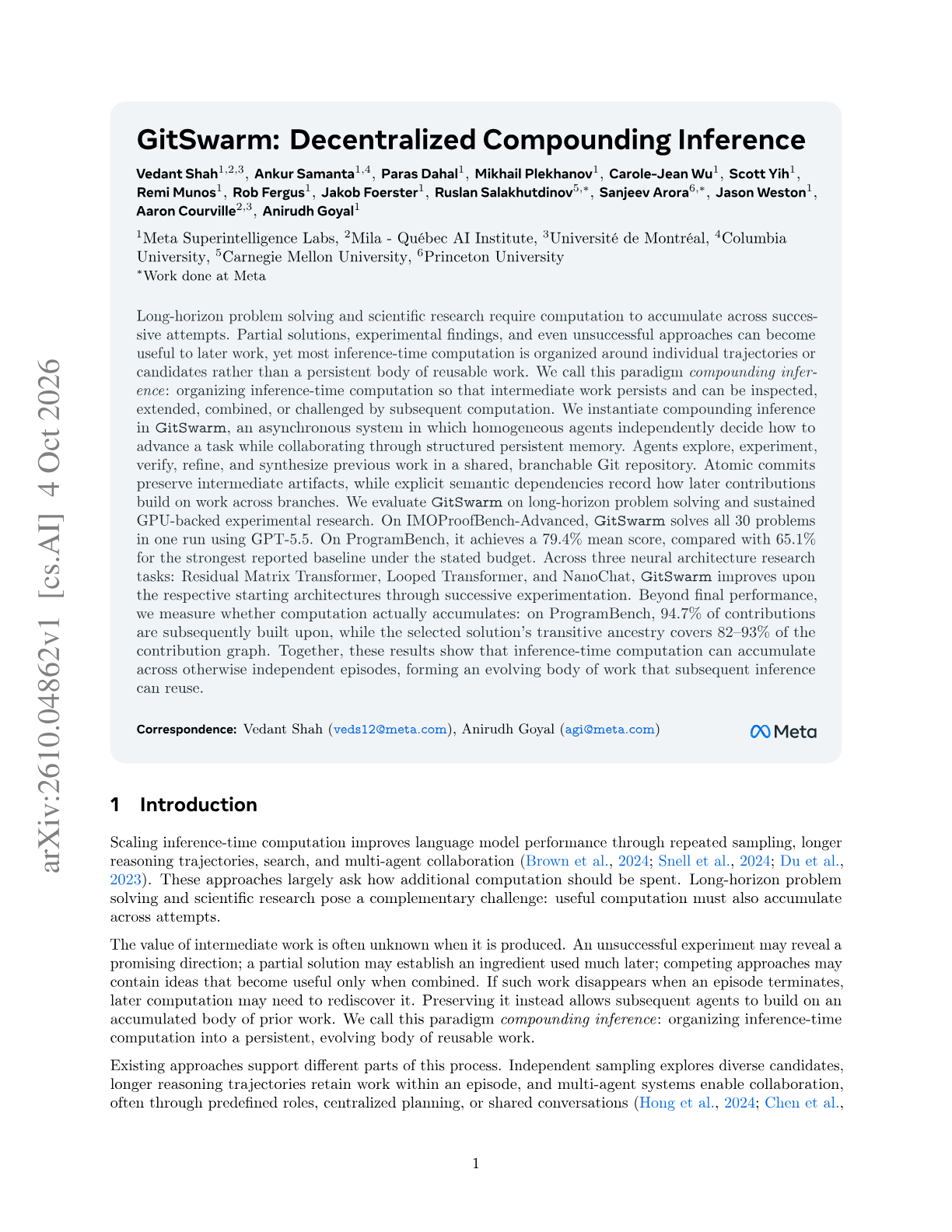
Researchers from Meta Superintelligence Labs and colleagues build GitSwarm, where hundreds of asynchronous agents share one Git repository and each contribution is a commit that records which earlier commits, on any branch, it builds on, with no central planner assigning work. With GPT-5.5 Codex workers it solves all 30 IMOProofBench-Advanced problems in one run and scores 79.4% on ProgramBench against 65.1% for a single Codex agent at a similar budget, rising from 73.1% at 100 workers to 79.4% at 500. Later workers build on 94.7% of published contributions, and 70.1% of failed research commits are cited by later accepted work.