xLSTM: Extended Long Short-Term Memory
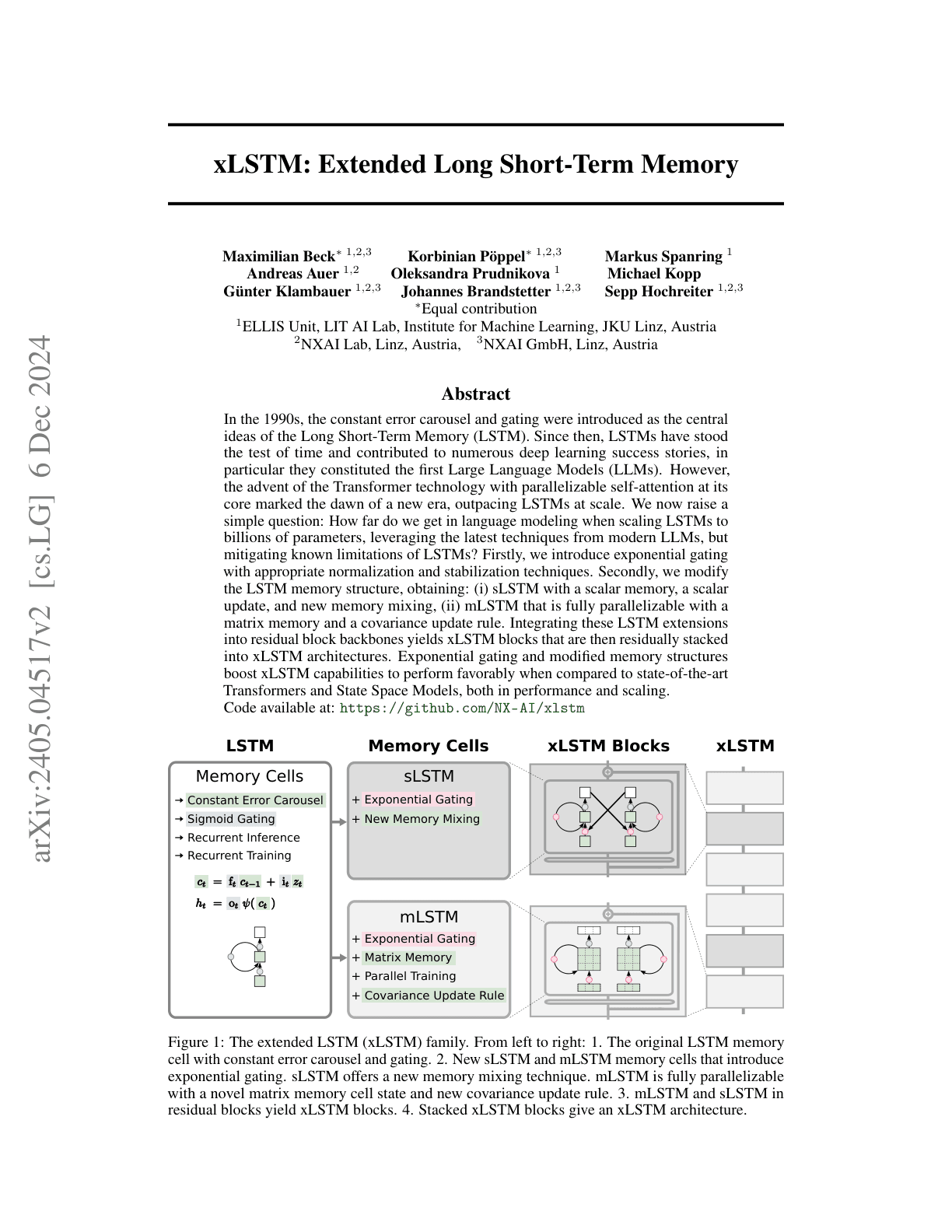
attempts to scale LSTMs to billions of parameters using the latest techniques from modern LLMs and mitigating common limitations of LSTMs; to enable LSTMs the ability to revise storage decisions, they introduce exponential gating and a new memory mixing mechanism (termed sLSTM); to enhance the storage capacities of LSTMs, they add a matrix memory and a covariance update rule (termed mLSTM); Both the sLSTM and xLSTM cells stabilize their exponential gates using the same technique; these extensions lead to xLSTM blocks that are residually stacked into the final xLSTM architecture; compared to Transformers, xLSTMs have a linear computation and constant memory complexity concerning the sequence length; the xLSTM architecture is shown to be efficient at handling different aspects of long context problems; achieves better validation perplexities when compared to different model classes like Transformers, SSMs, and RNNs.
Ask this paper
Abstract
In the 1990s, the constant error carousel and gating were introduced as the central ideas of the Long Short-Term Memory (LSTM). Since then, LSTMs have stood the test of time and contributed to numerous deep learning success stories, in particular they constituted the first Large Language Models (LLMs). However, the advent of the Transformer technology with parallelizable self-attention at its core marked the dawn of a new era, outpacing LSTMs at scale. We now raise a simple question: How far do we get in language modeling when scaling LSTMs to billions of parameters, leveraging the latest techniques from modern LLMs, but mitigating known limitations of LSTMs? Firstly, we introduce exponential gating with appropriate normalization and stabilization techniques. Secondly, we modify the LSTM memory structure, obtaining: (i) sLSTM with a scalar memory, a scalar update, and new memory mixing, (ii) mLSTM that is fully parallelizable with a matrix memory and a covariance update rule. Integrating these LSTM extensions into residual block backbones yields xLSTM blocks that are then residually stacked into xLSTM architectures. Exponential gating and modified memory structures boost xLSTM capabilities to perform favorably when compared to state-of-the-art Transformers and State Space Models, both in performance and scaling.