A Few Tokens Are All You Need
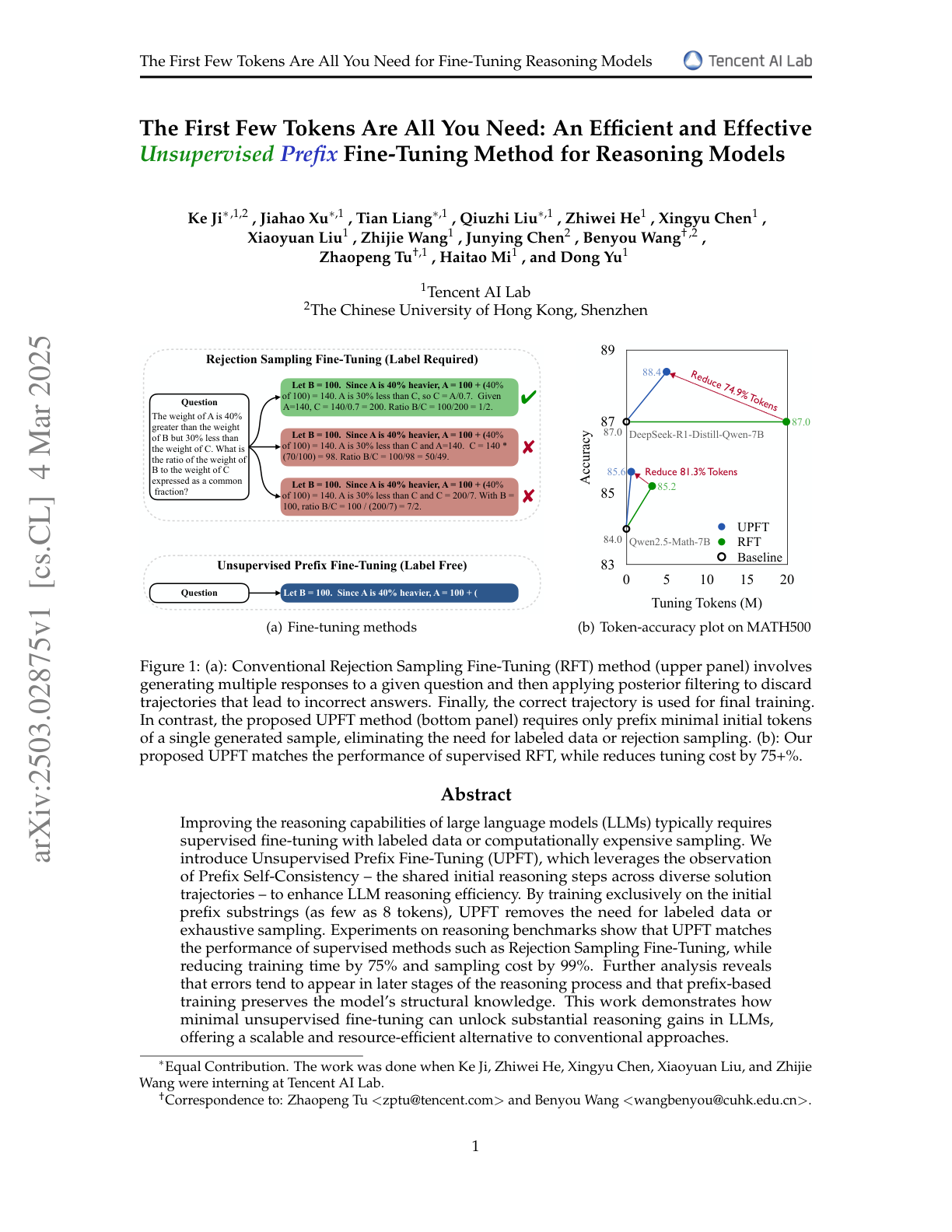
Researchers from Tencent AI Lab and The Chinese University of Hong Kong, Shenzhen propose a new approach to boost reasoning in LLMs by only fine-tuning on the first few tokens of generated solutions. Key ideas include:
Ask this paper
Prefix Self-Consistency - The authors show that even if different solution paths diverge later, their initial tokens often share core reasoning steps. Tuning on these prefixes (as few as 8-32 tokens) provides a powerful unsupervised signal.
Minimal Token Training - By training only on short prefixes, the method drastically reduces computational cost (up to 16× fewer tokens vs. full-chain fine-tuning) while preserving reasoning structure.
Comparable to Supervised Methods - Despite relying on unsupervised prefixes (no correctness filtering), it matches or exceeds the performance of more compute-heavy methods like Rejection Sampling Fine-Tuning (RFT).
Broad Applicability - It works with different LLM architectures (general-purpose and math-specialized) and scales effectively from small to large custom datasets.
Label-Optional Approach - Works in purely unsupervised mode but can also incorporate ground-truth answer checks if available, further boosting accuracy.