Adapting the Interface, Not the Model
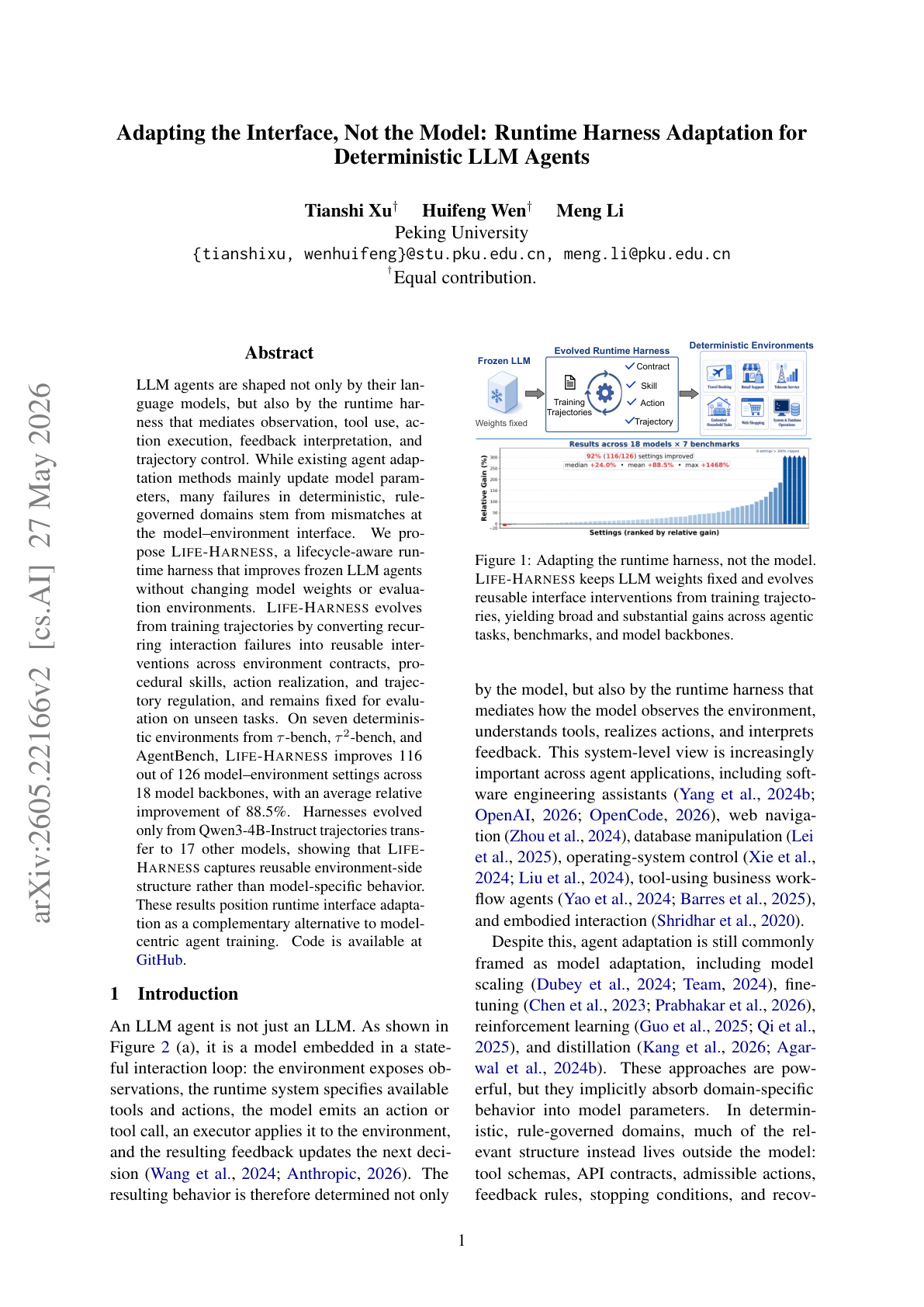
When a frozen LLM agent repeatedly fails in a deterministic, rule-governed environment, do you have to retrain the model? Life-Harness argues no. Many failures come from mismatches at the model-environment interface, not from the model's reasoning, so the fix belongs in the runtime harness. Life-Harness is a lifecycle-aware harness that improves frozen agents without touching model weights or the evaluation environment.
Ask this paper
Failures become reusable interventions: Recurring errors are turned into runtime fixes across four areas: action realization, environment contracts, trajectory regulation, and procedural skills. Each fix is a harness-level patch the agent reuses on later attempts.
Model frozen, environment intact: Nothing about the model or the benchmark changes. Only the interface between them adapts, which keeps the approach drop-in for any backbone and avoids the cost and risk of fine-tuning.
Broad, consistent gains: Across 7 deterministic agent benchmarks and 18 model backbones, Life-Harness improves 116 of 126 model-environment settings, with an 88.5% average relative improvement. The effect holds across model scales rather than helping only weak models.
Why it matters: This is more evidence for the code-as-harness thesis: a large share of agent failures are interface problems that harness engineering can fix without retraining. For builders, the leverage is in the runtime, not the model.