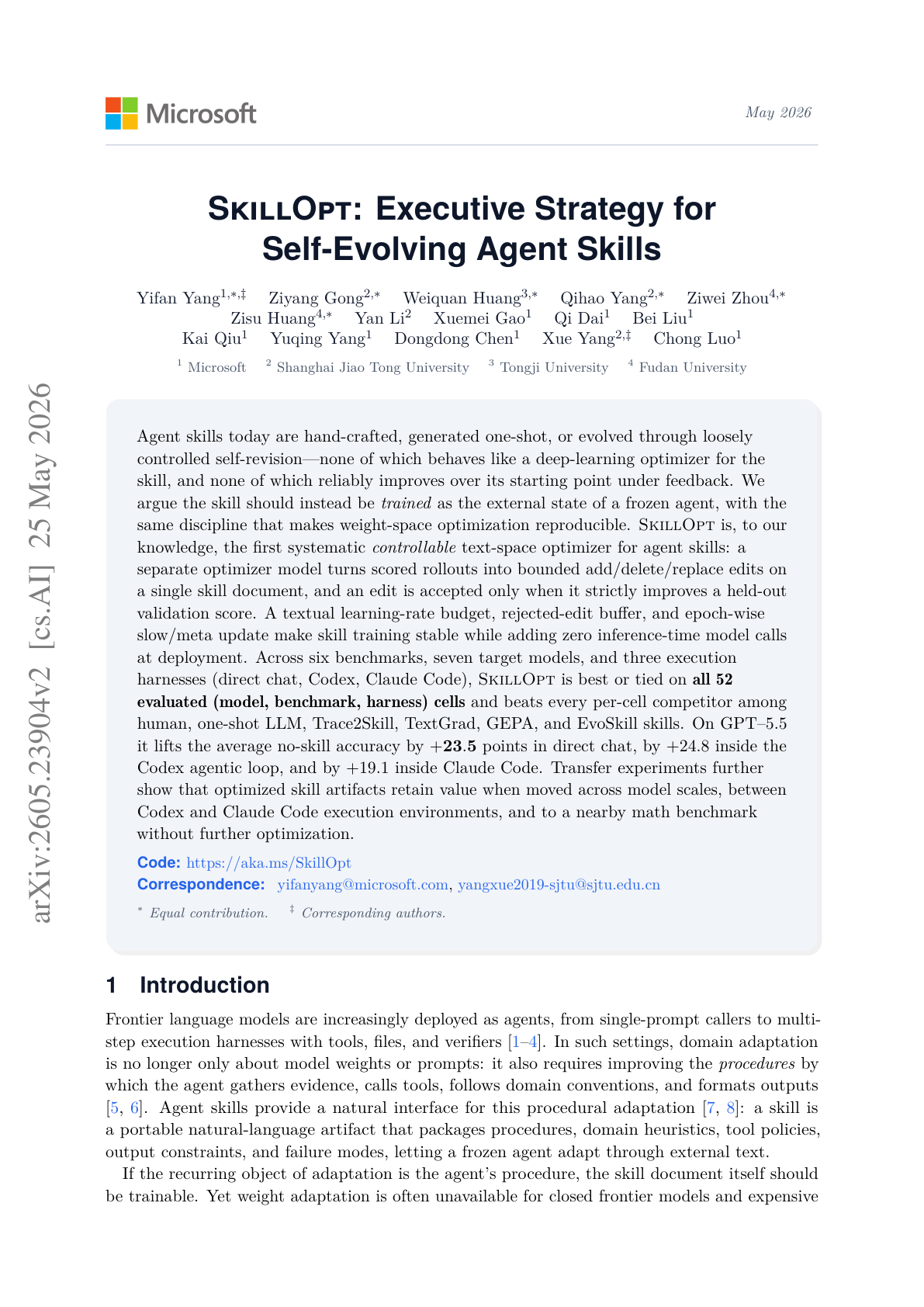
SkillOpt
Microsoft Research treats a compact natural-language skill document as the trainable state of a frozen agent, then learns that document through rollouts, reflection, and bounded edits gated by held-out validation. The argument is direct: most engineers handwrite agent skill docs and hope they generalize, when the doc itself should be optimized like a parameter. SkillOpt reframes the SKILL.md file as an external parameter of a model whose weights never change.
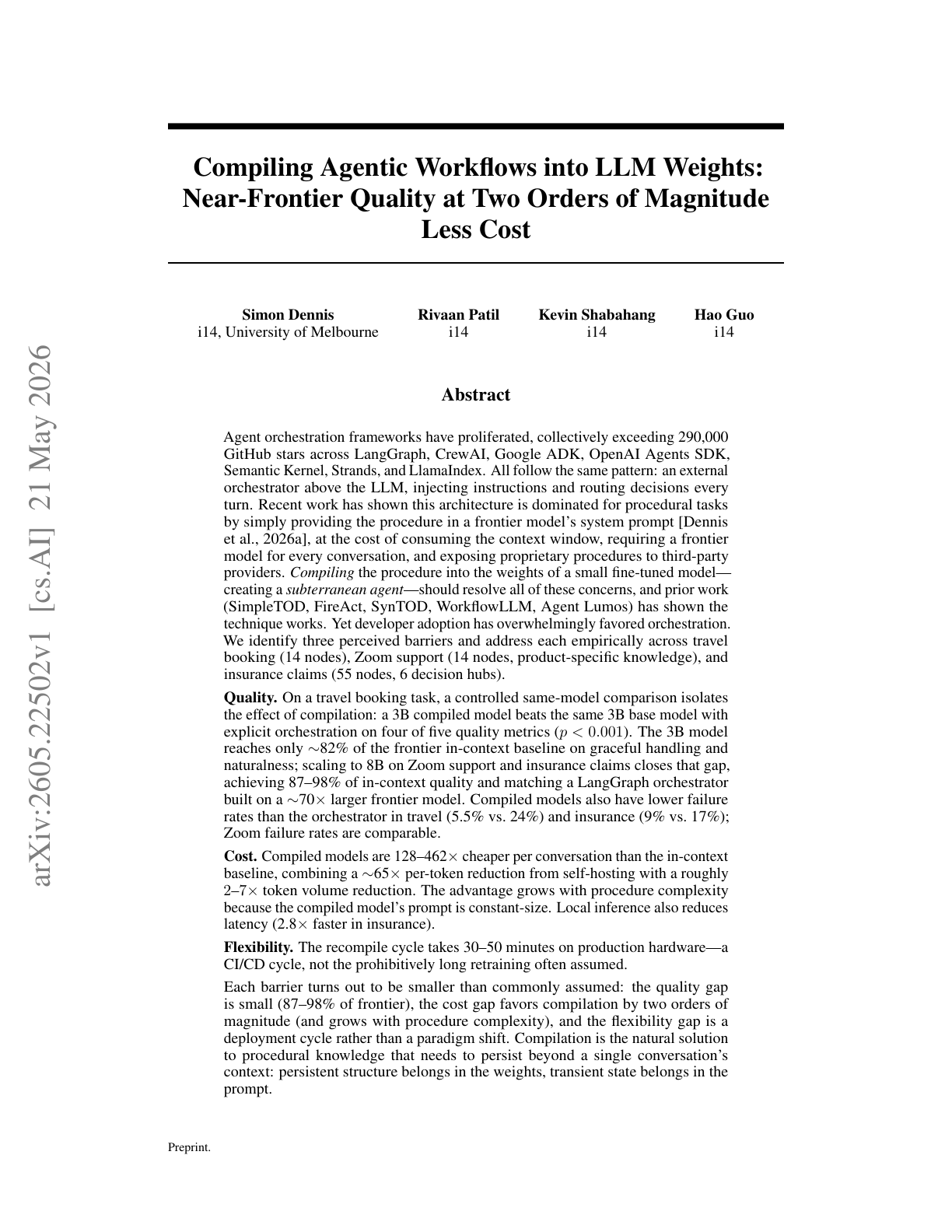
Compiling Agentic Workflows into Weights
This paper shows that a full agentic workflow can be distilled into the weights of a small model and run at roughly two orders of magnitude lower inference cost while preserving near-frontier task quality. Instead of keeping an external orchestrator above the LLM, the procedure is compiled into the weights of a fine-tuned model, producing what the authors call a subterranean agent.
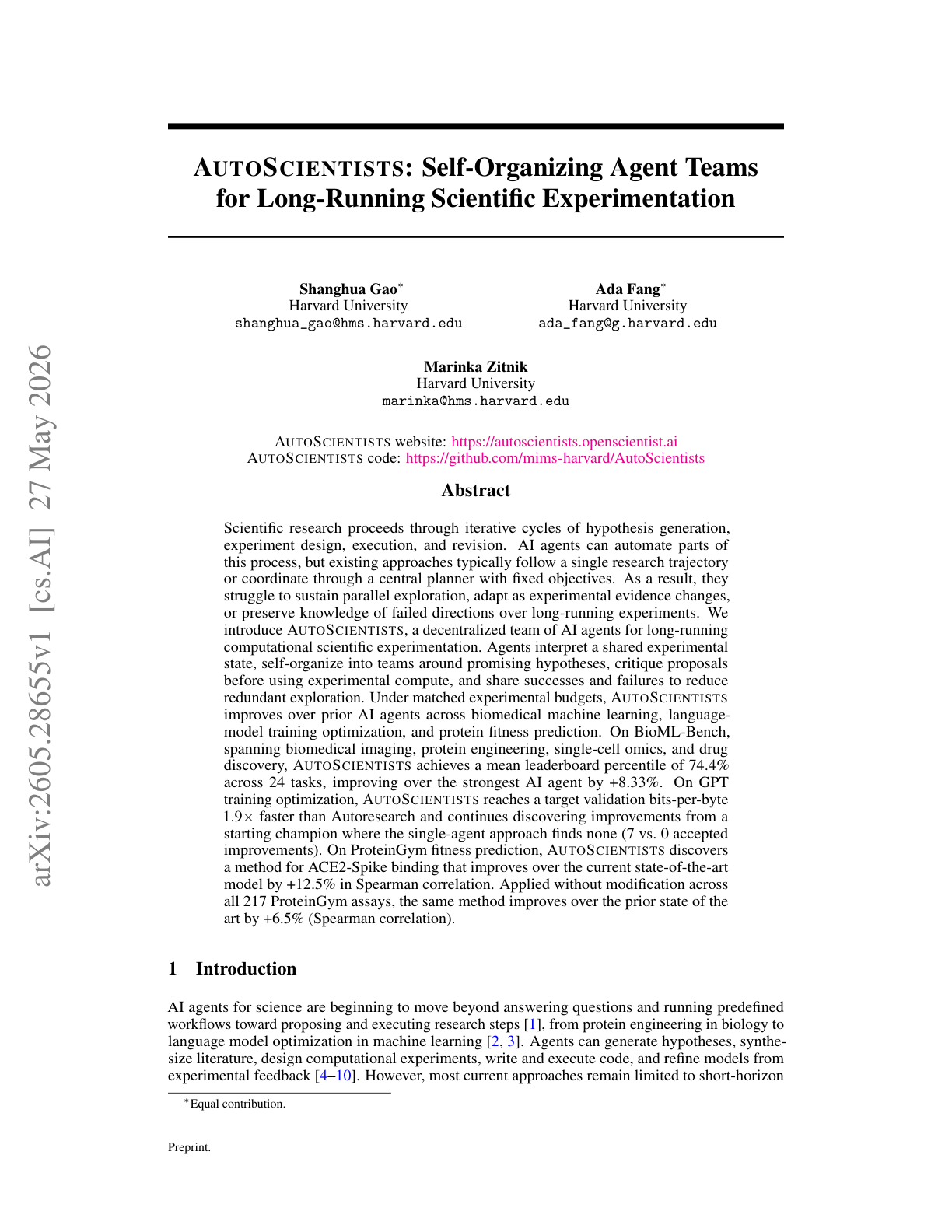
AutoScientists
AutoScientists, from Harvard, is a decentralized team of AI agents for long-running computational science that drops the central planner entirely. Rather than following one research trajectory coordinated from the top, agents self-organize around promising hypotheses, critique each other's proposals before spending experimental compute, and record both successes and failures so the system avoids redundant exploration as evidence accumulates over hours or days.
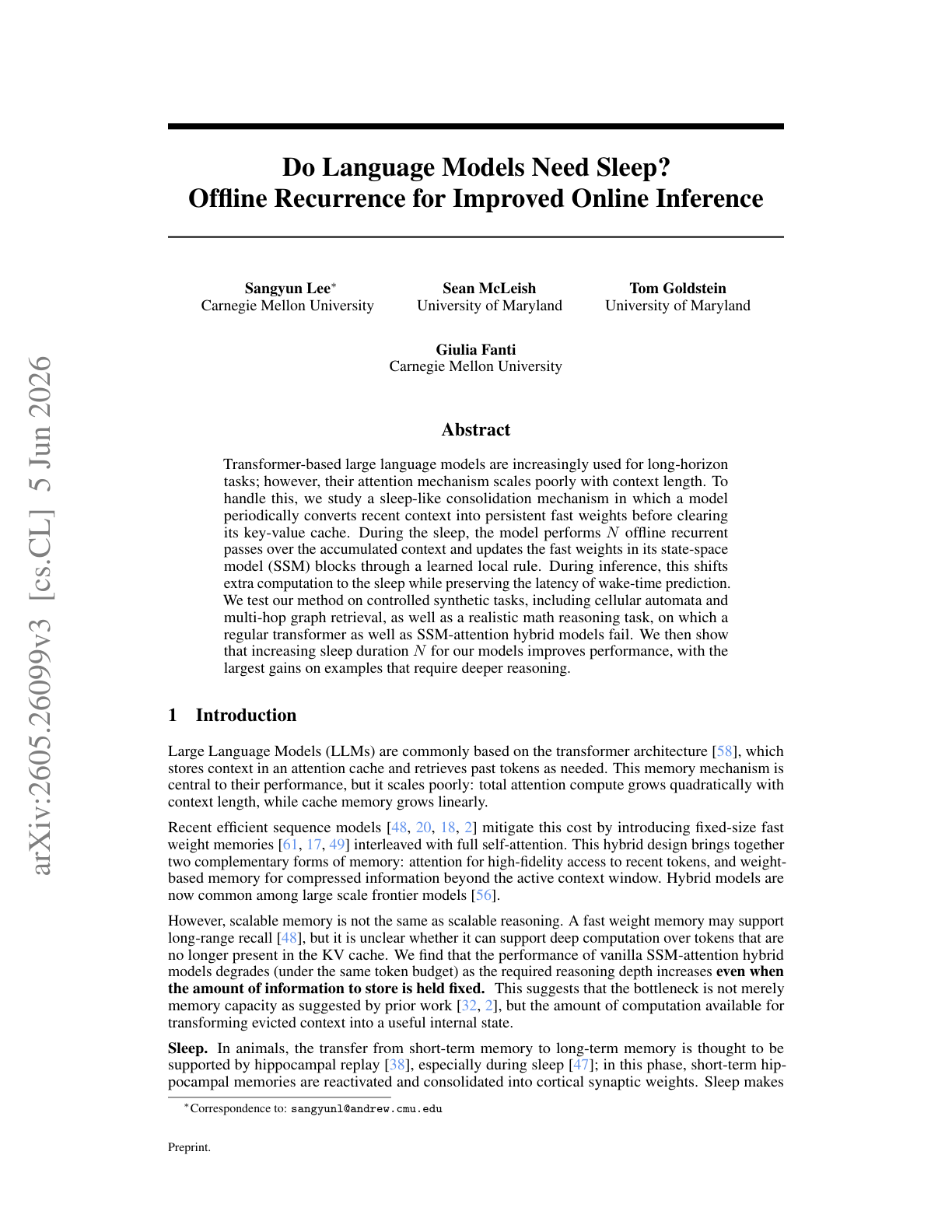
Language Models Need Sleep
Attention scales badly with context length, so long-horizon agents keep paying a growing cost as their context grows. This paper studies a sleep-like consolidation mechanism: the model periodically converts recent context into persistent fast weights, then clears its key-value cache. During the sleep phase it performs offline recurrent passes over the accumulated context and updates fast weights in its state-space blocks through a learned local rule.
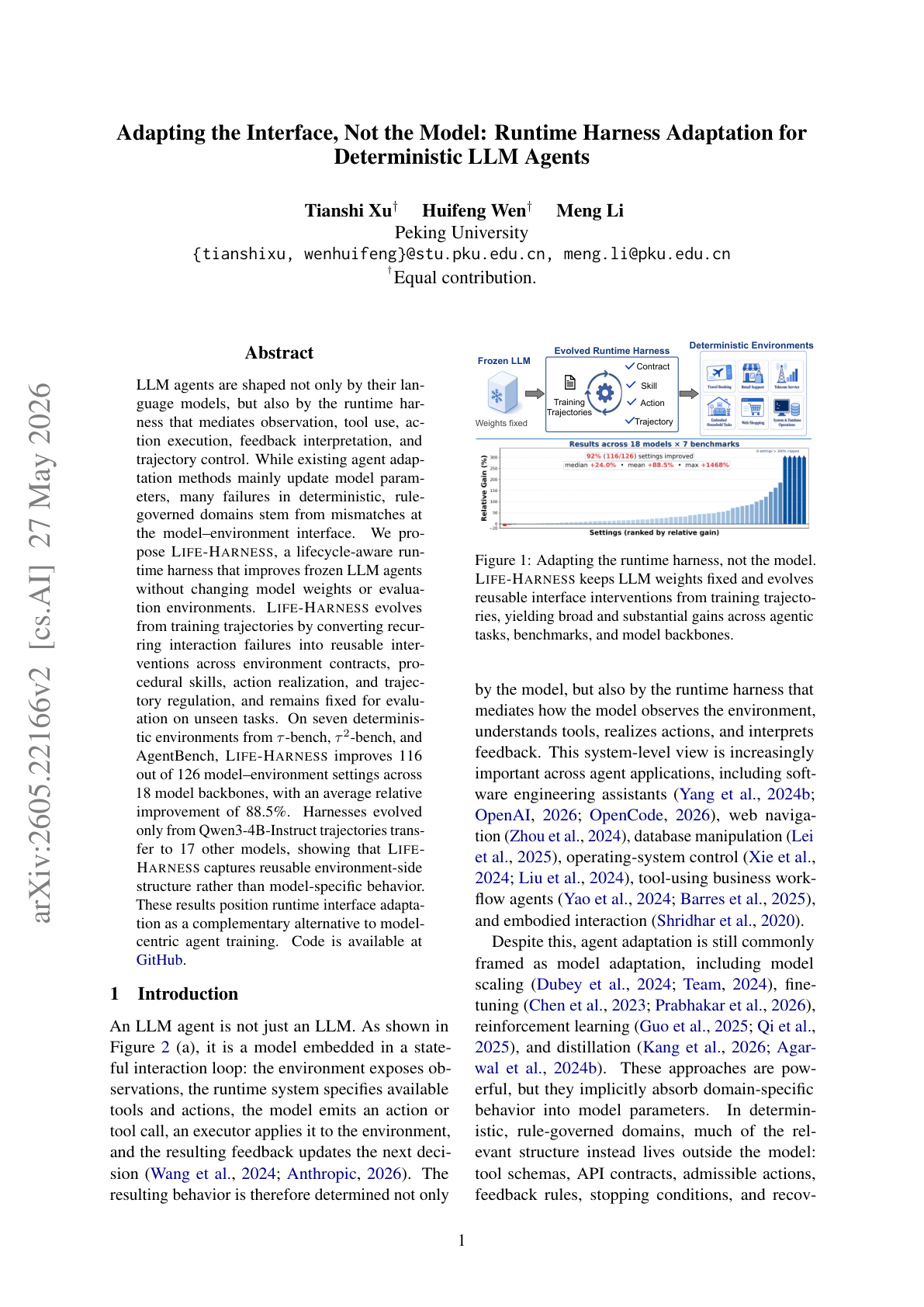
Adapting the Interface, Not the Model
When a frozen LLM agent repeatedly fails in a deterministic, rule-governed environment, do you have to retrain the model? Life-Harness argues no. Many failures come from mismatches at the model-environment interface, not from the model's reasoning, so the fix belongs in the runtime harness. Life-Harness is a lifecycle-aware harness that improves frozen agents without touching model weights or the evaluation environment.
The Efficiency Frontier
Context costs dominate production LLM bills, and the right strategy depends on how often preprocessing gets reused. This paper models context-strategy selection as a deployment-aware optimization problem that jointly accounts for task performance, token cost, and reuse, then uses it to compare retrieval-based and preprocessing-based approaches under realistic constraints.
Forecasting Scientific Progress with AI
Can frontier models predict where science is going? This work introduces CUSP, a cutoff-conditioned benchmark built from 4,760 real scientific events across multiple disciplines, each grounded against a verified knowledge cutoff. For every event, models are tested on four tasks: feasibility assessment, mechanistic reasoning, generative solution design, and temporal prediction. The headline is sobering: models recognize plausible directions but cannot forecast outcomes.
Your Agents Are Aging Too
AgingBench is a longitudinal reliability benchmark for agent lifespan engineering, built on the observation that long-lived agents are still evaluated like freshly initialized models. It organizes agent degradation into four mechanisms: compression aging, where write-time summarization drops future-relevant details; interference aging, where accumulated similar memories crowd out the target fact; revision aging, where changed or derived state is not updated correctly; and maintenance aging from routine lifecycle events. Using a temporal dependency DAG to encode cross-session structure, it produces aging curves over an operational lifetime rather than a single day-one score, and points to where repair should target.
Harnesses Are Not Uniformly Better
This paper studies LLM agent harnesses through the lens of inference-time trajectory alignment, separating a harness into two mechanisms: task decomposition, which structures a task into sub-goals, and guided execution, which reshapes local action distributions during execution. The key finding is that more elaborate harnesses are not uniformly better. Increasing decomposition or guidance can improve execution but can also reduce final task success, producing concrete failure modes like over-decomposition, over-pruning, and hallucinated execution. Strikingly, partial harnesses that specify only the initial steps and leave the rest to the agent can reach a higher pass rate than fully structured workflows.
Epicure
Epicure trains a family of multilingual ingredient embeddings from scratch on 4.14 million recipes aggregated from 11 sources across seven languages, with raw ingredient strings normalized to 1,790 canonical entries via an LLM-augmented pipeline. It ships three skip-gram (Metapath2Vec) variants that share architecture but differ in what they walk: recipe co-occurrence only, chemical-compound structure from FlavorDB only, or a blend of both, placing each model at a different point on the chemistry-versus-recipe-context spectrum. The result is a compact, downloadable map of the emergent geometry of food, a clean reminder that representation learning generalizes well beyond text into surprisingly everyday domains.