AdaptThink
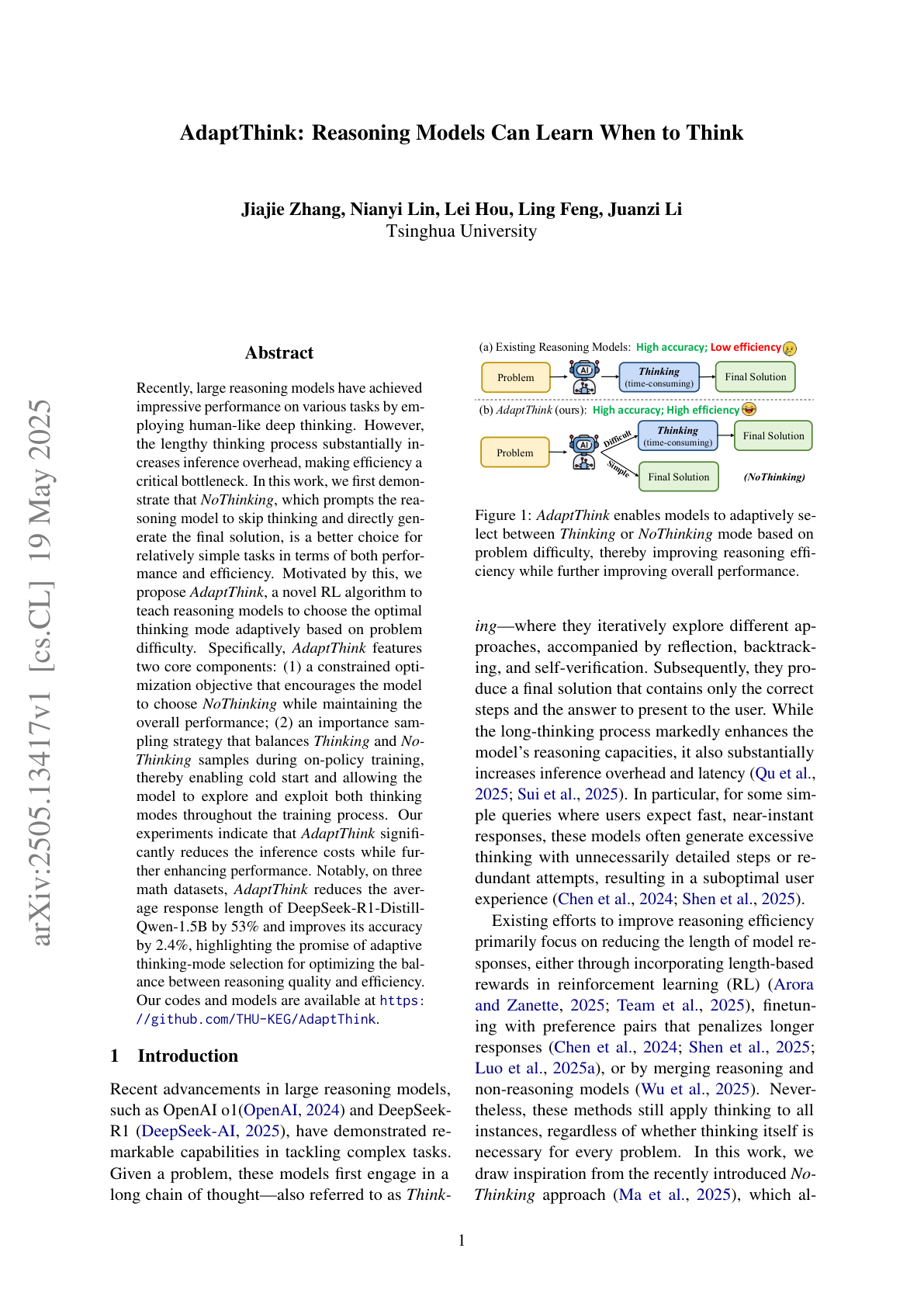
This paper introduces AdaptThink, an RL framework designed to help reasoning models decide when to use detailed chain-of-thought reasoning (“Thinking”) versus directly producing an answer (“NoThinking”), based on task difficulty. This approach challenges the prevailing assumption that deep reasoning should be applied uniformly across all problems, showing that skipping the “thinking” step often yields better efficiency and even higher accuracy on simpler tasks. Key insights:
Ask this paper
NoThinking outperforms Thinking on simple problems: The authors demonstrate that models like DeepSeek-R1 perform better (in both accuracy and efficiency) when using NoThinking mode, an empty <think></think>token prompt, for easy problems. For example, on Level 1 MATH500 problems, NoThinking achieved slightly better accuracy with significantly fewer tokens used.
AdaptThink learns to switch modes: The proposed RL algorithm introduces a constrained optimization that promotes NoThinking as long as accuracy doesn’t degrade. It uses a novel importance sampling strategy to enable cold-start learning of both modes from the beginning, avoiding the collapse into all-Thinking behavior.
Massive gains in efficiency and performance: On GSM8K, MATH500, and AIME 2024, AdaptThink reduced response length by up to 53% and improved accuracy by up to 2.4% over DeepSeek-R1-Distill-Qwen-1.5B. It also outperformed prior methods (e.g., DPOShortest, TLMRE, ModelMerging) in the trade-off between accuracy and response length.
Robustness and generalization: AdaptThink generalizes to out-of-distribution tasks such as MMLU, maintaining or improving accuracy while reducing token usage. It also avoids "implicit thinking" in NoThinking responses, showing controlled behavior during inference.